


Category
Strategic SourcingDate Posted
April 9, 2026The debate around auction software vs paper bidding should have been settled years ago. And for most enterprise procurement teams, it was. But walk into a mid-market manufacturer, a regional construction firm, or a facilities management company and you’ll find something different. Paper-based bid sheets, sealed envelopes, spreadsheets stitched together from email attachments, and an evaluation process that depends on whoever had time to build the comparison template last Tuesday.
This isn’t an article about whether digital is better than paper. That’s obvious. What’s less obvious is where exactly paper bidding breaks down, what auction software actually changes about the process (versus what vendors claim it changes), and why some organisations resist making the switch even when the case is clear. If you’re evaluating auction software vs paper bidding for your team, this is the comparison that cuts through the noise.
What Each Method Actually Looks Like in Practice
Paper bidding in the real world
Let’s be honest about what paper bidding actually means in 2026. Almost nobody is literally printing bid documents and mailing them anymore. But the process is still fundamentally manual. The RFQ goes out as a Word document or PDF attached to an email. Suppliers respond in whatever format they prefer — some in Excel, some in PDF, one just types the numbers into the email body. Somebody on the procurement team collects all the responses, manually enters the data into a comparison spreadsheet, and tries to normalise formats that don’t match. The “paper” isn’t literal paper. It’s the absence of a structured system. And the problems are the same as they were when it was actual paper: inconsistency, manual errors, no audit trail, and a process that takes three times longer than it should.
Auction software in the real world
An auction platform structures the entire cycle. The buyer publishes the event with specifications, evaluation criteria, and a deadline. Suppliers receive it simultaneously. They submit bids through the same structured form — so every response arrives in the same format, with the same fields, comparable from the start. The platform scores, ranks, and produces a comparison automatically. In a reverse auction sourcing format, suppliers compete live and prices drop in real time. But even in a standard sealed-bid event, the software handles collection, normalisation, and evaluation without anyone touching a spreadsheet. The difference between auction software vs paper bidding isn’t just speed. It’s structure.
Auction Software vs Paper Bidding: The Comparison That Matters
The table below lays out the seven dimensions where these two approaches diverge. Not theoretical differences. The kind you feel on a Wednesday afternoon when you’re trying to evaluate fifteen bids for a deadline that hasn’t moved.
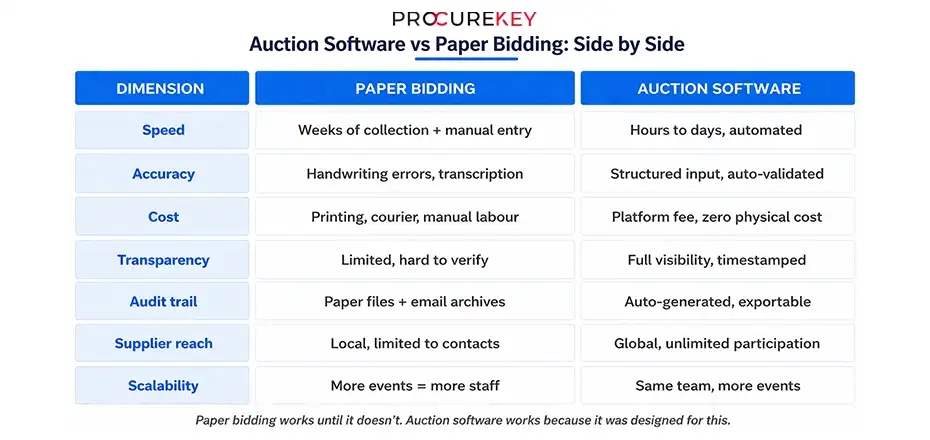
Speed
Paper bidding: you email the RFQ, wait for responses (chasing the ones that don’t reply), collect submissions over a week, then spend two to three days building the comparison. Auction software: bids arrive in a structured format by the deadline, the comparison exists before you open the platform the next morning. On a 10-supplier event, the difference is typically five to seven working days.
Accuracy
Manual data entry is where paper bidding quietly destroys value. Somebody transposes a number. Somebody reads a handwritten figure wrong. Somebody copies a unit price from the wrong column. You don’t catch it until the award is issued and the supplier says “that’s not what we quoted.” Auction software eliminates this entirely — suppliers enter data directly into structured fields, the system validates inputs, and the comparison is calculated, not assembled.
Cost
Paper bidding looks cheap. No platform licence. No implementation. But the hidden cost is labour. Every hour your procurement team spends formatting, chasing, and manually comparing bids is an hour they’re not spending on sourcing strategy, supplier negotiation, or running additional events. The real comparison on cost isn’t platform fee versus zero — it’s platform fee versus the salary cost of doing everything by hand.
Transparency and fairness
Did every supplier receive the same information at the same time? In paper bidding, you’d have to check your sent folder to prove it. Was a clarification shared with all bidders or just the one who asked? On a platform, the answer is logged automatically. For any organisation that cares about tender fairness — public sector, regulated industries, or any team that doesn’t want an award challenged — the transparency gap between these two methods is the single strongest argument for switching.
Audit trail
This is where paper bidding completely falls apart. Six months after the award, somebody asks how Supplier C was eliminated. With paper? You’re searching through email threads, trying to reconstruct a process from memory and file timestamps. With auction software, every score, every comment, every bid revision is timestamped and logged. The audit trail exists because the process created it. Not because somebody remembered to save the file.
Supplier reach
Paper bidding limits you to the suppliers you already know. The ones in your contact list. The ones a colleague recommended. Auction software opens the event to a wider pool — including international vendors who would never have been contacted through a manual process. More competition. Better pricing. And suppliers you didn’t know existed until they submitted the most competitive bid.
Scalability
Here’s the question that exposes paper bidding’s real ceiling: what happens when your sourcing volume doubles? On paper, you hire another analyst. On a platform, the same team runs twice the events because the manual overhead per event drops by 60–70%. This conversation is really about whether your process scales with technology or with headcount. And headcount is always more expensive.
Ready to See What Auction Software Actually Looks Like?
Where Paper Bidding Still Has a Place
I’m not going to pretend paper bidding is never appropriate. For some events, it’s fine. One vendor, one requirement, low value, no compliance pressure, no need for a formal evaluation record. You need a quote for a one-off repair job from the contractor who’s already on site. You’re buying office furniture for three desks and the budget is $2,000. In those scenarios, firing up a platform is overkill. A phone call, an email, and a PO is the right process.
But here’s where organisations get stuck: they use paper bidding for those simple scenarios and then default to the same approach for complex ones. Three suppliers becomes twelve. A single-line quote becomes an 80-item BOQ. A casual evaluation becomes a multi-stakeholder scoring exercise. And suddenly the process that worked for a $2,000 purchase is being used for a $500,000 contract — with the same email-and-spreadsheet infrastructure underneath. Nobody made a deliberate decision to use paper for the complex event. It just happened because nobody set a threshold where the process changes. That’s the pattern. And it’s costing more than anyone realises.
Where Auction Software Pulls Ahead — Decisively
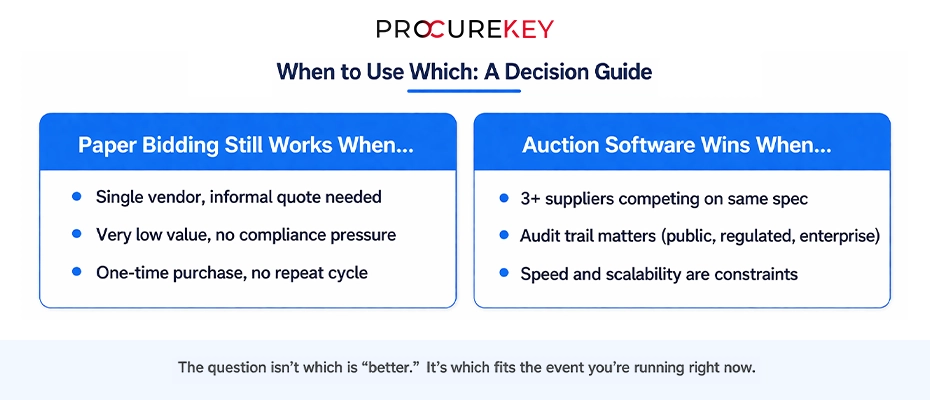
The moment your sourcing event involves three or more suppliers, a structured specification, and an evaluation that needs to be defensible, auction software vs paper bidding stops being a debate. The software wins on every dimension that matters.
Competitive events with real price pressure
A reverse auction where five suppliers bid against each other in real time? Paper can’t do that. It’s not a limitation of paper — it’s a format that doesn’t exist outside of software. And the pricing outcomes from live competitive events are consistently 10–19% better than bilateral negotiation. That’s not a software benefit. It’s a structural benefit that only software makes possible.
Multi-stakeholder evaluation
Engineering scores technical criteria. Finance scores commercial terms. Operations scores delivery. With paper bidding, each evaluator builds their own spreadsheet, the scores don’t match, and somebody spends a day reconciling. On a platform, evaluators score independently against pre-configured criteria, the system consolidates automatically, and the evaluation committee walks into the room with a ranked comparison instead of a stack of conflicting spreadsheets.
Events that get audited
Public sector procurement. Regulated industries. Any organisation with an internal audit function that reviews sourcing decisions. The conversation about auction software vs paper bidding in these environments is short. Paper can’t produce the documentation required. Software produces it by default. That’s not a preference. It’s a compliance reality.
Repeat sourcing cycles
If you source the same category quarterly or annually, paper bidding means starting from scratch every time. Rebuild the template. Re-collect the supplier list. Re-enter the data. Re-explain the evaluation criteria to the committee. Auction software retains the historical data, the supplier panel, the evaluation framework, and the results from previous events. Event number two takes half the time of event number one. By event number four, the process is almost entirely configuration, not creation. And you can benchmark this year’s pricing against last year’s because the data actually exists in a comparable format.
The Hidden Costs Nobody Talks About
When teams compare the two approaches on cost, they usually look at the wrong number. The platform licence is visible. The hidden costs of paper are invisible. But they’re real. And they compound every single quarter.
The cost of missed savings
Paper bidding doesn’t create competitive pressure. Suppliers quote what they think you’ll accept, not the market floor. Without the live competition that only a digital platform can create, you’re leaving 5–15% on the table on every event where three or more qualified suppliers could have competed. Across a year of sourcing, that number dwarfs any platform fee.
The cost of errors
A transcription mistake on a $200K contract can cost tens of thousands before anyone catches it. And nobody catches it quickly. Manual entry is where errors hide. In paper bidding, errors hide until they become disputes — sometimes months after the award. On a platform, the data suppliers entered is the data you evaluate. No re-keying. No interpretation. No guesswork.
The cost of team time
Your procurement analyst didn’t go to university to copy numbers from PDFs into spreadsheets. But on paper bidding, that’s 40–60% of what they do during an evaluation cycle. The auction software vs paper bidding argument isn’t about technology. It’s about whether you want your sourcing team doing sourcing or doing data entry.
How to Decide for Your Organisation
Forget the general debate. Think about your last five sourcing events. How many involved three or more suppliers? How many required a formal evaluation with documented scores? How many generated an audit trail that you’d be comfortable showing an internal auditor? If the answer to any of those is “most of them,” you’ve already outgrown paper. And you probably knew that before you started reading this article. The practical decision point is this: auction software vs paper bidding comes down to whether your sourcing volume and complexity justify a platform. If you run fewer than five competitive events a year, all under $10,000, with two or three suppliers each — paper works. You’ll be fine. But if you run ten or more events, with five or more bidders, across multiple categories, with stakeholders who need to evaluate and compliance requirements that need satisfying — paper isn’t saving you money. It’s costing you money you can’t see.
Three Things to Do This Quarter
Audit your last five sourcing events. How many hours went into bid collection, data entry, and comparison building? Multiply by your team’s hourly cost. That number is what paper bidding costs. Now compare it to a platform licence. Pick one upcoming event with 5+ suppliers and a clear spec. Run it on an auction platform alongside your normal process. Compare: time to completion, bid quality, audit trail, and whether the evaluation committee trusted the output. One event. Side by side. Ask yourself the audit question: if internal audit pulled any sourcing decision from the last 12 months, could you produce a complete record of how the award was made? If the answer is no, the auction software vs paper bidding decision is already made.
The conversation around auction software vs paper bidding isn’t really about paper versus software. It’s about whether your sourcing process produces a defensible, efficient, repeatable outcome — or whether it depends on whoever happened to build the spreadsheet that week. Paper works at the simplest end of the spectrum. It always will. But the moment the event involves real competition, real evaluation, and real accountability, the manual process stops being adequate and starts being a liability. The organisations that have already moved aren’t looking back. And the ones still running complex events on email and Excel aren’t saving money — they’re spending it in ways nobody’s measured yet. The question isn’t whether to switch. It’s how many more events you want to run the hard way before you do.
 17th, June 2026 | 12:00 PM EST
 30 Min + Q&A