


Category
Strategic SourcingDate Posted
May 25, 2026In Deloitte’s 2023 Global CPO Survey, 41% of procurement leaders cited inadequate technologies as a top barrier to improvement — tied for the number one obstacle alongside conflicting priorities. And these are the people running the function. The sourcing process at most organisations isn’t broken because the team lacks talent. It’s broken because the infrastructure underneath hasn’t changed in a decade. Sourcing optimization is the discipline of making your sourcing process faster, cheaper, more competitive, and more repeatable — without adding headcount. That’s the short definition. What does it look like when it’s working? A sourcing team that runs more events, covers more spend, gets better pricing, and produces award decisions that hold up when somebody audits them. Same people. Better machinery underneath.
This guide covers the pillars that make sourcing optimization work, the roadblocks that keep teams stuck on email and Excel, and what changes when an eSourcing platform replaces the manual infrastructure. No vendor pitch. Just what’s actually different.
The Four Pillars of a Sourcing Optimization Strategy
Talk to ten procurement leaders about optimising their sourcing function and you’ll get ten different starting points. That’s because the term covers a lot of ground. But strip it back and there are four pillars that every mature sourcing function has in common. Miss one and the other three can’t compensate.
The Four Pillars of Sourcing Optimization
Supplier Evaluation & Selection
Spend Analysis & Visibility
Process Standardisation
Data-Driven Decision Making
Most teams nail one or two pillars. The gap is usually in the ones they haven’t built a process around yet.
Pillar 1: Supplier evaluation that runs on criteria, not memory
Pillar 2: Spend visibility that actually covers the spend
Pillar 3: Process standardisation across every event
Pillar 4: Decisions backed by evidence, not instinct
Why Most Procurement Teams Get Stuck
If these pillars are obvious — and they are — why aren’t more teams operating at a high maturity level? Because the gap isn’t knowledge. It’s infrastructure.
Manual processes eat bandwidth. When your sourcing analyst spends Monday through Wednesday building a bid comparison spreadsheet, they’re not doing sourcing strategy. They’re doing data entry. And a five-person team running 30+ events a year simply doesn’t have the capacity to apply structured evaluation, spend analysis, and process discipline to every event when the tools underneath are email, Excel, and hope.
Fragmented data kills visibility. The spend data sits in one system. The supplier records sit in another. The evaluation history lives in someone’s personal drive. Getting a complete picture for one category takes a week of manual consolidation. So nobody does it. And without visibility, every sourcing decision is made on partial information.
And then there’s the compliance problem. When the process isn’t standardised and the documentation isn’t automatic, audit readiness depends on individual discipline. Some events are well-documented. Some aren’t. And when audit pulls a random sample, the team scrambles to reconstruct a process from memory and email threads. That’s not an optimised function. That’s survival.
How eSourcing Tools Change the Equation
This is the section that matters most. Not because eSourcing tools are magic. Because the pain described above has a systematic solution — and the tool is the vehicle.
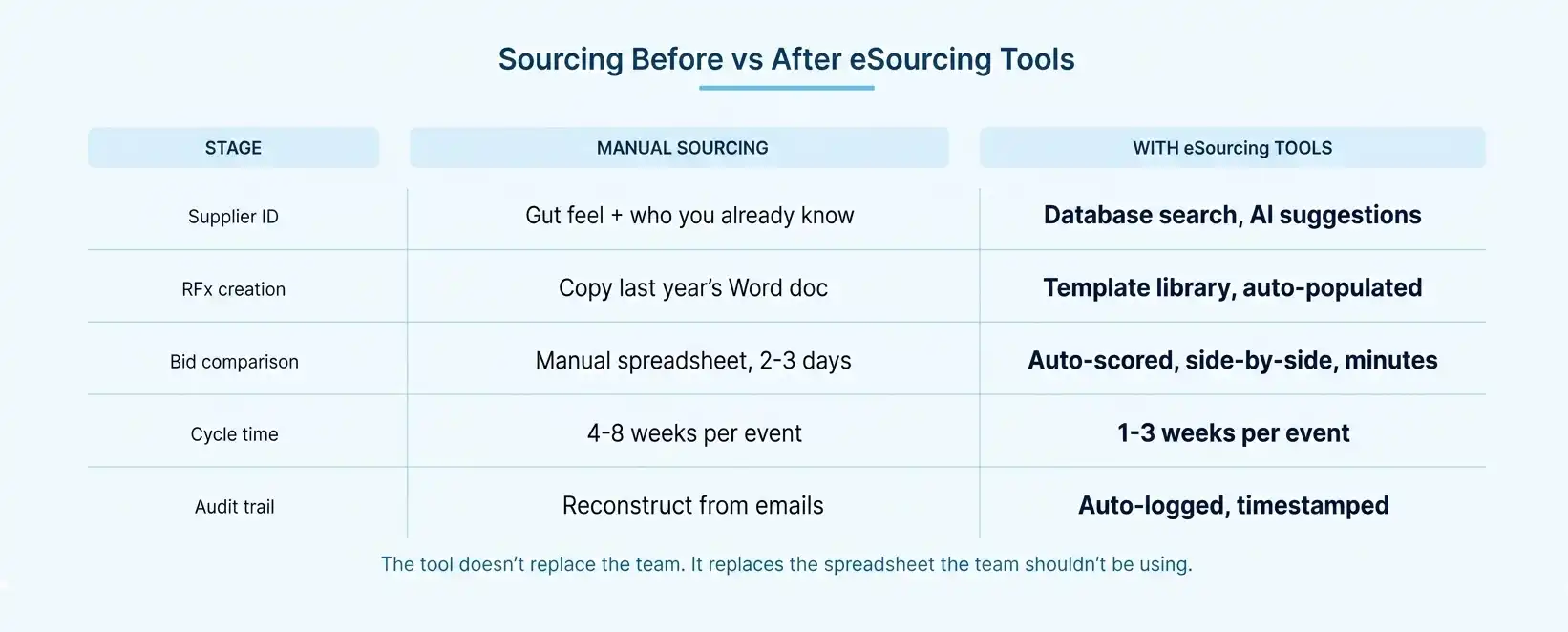
An eSourcing platform manages everything from finding the right suppliers to issuing the award — RFIs, RFPs, RFQs, bid evaluation, the lot. That’s the formal definition. But here’s what it changes in practice. Before: your team emails a Word document to eight suppliers, waits two weeks for responses in six different formats, spends three days building a comparison, and hopes the evaluation is consistent. After: the event publishes with structured response formats, bids arrive in one system, the comparison builds itself, and every score is timestamped and logged. Same team. Same category. Fundamentally different output. The gain isn’t theoretical — it shows up in hours saved per event, in pricing improvement from structured competition, and in compliance readiness that exists by default instead of by accident.
What specifically makes the difference? Start with something basic: your team can actually find supplier contact details without searching three inboxes and a shared drive from 2022. The supplier database is centralised. Then there’s bid tracking — real-time, visible to the whole team, so nobody discovers on deadline day that two vendors haven’t responded. The evaluation? Pre-configured criteria with weighted scoring. No more arguments about whether price matters more than delivery time because the weighting was agreed before the event launched. And every RFQ starts from a standardised template instead of whatever somebody cobbled together from last year’s version. The audit trail writes itself. Nobody has to remember to save anything. Every decision, every score, every bid revision — timestamped and logged automatically.
That’s where the whole concept moves from theory to execution. The four pillars we described earlier? Supplier evaluation, spend visibility, process standardisation, data-driven decisions — the eSourcing tool is what makes all four possible at scale. A 5-person team running 40 events a year through a platform has the analytical capacity of a team twice that size running events manually. The maths are that stark. And for organisations already running structured events like reverse auction sourcing, the platform just extends the same discipline to every category.
What to Look for in an eSourcing Platform
Not all platforms are built the same. And the demo always looks great. Here’s what actually matters when you’re evaluating.
RFx automation that handles the full cycle
Supplier database with real depth
Analytics that answer real questions
Integration with what you already run
Measuring Success: KPIs for Sourcing Optimization
Your CFO doesn’t care about process improvements they can’t see in a number. And next year’s budget for the sourcing programme depends entirely on whether you can point to results that showed up on a dashboard, not in an anecdote. So what do you actually track?
The number that gets leadership’s attention first is always cost savings as a percentage of addressable spend. Mature programmes typically deliver 3–8% annually across competitively sourced categories. But that’s a lagging indicator. The leading indicator? Cycle time. How many days from RFQ publication to award recommendation. If the platform doesn’t compress this number by 40–60% in the first year, something’s broken in the adoption, not the tool.
Then there’s supplier performance — which matters because it compounds. Track delivery, quality, and responsiveness per supplier per event, and over three or four cycles you’ve built a dataset that makes every subsequent shortlist smarter. Track compliance rate too: what percentage of events actually ran through the platform versus the old email-and-Excel route? Below 80% and adoption is the real bottleneck. And finally, spend under management — how much of total procurement spend flows through governed sourcing events? Push that number up quarter by quarter and the programme justifies itself.
Frequently Asked Questions
Sourcing optimization isn’t a project with a completion date. It’s an operating model. The four pillars — supplier evaluation, spend visibility, process standardisation, data-driven decisions — aren’t things you build once and walk away from. They’re disciplines that compound over time. Each event produces data that makes the next event better. Each category that moves from unmanaged to governed reduces cost and risk. And the sourcing function stops being the team that processes RFQs and starts being the team that creates commercial value.
The gap between where most teams are and where they could be isn’t talent. It’s infrastructure. The eSourcing platform is how you close that gap — not by working harder, but by giving the work a structure that scales. If your team is still running sourcing through email and spreadsheets, the question isn’t whether to upgrade. It’s how many more events you want to run the slow way.
 17th, June 2026 | 12:00 PM EST
 30 Min + Q&A