

Category
Strategic SourcingDate Posted
May 25, 2026A $4M transformer procurement. Twelve qualified suppliers. Technical evaluations running in parallel with commercial scoring. Two internal approvers who need to sign off before the award recommendation reaches the committee. And the entire thing managed through email threads, a shared Excel file, and a PDF comparison document that three people maintain differently.
Sound familiar? In energy and utilities procurement, the stakes are high and the governance requirements are real. Regulators expect traceability. Internal audit expects defensible award decisions. Finance expects cost control. And the procurement team is stuck trying to deliver all three using tools that were never built for structured sourcing. The result: eSourcing for energy and utilities isn’t a nice to have. It’s the infrastructure gap that’s creating both compliance exposure and unnecessary cost.
Why Energy and Utilities Procurement Needs More Than Basic RFQ Digitisation
There’s a category of procurement tool that does one thing well: it sends an RFQ to a list of suppliers and collects responses in one place. Helpful? Sure. Sufficient for a regulated utility running CAPEX tenders with multi-stage evaluation requirements? Not even close.
Energy procurement software for this sector needs to handle supplier pre-qualification that goes beyond a vendor form. It needs to enforce separation between technical and commercial evaluations so that the engineer scoring capability doesn’t see the commercial pricing until the technical round is complete. It needs approval workflows with role-based access so that the right people sign off at the right stage and the system records it. And it needs documentation that stands up when an internal auditor or external regulator pulls a sourcing file eighteen months after the award. Most lightweight procurement tools weren’t designed for any of this. They were designed for straightforward category purchasing where governance is optional.
What Actually Goes Wrong in Manual Sourcing
Let’s be specific. Because the risks in manual energy sourcing aren’t theoretical. They’re the things that show up in audit findings.
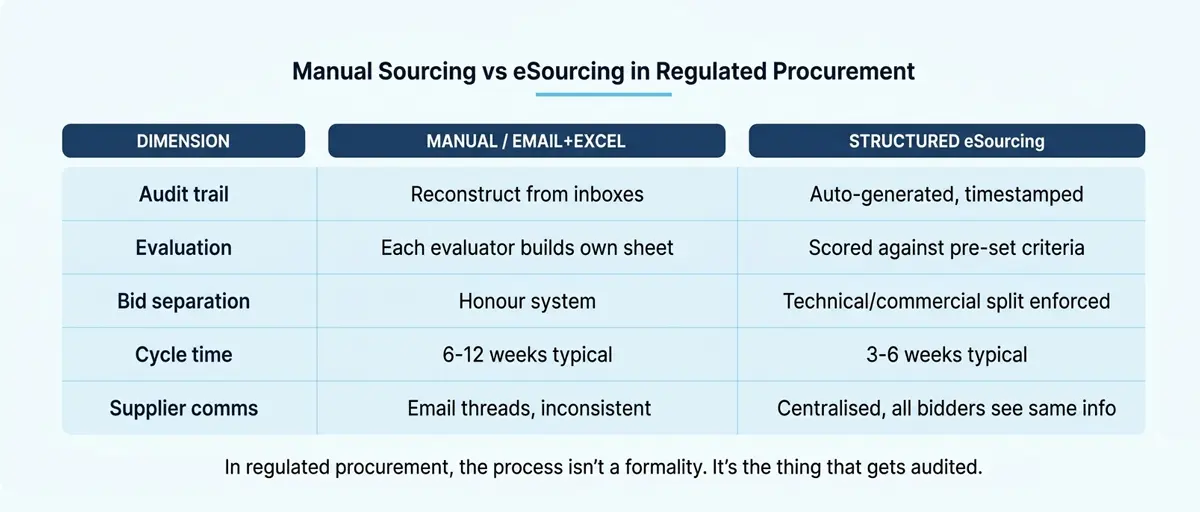
A clarification goes out to one bidder but not the others. Nobody notices until evaluation, when the advantaged supplier’s bid reflects information the others didn’t have. That’s a fairness problem that can invalidate the entire event. Or the technical evaluation is completed, but the scores live in a personal spreadsheet that one evaluator built in a format nobody else can replicate. When audit asks how the technical recommendation was reached, the answer is “I’ll have to ask David. He did the scoring.” David left the company in March.
And then there’s the approval trail. Who authorised the shortlist? Who approved the deviation from the preferred supplier list? Who signed off on the final award? In a manual process, the answer is usually somewhere in an email chain that takes 45 minutes to reconstruct. Regulatory compliance in procurement doesn’t fail because people make bad decisions. It fails because good decisions aren’t documented in a way that proves they happened.
Where the Real Procurement Cost Reduction Comes From
Cost reduction in energy procurement is not about beating suppliers down on price. The serious savings come from somewhere else entirely.
Sourcing cycle time is the first lever. A CAPEX tender that takes twelve weeks on email takes six on a platform. That’s six weeks of project schedule recovered. On a construction or maintenance programme with time-dependent costs, compressed sourcing directly reduces project overhead. Then there’s admin effort. Every hour a procurement analyst spends formatting bid comparisons, chasing missing responses, and rebuilding evaluation templates from scratch is an hour they’re not spending on supplier negotiation or running the next event. Utilities procurement software that automates the administrative layer doesn’t just save time. It frees the team to cover more spend with the same headcount.
Better supplier participation matters too. When the tender process is clear, the documents are structured, and the submission mechanism is simple, more suppliers bid. More competition on a well-specified event consistently produces better pricing than fewer bids on a poorly structured one. And better bid comparability means less time in evaluation, fewer qualification notes, and a cleaner path to an award decision that doesn’t get challenged downstream. That’s the cost argument for eSourcing for energy and utilities. Not lowest price wins. Better process, better competition, better outcome.
How eSourcing Supports Both Compliance and Cost Control
This is where the argument comes together. Because in energy and utilities procurement, the governance requirement and the cost reduction opportunity aren’t competing priorities. They’re two sides of the same process problem.
A structured eSourcing platform solves both by making the compliant process also the fastest process. Standardised RFQ and RFP workflows mean every event starts from a proven template with the right fields, the right evaluation criteria, and the right approval gates already configured. Supplier communication runs through one channel so every bidder gets the same information at the same time and the system logs it automatically. Utility tender management stops depending on who remembered to copy whom on the email.
Bid evaluation runs against pre-configured weighted criteria. Technical scores and commercial scores stay separated until the process says otherwise. Every evaluator’s input is recorded, timestamped, and traceable. Approvals route through defined workflows with role-based access so the system knows who approved what and when. And the entire sourcing event produces a complete record that’s exportable for audit without anybody spending a day compiling it.
That’s compliant sourcing software in practice. Not compliance as a burden bolted onto procurement. Compliance as the natural byproduct of a well-structured sourcing process.
What to Look for in eSourcing Software for Energy and Utilities
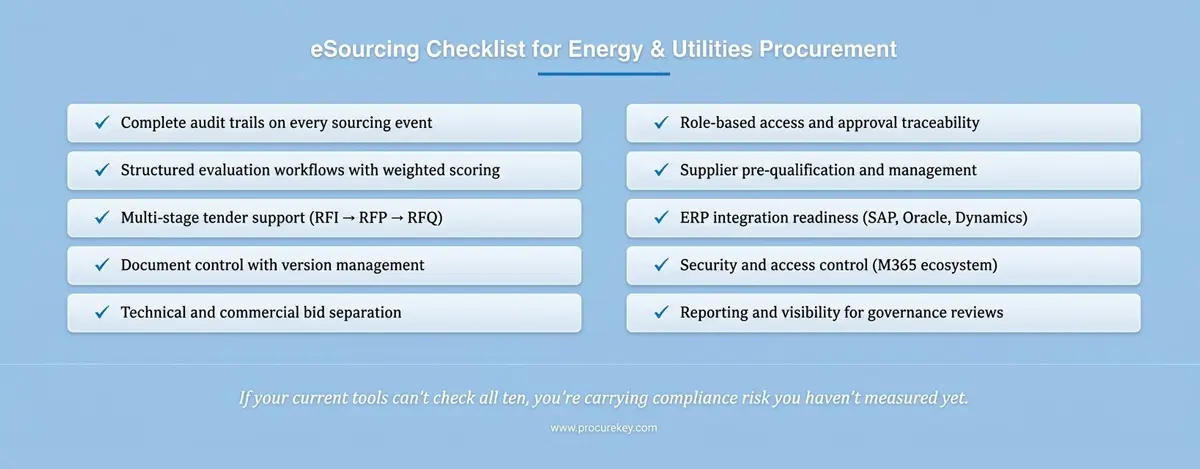
Not every platform is built for governance-heavy procurement. When you’re evaluating tender evaluation software for the energy sector, here’s what the checklist actually needs to include: complete audit trails that generate automatically, not retrospectively. Structured evaluation workflows where scoring criteria and weights are locked before bids arrive. Multi-stage tender support so you can run an RFI to qualify, an RFP for technical capability, and an RFQ for final pricing in a connected sequence. Document control with version management so addenda don’t create confusion. The ability to separate technical and commercial envelopes where the evaluation requires it. Role-based access that controls who sees what at which stage. And integration readiness with SAP, Oracle, Dynamics, or whatever enterprise system your finance team already depends on.
If your current sourcing process can’t check every one of those boxes, you’re carrying compliance risk that hasn’t been measured yet. And you’re spending more in administrative time than you realise.
How ProcureKey Fits This Need
ProcureKey is a sourcing platform built for structured, compliant procurement. Sourcing workflows run from requisition through to award with controlled evaluations, itemised bid comparison, and supplier collaboration that stays governed throughout. Technical and commercial evaluations can be separated where the sourcing event requires it. Approvals are traceable. Documentation is automatic. And the platform deploys within the Microsoft 365 ecosystem, which means data stays within your tenant, security follows your existing M365 policies, and the team doesn’t need to learn an entirely separate infrastructure.
It’s not an ERP replacement. ProcureKey complements SAP, Oracle, and Dynamics by handling the sourcing and evaluation layer that those systems were never designed to manage in a structured, auditable way. For energy and utilities organisations sourcing high-value equipment, maintenance contracts, or CAPEX project packages, it’s the piece that makes the procurement process both faster and defensible.
Three Things to Assess This Quarter
Pull three recent sourcing events and ask: could I produce a complete audit trail for each one within an hour? If the answer involves reconstructing from email, you have a documentation gap that manual effort won’t fix. Check how many sourcing events required technical and commercial evaluation separation. If the separation depended on personal discipline rather than system-enforced controls, you’re one mistake away from an audit finding. Measure your average sourcing cycle time from RFQ publication to award recommendation. If it’s above eight weeks for standard events, the process is adding cost that a structured platform would eliminate.
For energy and utilities procurement teams, eSourcing is not a productivity upgrade. It’s how you run compliant, defensible, cost-efficient sourcing events in an operating environment where governance isn’t optional and budgets aren’t growing. The organisations getting this right aren’t choosing between compliance and cost control. They’re building a process where one produces the other. And that process runs on a platform, not on email. eSourcing for energy and utilities isn’t a category of software. It’s a decision about whether your procurement process can survive the next audit and the next budget review at the same time.
 17th, June 2026 | 12:00 PM EST
 30 Min + Q&A