


Category
Strategic SourcingDate Posted
May 26, 2026Every procurement decision starts with a number. But the number most teams look at first is the wrong one. They look at the purchase price. What is acquisition cost? It’s the total cost your organisation actually pays to acquire an asset, material, or service. And it’s almost always higher than the price on the supplier’s quote. Because the quote doesn’t include the freight to get it to your plant. Or the installation crew to set it up. Or the import duties, the insurance during transit, the legal fees to review the contract. The acquisition cost includes all of that. Every dollar between the supplier’s number and the moment the thing is operational in your facility.
This article is about what acquisition cost meaning looks like in a procurement context. We’ll go through the formula (with an actual worked example, not a generic one), cover the different types, and get into how sourcing teams can reduce their cost of acquisition by changing how they run competitive events. No marketing metrics here. No customer acquisition cost. This is strictly about what procurement teams spend to acquire what the business needs.
What Is Acquisition Cost? The Full Definition
The acquisition cost meaning is straightforward once you stop thinking about it as a single line item. Acquisition cost is the total expenditure required to acquire an asset or good and bring it to a condition and location where it’s ready for use. That’s the accounting definition. But in procurement, it means something more practical.
Think about it this way. Your team issues an RFQ for a CNC milling machine. Three bids come back. The cheapest is $178,000 from a supplier in Shenzhen. Another supplier, regional, quotes $185,000. The third comes in at $192,000. On paper, the Shenzhen quote wins by $7,000. But then you add the freight from Shenzhen to your plant, plus customs duties, plus the installation crew flying in to commission the machine. That’s another $37,000. The $178,000 quote is now a $215,000 acquisition. The regional supplier at $185,000 with installation included? $215,200 total. A $200 difference. And that regional supplier throws in a 12-month warranty the Shenzhen vendor doesn’t.
Acquisition cost is the full, landed, ready-to-use cost of acquiring an asset, material, or service. It includes every cost between the supplier’s quote and the point where the item is operational in your facility.
What is the acquisition cost in practice? It’s the number that answers one question: “How much did we actually spend to get this?” Not the invoice figure. The real figure. Start with what you paid the supplier. Then add the delivery charges. Then the installation crew. Then the import duties your customs broker invoiced separately. The insurance policy on the shipment. The legal review of the contract. Whatever testing or commissioning had to happen before anybody could switch the thing on. That full number is your acquisition cost.
Types of Acquisition Cost in Procurement
Not every acquisition looks the same. Buying a CNC machine involves freight and commissioning. Buying a consulting engagement involves onboarding and training. Buying an ERP licence involves implementation and data migration. The cost of acquisition calculation changes depending on the category, but the principle doesn’t: whatever the supplier quoted is just the starting line.
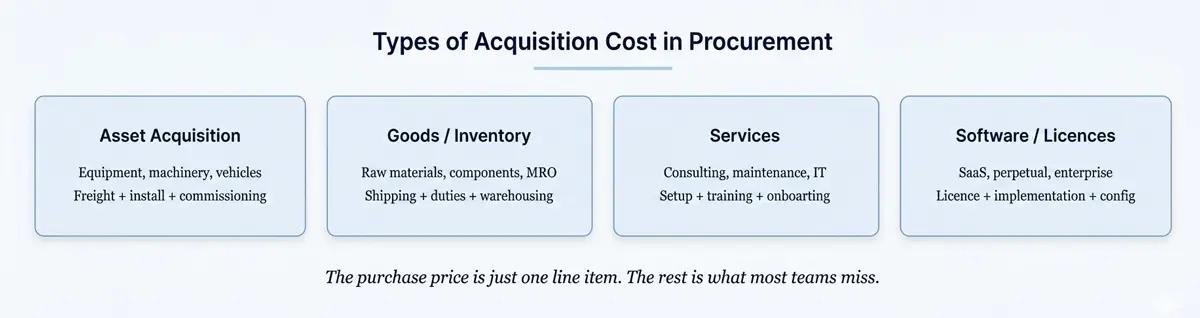
| TYPE | DEFINITION | EXAMPLE |
|---|---|---|
|
Asset Acquisition |
What you pay to buy a physical asset AND get it running. The supplier’s quote is just the start — freight, duties, installation labour, and commissioning testing all add to the number. | CNC machine quoted at $185K. By the time it’s installed and calibrated in your Chicago plant: $215.2K. |
| Goods / Inventory | The landed cost of raw materials, components, or MRO supplies. Think of it as the price per unit after you’ve paid for shipping, cleared customs, and had quality inspection sign off. | Steel coils: $42/ton FOB Shenzhen. $52.30/ton sitting in your warehouse inspected and cleared. That’s a 24% gap. |
| Services | Procuring a service isn’t just the monthly retainer. There’s onboarding, training your team, mobilisation costs, and sometimes a setup fee that only appears in the first invoice. | IT managed services: $18K/month retainer. First month actually costs $24.5K once onboarding ($4.5K) and training ($2K) land. |
| Software & Licences | The licence fee is rarely the whole story. Implementation, configuration, migrating data from the old system, and getting your users trained all sit on top of the sticker price. | ERP module: $120K licence. $230K by the time implementation, migration, and training are done. |
The acquisition cost meaning shifts depending on what you’re buying. A $42/ton steel coil at FOB becomes $52.30/ton by the time it’s sitting in your warehouse inspected and cleared. That 24% gap between quoted price and landed cost? It exists in every category. The only question is whether your team is measuring it.
How to Calculate Acquisition Cost
The formula is not complicated. What’s harder is getting your team to use it on every sourcing event instead of just eyeballing the quoted price and moving on.
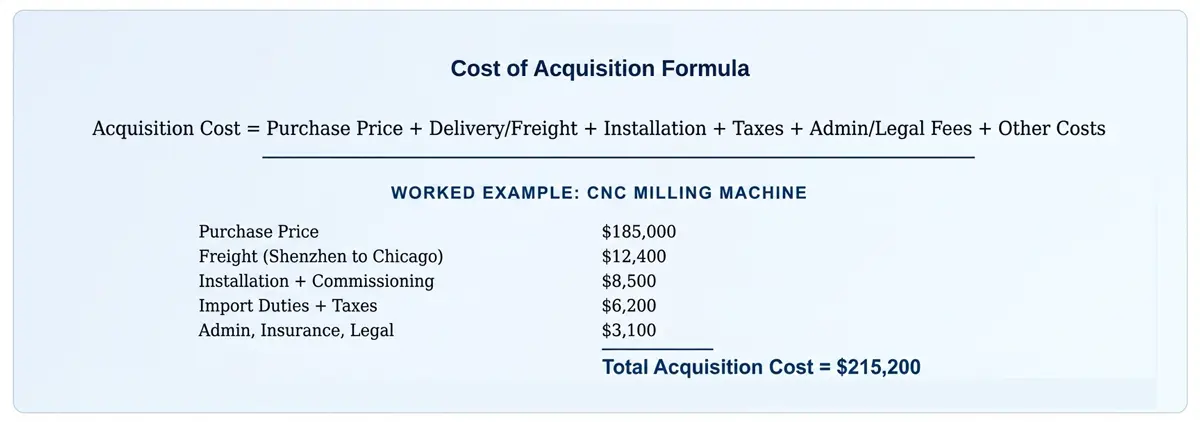
The formula
Acquisition Cost = Purchase Price + Delivery/Freight + Installation/Setup + Taxes/Duties + Admin/Legal Fees + Other Associated Costs
Worked example: CNC milling machine
Say your manufacturing team is buying a 5-axis CNC milling machine. You’ve got a shortlisted supplier in Shenzhen quoting $185,000 FOB. Looks competitive. But here’s what the full acquisition cost actually looks like once you add every line item that won’t appear on the quote.
Freight from Shenzhen to your plant in Chicago runs $12,400 including ocean shipping, inland trucking, and port handling. Installation and commissioning by the supplier’s field engineer costs $8,500 including travel, two days of setup, and calibration testing. Import duties and taxes come to $6,200 based on the HS code classification. And the admin side, covering cargo insurance, customs brokerage, and your procurement team’s processing time, adds another $3,100.
Total acquisition cost: $215,200. That’s $30,200 above the purchase price. A 16.3% premium that doesn’t appear on the supplier’s quote but absolutely appears on your P&L. If your team evaluates bids on quoted price alone, you’re making a $30,000 decision with $185,000 worth of information.
Acquisition Cost in Procurement: Why It Matters
So what is acquisition cost to a procurement team, specifically? It’s the number that makes bid comparison honest.
Here’s the problem most sourcing teams face. You’ve got three bids on the same item. Supplier A comes in at $100,000 and includes freight. Supplier B undercuts everyone at $94,000 — but read the fine print and freight is extra. They’re shipping from overseas. Then there’s Supplier C at $102,000, which looks expensive until you notice installation is bundled in. On quoted price, B wins. On acquisition cost? B is actually the most expensive option because the freight, duties, and installation push the real number to $108,000. That’s $8,000 more than A’s all-in figure.
Without calculating the cost of acquisition, the team awards to the cheapest quote and then discovers the total spend was $8,000 higher than the “more expensive” option. That happens more than procurement leaders want to admit. And it happens because the evaluation framework doesn’t require acquisition cost as a standard metric.
What is the acquisition cost doing in this scenario? It’s levelling the field. When you compare suppliers on total acquisition cost instead of quoted price, the numbers tell the truth. The supplier with the lowest price isn’t always the cheapest to acquire. And the one with the highest price sometimes is.
Compare Suppliers on Total Cost, Not Just Price
How to Reduce Your Cost of Acquisition
Understanding what is the acquisition cost is the first step. Reducing it is where procurement actually creates value. And the levers aren’t complicated. They’re just underused at most organisations.
Run competitive bidding on every significant category
Consolidate suppliers where it makes sense
Automate the sourcing process
Use AI to evaluate bids on total cost, not just price
Require acquisition cost as a standard evaluation metric
Frequently Asked Questions
Three Things to Do This Quarter
Pull your last five awarded contracts and recalculate each one on total acquisition cost instead of quoted price. If the ranking changes on even one, your evaluation framework has a blind spot that’s costing you money. Add an “acquisition cost” column to your RFQ evaluation template. Require every bid to be scored on total cost, not just unit price. Make it a policy, not an option. Identify your top three spend categories by value and run competitive events on each one through an eSourcing platform. The categories where you’ve been single-sourcing or informally quoting are where the cost of acquisition gap is widest.
Understanding acquisition cost is not an accounting exercise. It’s a sourcing discipline. The procurement teams that get this right don’t just know the number. They build it into the evaluation template so every bid gets compared on what the organisation will actually pay. And those teams consistently pay less for the same goods and assets. Not because they negotiated harder. Because they measured better.
 17th, June 2026 | 12:00 PM EST
 30 Min + Q&A