
Date Posted
June 30, 2026Procurement vs purchasing: they are not the same thing. Your finance team probably uses them interchangeably. Your operations team definitely does. And that confusion has a price tag: it shows up as $400K spent with a vendor nobody vetted, savings negotiated in Q1 that never reached the P&L by Q3, and a CPO who can’t explain to the board where the money went. That’s what happens when the person choosing suppliers is also the person placing orders with zero separation between the two.
You’ve probably read a dozen articles on this topic and gotten the same recycled definitions every time. This one is different. Below: an 8-row comparison table, the buying lifecycle with ownership marked at each stage, five real ways your company bleeds money when these functions get tangled, and an AI angle that none of the usual guides bother covering.
Quick answer: Procurement is the strategic function that decides what the business buys, from whom, and on what terms. It covers needs analysis through supplier management. Purchasing is the transactional execution: raising POs, receiving goods, matching invoices, processing payment. Procurement decides. Purchasing executes.
What Is Procurement?
If you remember one thing from this article, make it this: procurement is everything that happens before the purchase order. Procurement sourcing: choosing suppliers, running competitive events, scoring bids on value rather than just whoever typed the lowest number. Locking in terms that hold up for three years. And circling back to check whether the supplier is actually delivering what they said they would. Real deal. A packaging category worth $2M annually at a Houston manufacturer. The current supplier’s reject rate has been climbing for two quarters. Procurement goes to market. Six vendors get invited to bid. Responses are scored on TCO, not just unit price, because the cheapest quote last time ended up costing 12% more in quality rework. Top two make the shortlist. Negotiation. Contract signed.
Upstream of the PO: procurement. Downstream: purchasing. Once you see it that way, the confusion disappears.
What Is Purchasing?
Purchasing takes over after the decision has been made. Somebody already chose the supplier. Somebody already negotiated the price. Somebody already signed the contract. Purchasing’s job is to make the actual transaction happen without errors.
What does that mean on a Tuesday morning? Turning approved requisitions into POs. Calling a supplier whose delivery is three days late. Checking whether the invoice amount matches the PO amount and the goods receipt. If everything lines up, payment goes out. If it doesn’t, someone starts making phone calls.
No supplier to choose. No terms to negotiate. Purchasing raises the req, cuts the PO, confirms the delivery, and matches the invoice. Entirely operational. And companies execute hundreds of these a month, which is exactly why speed and accuracy matter more than creativity on this side of the house.
Difference Between Procurement and Purchasing
I’ve been asked this question in conference rooms, on calls, and once in an airport lounge in Dubai. The honest answer is that the difference between procurement and purchasing plays out across at least eight dimensions. No single sentence captures it.
| DIMENSION | PROCUREMENT | PURCHASING |
|---|---|---|
| Nature | Strategic: decides the direction | Operational: follows the playbook |
| Scope | End-to-end: source-to-pay | Order-to-receipt only |
| Focus | Total Cost of Ownership, value, risk | Unit price and delivery speed |
| Time horizon | Years. Contracts, relationships, risk. | Days. This PO, this delivery, this invoice. |
| Core activities | Supplier discovery, competitive bidding, contract negotiation, vendor reviews | PO creation, delivery expediting, three-way invoice match, payment processing |
| Supplier relationship | Develops and manages the relationship | Places orders with vendors procurement already approved |
| Goal | Value creation, risk reduction, compliance | On-spec, on-time order fulfillment |
| KPIs measured | Savings realized, supplier scores, contract compliance, cycle time | PO accuracy, delivery time, invoice match rate |
Purchasing cares about unit price and whether the delivery shows up on time. Both are legitimate priorities. But when one person is doing both jobs, the company optimizes for speed every time and the long-term view goes dark.
You can’t manage what you don’t measure on either side. For tracking the procurement half specifically, measure procurement performance with the right KPIs.
Where Procurement and Purchasing Fit in the Buying Process
Procurement people call the end-to-end buying cycle “source-to-pay” or S2P. The procurement purchasing split runs along a clear line: procurement owns the first half (source-to-contract, also called PR-to-Award) and purchasing owns the second (procure-to-pay).
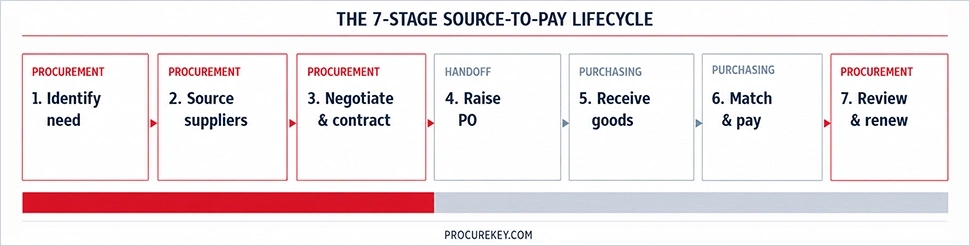
Stage 2: is where procurement sourcing happens: competitive events, vendor scoring, shortlisting.
Stage 3: covers negotiation and contracting. By the end of stage 3, pricing, SLAs, and compliance terms are locked in writing. Still no PO.
Stage 4: is the handoff point. Procurement checks that the PO reflects the negotiated contract. Purchasing issues it to the supplier.
Stages 5 and 6: belong to purchasing: goods receipt, inspection, three-way matching, payment.
Stage 7: belongs to procurement again. Keep this supplier or go back to market? Purchasing feeds in delivery data and order accuracy. Procurement makes the call.
costs creep up and nobody can trace why. A procurement director in Chicago described it perfectly: “We negotiate great contracts. Then purchasing issues POs that don’t reference them. The savings exist on paper. The P&L tells a different story.” That’s a handoff problem. And it gets worse at scale.
see how ProcureKey structures the PR-to-Award side so the data flows cleanly into whatever P2P system handles the rest.
Why the Distinction Matters: What Breaks When the Lines Blur
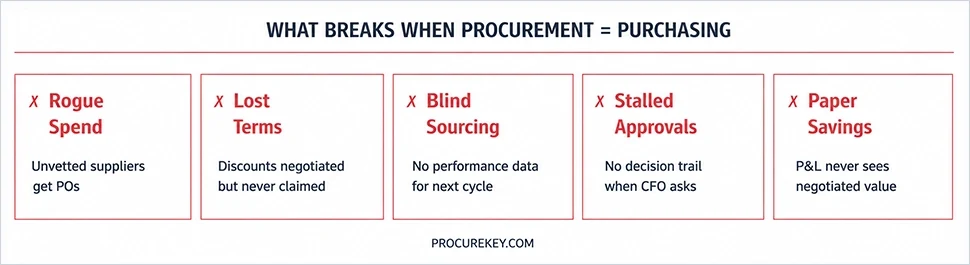
Real example. A department head in Dallas finds a vendor online, agrees to a price over the phone, and raises a PO. Procurement was never involved. No competitive event. No compliance review. No contract. Textbook rogue spend. This happens weekly in companies where the purchasing and procurement boundary doesn’t exist.
Or consider the negotiated discount that nobody claims. Procurement locks in a 2% early payment clause. Purchasing raises POs that don’t reference it. Six months later, finance realizes the discount was sitting there unclaimed the entire time.
Performance tracking is another casualty. Procurement assumes purchasing is flagging delivery issues. Purchasing assumes procurement is running vendor reviews. The next sourcing cycle launches with zero performance history to work from.
Fourth: approval bottlenecks that shouldn’t exist. A $200K award stalls for three weeks because the CFO wants documentation on why Supplier B was chosen over Supplier A. The procurement team scored the bids in a spreadsheet that got overwritten. The evaluation rationale exists in someone’s memory but not in the system. Three weeks of delay on a single decision because the upstream process left no trail.
The one that stings most politically: $500K in negotiated savings appears on the quarterly slide. The CPO takes credit. Then finance looks at the actuals and can’t find a dollar of it. What happened? Purchasing issued POs at prices that didn’t match what procurement negotiated. Contract said one price. POs said another. The gap between those two numbers is the CFO’s least favorite line item at the quarterly review.
How AI Is Reshaping Procurement and Purchasing
The two-team setup wasn’t born from a strategy offsite. It happened because one group of people physically couldn’t vet 200 suppliers, score 50 bids, close 30 contracts, AND get 500 POs out the door in the same month. Something had to give. So companies split the work.
The shift on the procurement side is already visible. AI generates RFx documents from intake data in minutes instead of days. The purchasing procurement cycle that used to stretch across weeks now compresses into days because the manual bottlenecks aren’t manual anymore. Bids get scored against weighted criteria without anyone building a comparison spreadsheet. The system surfaces suppliers the team wouldn’t have found on their own because it’s analyzing patterns across hundreds of past events in the same category. The sourcing cycle compresses from weeks to days.
Automate sourcing and the savings compound across every category the team manages. A 15% saving on one category through competitive bidding is a number. That same discipline applied to 40 categories through AI-led sourcing is a structural cost advantage.
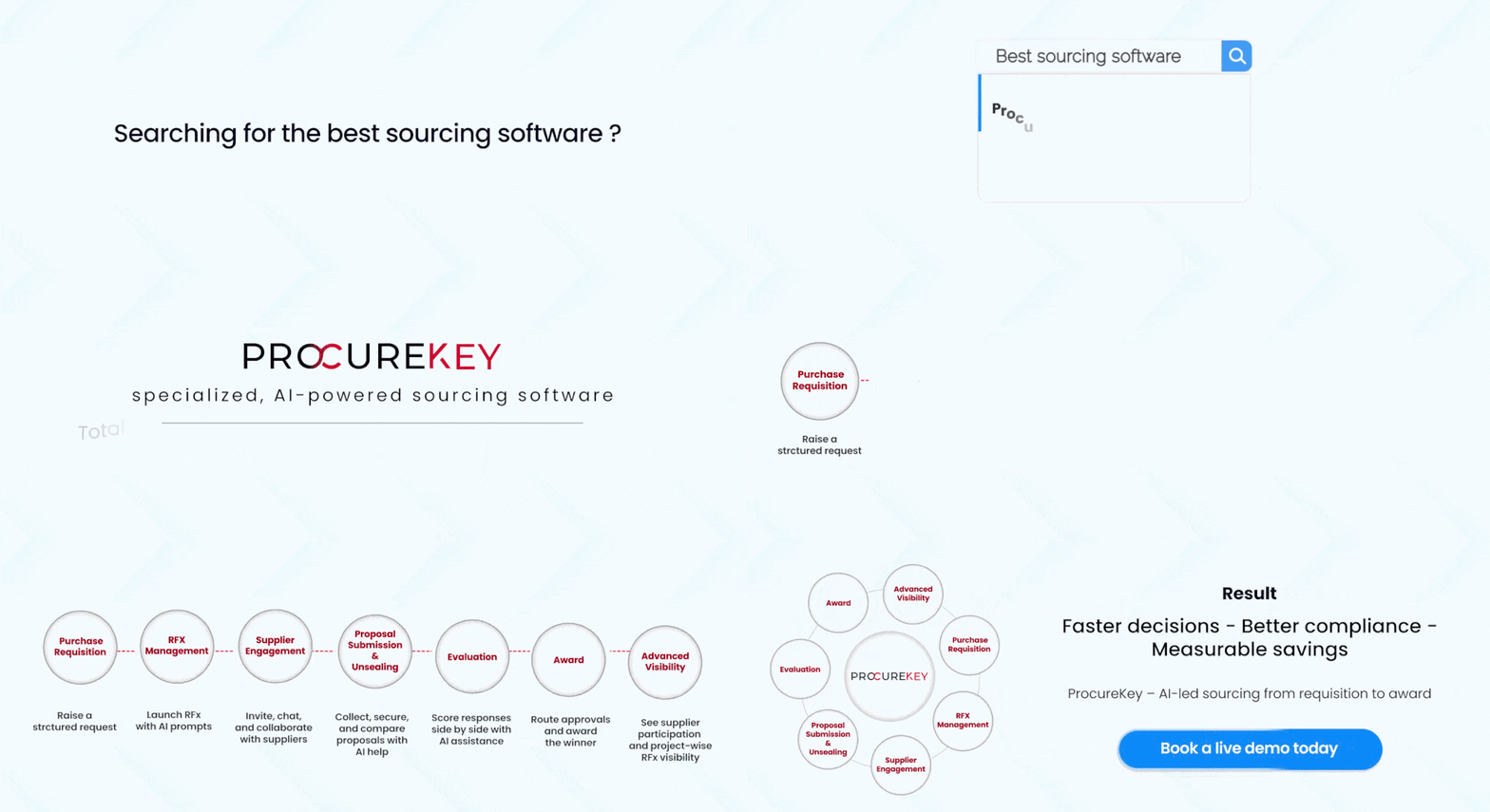
This is the model ProcureKey is built around: an AI-led PR-to-Award platform with agents that handle RFx generation, supplier suggestions, and bid scoring, so procurement teams stop spending their weeks on tactical sourcing and start spending them on strategy. See the full AI sourcing and procurement software capabilities.
How to Align Procurement and Purchasing in Your Organization
When procurement and purchasing are tangled in your org, untangling starts with one exercise. Map every step from “we need something” to “the supplier got paid.” Mark each handoff. You’ll probably find three or four spots where information vanishes into an email nobody reads.
Name an owner for every stage. If procurement and purchasing both assume the other team is tracking supplier performance, the answer is that nobody is.
Third: get sourcing onto a single platform and connect it to your P2P system through a proper data feed. That Excel file sitting between procurement’s contract database and purchasing’s PO system? It’s where negotiated value goes to die.
Shared measurement is non-negotiable. If procurement reported $500K saved last quarter and finance’s books show nothing, the dashboard is lying to one of them. Contract utilization, match rates, and realized savings need to be visible to both teams.
And finally: stop making your procurement team write RFQs from scratch, manually hunt for suppliers, and build comparison spreadsheets by hand. Those tasks eat weeks every quarter and keep the team stuck in execution mode. AI does them faster and frees the team for the category strategy work that actually moves the needle.