
Category
Strategic SourcingDate Posted
July 3, 2026Ask five procurement leaders whether their organisation needs Source-to-Pay or Source-to-Contract and you’ll get five different answers, at least two of which will contradict each other. The terms get thrown around interchangeably in vendor demos. They get confused in RFP requirements. And a surprising number of organisations end up buying S2P when what they actually needed was S2C, because a vendor convinced them that bigger scope means better outcomes.
It doesn’t. Not always. For most mid-market procurement teams, the part of the cycle that’s broken is the sourcing decision, not the payment process. The ERP handles POs and invoices adequately. What’s missing is the structured competitive process that happens before the PO gets raised. That’s where S2C lives. And that’s where the highest-value improvements typically sit.
What Is Source-to-Pay?
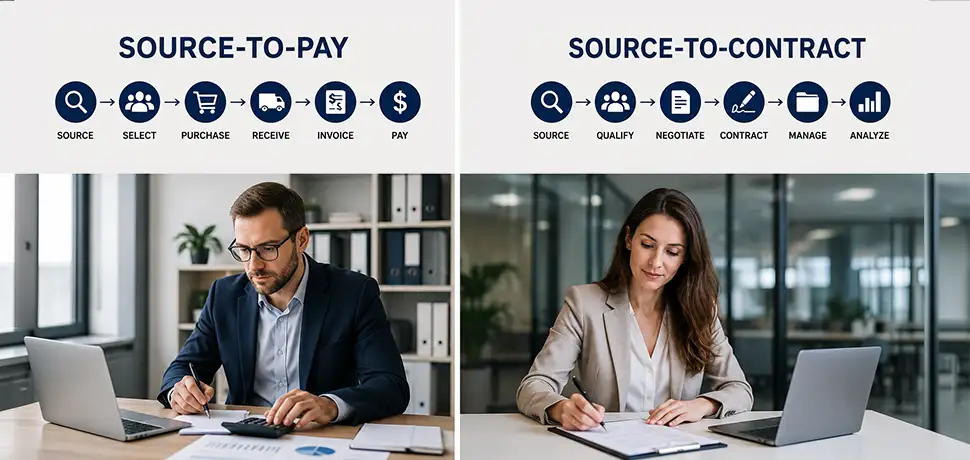
Source-to-Pay covers the entire procurement lifecycle. From the moment somebody identifies a need through supplier identification, RFQ events, bid evaluation, contract negotiation, purchase requisitions, purchase orders, goods receipt, invoice matching, and all the way to payment processing. The full ride, end to end.
S2P exists because large enterprises got tired of running the strategic half of procurement on one system and the transactional half on another, with a manual handoff in the middle. For organisations with hundreds of millions in annual spend, dedicated AP departments, and complex multi-entity payment workflows, S2P makes sense. But for a mid-market company whose ERP already handles POs and AP reasonably well? An S2P implementation can take 12 to 18 months, touch every department from procurement to finance to operations, and cost significantly more than a focused S2C deployment that goes live in weeks.
What Is Source-to-Contract?
Source-to-Contract is the part of procurement where the value gets created. It covers everything from “we need to buy this” through “we have a signed contract with the supplier who won.” Supplier discovery, qualification, RFQ and RFP events, bid analysis, negotiation, and contract execution.
What S2C doesn’t do is handle what happens after the contract is signed. Purchase orders, three-way matching, invoice processing, payment. All of that stays in your ERP or whatever system already manages it. And honestly? For most mid-market companies, that’s fine. The ERP’s PO and AP modules work. What doesn’t work is the process that happens before the PO exists. That’s where teams run RFQs over email, evaluate bids in spreadsheets nobody trusts, and award contracts based on whoever quoted first rather than whoever offered the best value. S2C platforms like ProcureKey exist because that front half of the cycle is where the money is won or lost.
The Real Differences Between S2P and S2C
The choice between these models isn’t a scope preference. It affects which team owns the platform, how deep the IT involvement goes, what the implementation timeline looks like, and how you measure success.
| DIMENSION | SOURCE-TO-PAY (S2P) | SOURCE-TO-CONTRACT (S2C) |
|---|---|---|
Scope | Entire cycle from need identification to payment | Sourcing through signed contract. Hands off to ERP after. |
What it covers | Sourcing, evaluation, contract, requisitions, POs, goods receipt, invoice matching, payment | Sourcing, evaluation, negotiation, contract execution |
Who uses it | Procurement, finance, AP, and operations all share the system | Built for the sourcing team. Category managers and procurement leads. |
Implementation | 12–18 months typical. Touches multiple departments. | Weeks, not months. One team, one workflow. |
ERP relationship | Replaces or deeply integrates with ERP procurement modules | Works alongside ERP. Feeds contract data in, doesn’t touch PO or AP. |
What you measure | Full-cycle efficiency: invoice accuracy, payment term compliance, process cost | Sourcing impact: savings per event, cycle time from RFQ to contract, award defensibility |
The integration difference matters most in practice. An S2P platform needs to connect to your accounts payable system, your ERP’s PO module, your contract management tool, and sometimes your expense system. An S2C platform just needs to pass contract data into whatever handles POs downstream. Simpler connection, faster deployment.
That’s why S2C goes live faster. You’re deploying to one team doing one thing: running sourcing events and getting contracts signed. The stakeholder list is short. The integration surface is small. S2P is a completely different kind of project. Multiple departments, multiple integration points, and every one of those teams has opinions about how the workflow should function.
When Source-to-Pay Is the Right Call
S2P makes sense in a specific set of circumstances. Your organisation has a large, dedicated AP function that’s processing thousands of invoices monthly and needs those invoices linked directly to sourcing contracts. Your ERP’s procurement module is so outdated that people work around it rather than through it. You have multi-entity operations where payment workflows need to be governed centrally. Those are real S2P use cases. They’re just not where most mid-market procurement teams are.
If your pain is concentrated downstream — invoices not matching contracts, payments going out without proper matching, requisitions approved over email with no trail — and your ERP can’t fix it, then S2P is the conversation to have. But be realistic about the timeline and the change management required. S2P touches finance, operations, and AP. Every one of those teams needs to be on board.
When Source-to-Contract Is the Smarter Choice
Ask yourself two questions. Is your ERP handling purchase orders and invoice matching well enough? And is the real gap in how your team runs sourcing events?
If the answer is yes to both, you don’t need a platform that replaces your ERP’s transactional workflows. You need something that makes the sourcing decision better. S2C is the right fit when the problem looks like this: RFQs going out by email to the same three suppliers every time. Bid evaluation happening in a spreadsheet one person maintains. Award rationale living in someone’s head. Contracts getting signed but nobody tracking whether terms are actually being followed. Those are sourcing problems. An S2C platform with strong supplier management solves them without touching anything downstream.
Faster to implement. Lower cost. And the value shows up immediately because the first competitive sourcing event on a previously uncontested category typically delivers 15 to 20% savings. You don’t wait 18 months for value. You see it on the first event.
See What S2C Looks Like on ProcureKey
What Each Model Gives You
S2P’s value is control across the entire cycle. Requisition to payment in one system. End-to-end visibility. Policy enforcement at every stage. For organisations with the size and complexity to justify it, that control is worth the implementation investment.
S2C’s value is different, and for most mid-market teams, it’s more immediately useful. Better sourcing events with structured evaluation criteria. Faster cycle times from RFQ to contract. An award decision you can defend to anyone who asks because the scoring was weighted, documented, and time-stamped. A qualified supplier database that grows with every event instead of living in somebody’s inbox. And because S2C works alongside your ERP rather than replacing parts of it, the deployment is lighter, the risk is lower, and the team starts seeing results within weeks of go-live.
How to Make the Decision
Walk a purchase from request to payment and mark every point where the process depends on someone remembering to do something manually, a spreadsheet that might have errors, or an email that might get buried. If the breakpoints cluster in sourcing and evaluation, S2C is your answer. If they’re spread across requisitions, PO matching, and payment processing, the conversation is about S2P.
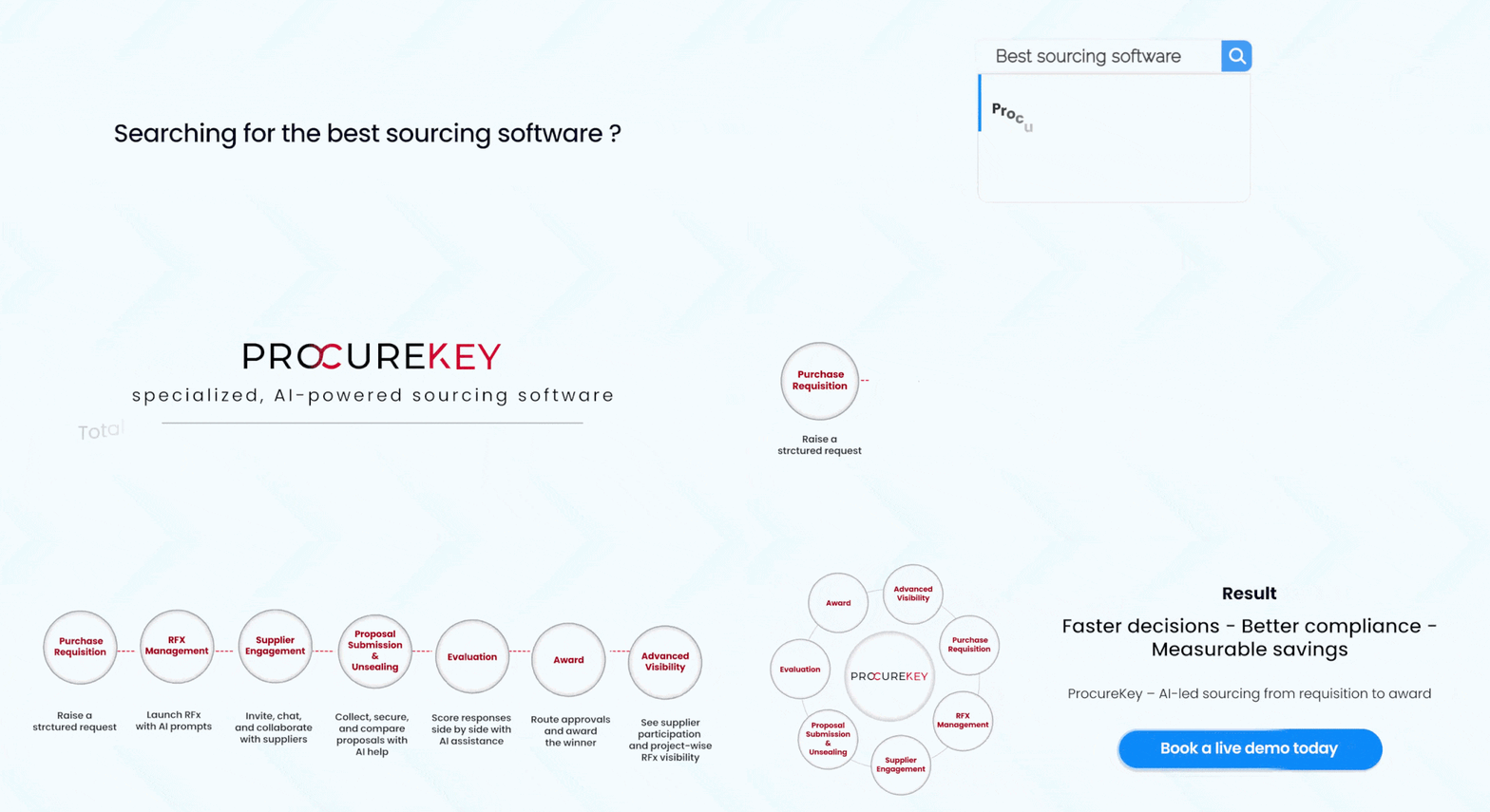
Then look at your ERP honestly. If it handles POs and AP reasonably well, adding S2C for the sourcing layer gives you the strategic intelligence your ERP was never designed to provide. If the ERP’s procurement module is something people work around, a broader rethink might be needed. And consider what your team can actually absorb. S2C touches one department and goes live fast. S2P touches several and takes quarters. ProcureKey’s purchase requisition and sourcing workflows integrate with your existing systems through secure connections, so the sourcing intelligence feeds into your downstream processes without requiring a full-cycle platform replacement.
The S2P vs S2C decision comes down to where your gaps are. If the sourcing process is the bottleneck — and for most mid-market procurement teams, it is — S2C gets you 80% of the value at a fraction of the implementation cost and timeline. The worst option is doing nothing and running sourcing on email and shared drives while waiting for a perfect end-to-end deployment that’s always six months away. ProcureKey is a Source-to-Contract platform. It handles sourcing, supplier management, competitive events, and contract award inside Microsoft 365. The transactional side stays in your ERP where it belongs. See how it works.