
Category
Strategic SourcingDate Posted
July 24, 2026We spent a morning last month watching a mid-market manufacturing team in Houston process a $180,000 order for packaging materials. The operations manager sent a Slack message to procurement. Procurement called their usual supplier. The supplier quoted a price. Finance approved the PO. Done.
Nobody asked whether there was a better supplier. Nobody ran a competitive process. Nobody checked if the spec was right. The company went from need to payment in four days and left what I’d estimate was $30,000 to $40,000 on the table because they skipped straight from intake to purchasing and forgot that sourcing exists.
These three words get used interchangeably in a lot of organisations. They’re not the same thing. Intake captures the business need. Sourcing finds the best supplier through competition. Purchasing executes the transaction. When you collapse them into one step, you lose money. Quietly and consistently.
What Is Intake in Procurement?
Intake is where a business need becomes a formal, trackable request. Somebody in operations, IT, or facilities needs something. They submit a purchase requisition. That requisition captures what’s needed, how much, by when, and against which budget.
The purchase requisition is the mechanism. Think of it as the front door. Without it, requests come in through Slack messages, hallway conversations, emails to someone’s personal inbox. I’ve seen a company in Melbourne where the plant manager was approving $50,000 purchases over text message. No record. No budget check. No way to aggregate demand across sites.
That’s what breaks without structured intake: maverick spend, duplicate orders, zero visibility into what the organisation is actually buying. The procurement team can’t source competitively if they don’t know what’s coming. And the CFO can’t control costs if nobody is capturing the requests in one place. For a deeper look at this process, see our purchase requisition software page.
What Is Sourcing?
Ask most procurement teams what sourcing means and they’ll say “finding suppliers.” That’s not wrong. But it’s about 20% of the picture.
Sourcing is the strategic, competitive process of selecting the right supplier at the right terms. It’s the phase where cost savings, supplier quality, and compliance outcomes are either won or lost. And it’s the phase that most mid-market organisations skip entirely because it takes effort, it takes tooling, and it takes time their teams don’t think they have.
The RFx Toolkit
Proper sourcing runs on a set of structured instruments. An RFI (Request for Information) is for market research. You’re not ready to buy yet. You’re figuring out who can deliver and at what general cost range. An RFP (Request for Proposal) asks for a detailed proposal when the requirement is complex and you need to evaluate capability alongside price. An RFQ (Request for Quotation) is a straight price request when the spec is already locked. And an eAuction puts suppliers in live competition, compressing weeks of negotiation into an afternoon.
Each instrument has a purpose. Using an RFQ when you need an RFP is like using a hammer when the job calls for a scalpel. Using none of them and just calling your usual vendor is how organisations leak 15 to 25% on categories where competition would have driven a better outcome. For more on the RFx side, see ProcureKey’s RFx management module.
Strategic vs Tactical Sourcing
Here’s where the confusion lives. Tactical sourcing is reactive. Someone needs packaging tape. You call a supplier and get a price. That’s purchasing dressed up as sourcing. Strategic sourcing is category-level thinking: who are the best suppliers for this category globally, what’s the total cost of ownership, what are the supply risks, and how do we structure a multi-year relationship that gives us both price stability and quality guarantees.
Most procurement teams I work with spend 80% of their time on tactical activities and call it sourcing. It isn’t. And the financial difference between the two is enormous.
What Is Purchasing?
Purchasing is the transactional work that happens after a supplier has been selected. The PO gets created. The supplier delivers. Goods receipt is logged. The invoice comes in. Three-way matching confirms the PO, the receipt, and the invoice all align. Payment goes out.
This is the operational engine. It has to run smoothly or the whole supply chain grinds. But let’s be honest: purchasing is execution. The strategic decisions happened upstream in sourcing. If you selected the wrong supplier because nobody ran a competitive process, the purchasing team is just efficiently processing a bad decision.
The compliance risk is real. When purchasing happens without proper sourcing upstream, there’s no defensible record of why a particular vendor was chosen. Internal audit asks for the decision trail. There isn’t one. That scenario plays out more often than most procurement leaders would admit. For how these transactions connect downstream, see ProcureKey’s supplier management module.
Intake vs Sourcing vs Purchasing: Side by Side
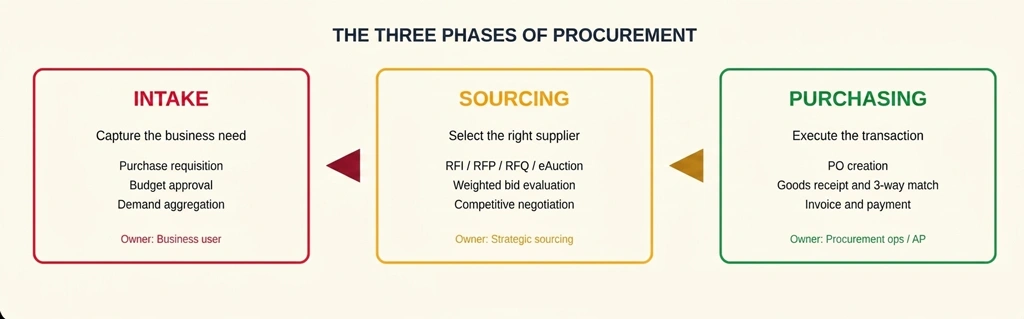
| INTAKE | SOURCING | PURCHASING | |
|---|---|---|---|
What it is | Capturing and approving the business need | Competitively selecting the right supplier | Executing the transaction after supplier selection |
Who owns it | Business user + procurement ops | Strategic sourcing / category management | Procurement ops / accounts payable |
Key output | Approved purchase requisition | Awarded contract or PO from competitive event | Completed PO, goods receipt, matched invoice |
What goes wrong without it | Maverick spend, duplicates, no visibility | Overpaying, single-vendor dependency, no audit trail | Payment delays, compliance gaps, mismatched invoices |
ProcureKey’s role | Purchase Requisition module captures and routes requests | RFx, eAuction, AI scoring, weighted evaluation | Integrates with ERP/finance for downstream execution |
Why Sourcing Is Where the Money Is Won or Lost
Think about it this way. Intake is paperwork. Necessary paperwork, but paperwork. Purchasing is execution. Also necessary. But the decision that actually determines how much your company pays for something? That happens in sourcing. And it’s the phase most organisations underinvest in by a wide margin.
Here’s what competitive sourcing actually delivers when teams have the right tooling. ProcureKey customers report up to 30% savings on negotiated spend when they run categories through competitive eAuctions instead of single-vendor negotiations. Negotiation cycles that used to take weeks compress by 75%. And the software lets teams manage 10x more suppliers per event than they could through email and spreadsheet rounds. That’s not a theoretical improvement. That’s the difference between calling one supplier and putting five qualified bidders on the same category with AI-powered bid analysis running in the background.
When sourcing is done properly, the purchasing team downstream is executing a decision that was made competitively, scored transparently, and recorded with a complete audit trail. That changes the conversation with finance, with internal audit, and with the board.
Three Things to Do This Quarter
1. Audit your last 20 purchases over $25K. How many went through a competitive sourcing process? If the answer is fewer than half, you have savings sitting uncollected in your top categories.
2. Pick one category where you’ve been sole-sourcing and run a competitive RFQ with three alternatives. Just one. The price movement will tell you everything you need to know about where the rest of your spend stands.
3. Separate intake from sourcing in your workflow. If the person raising the purchase requisition is also selecting the supplier, you don’t have a sourcing process. You have a buying process with no competitive check.
Intake sets context. Sourcing drives value. Purchasing closes the loop. Most organisations have decent intake and solid purchasing execution. What they’re missing is the sourcing layer in between, the phase where competitive bidding, structured evaluation, and supplier intelligence actually determine the price. If that gap sounds familiar, see how ProcureKey fills it.