

Category
Logistics SourcingDate Posted
March 5, 2026Transportation markets have become faster, tighter, and less predictable. Capacity cycles move rapidly, rate environments fluctuate, and service expectations continue to rise.
Logistic sourcing was once treated as a cyclical event triggered by contract renewals. But now it’s an ongoing strategic function that is aimed at optimising cost, safeguarding service levels, strengthening resilience, and accelerating responsiveness.
The responsibilities of modern procurement and logistics leaders are extended far beyond moving goods from one point to another. It is also about architecting supply networks that can sustain high performance and absorb uncertainty.
With the increasing global complexity, logistic sourcing has rightfully earned the recognition of a board level agenda item that is central to enterprise stability and competitive advantage.
Freight sourcing is evolving beyond manual rate collection and spreadsheet comparisons. It has also become about leveraging structured methodologies and real-time data to evaluate total value. Teams are moving forward towards evidence based, intelligent sourcing practices that help organisations scale with enhanced transparency, competitiveness, and long-term performance.
Leading organizations are:
- Standardizing lane definitions
- Increasing carrier collaboration
- Running multi-round competitive processes
- Using technology to normalize and compare bids
- Enhancing visibility while establishing strong, end-to-end audit controls.
Digital enablement is rapidly becoming the backbone of a scalable logistics procurement strategy.
In this environment, digital enablement is rapidly becoming the backbone of logistics procurement strategies powering scalable logistic procurement. It leverages standardised process, data integrity, and consistent compliance across global operations at every step.
What logistics sourcing means in mature enterprises
Logistics sourcing in mature and advanced supply chains is no longer centered on selecting the lowest bidder. It focuses on architecting the right carrier ecosystem. Cultivation of a carrier portfolio that supports performance, risk mitigation and strategic growth is important for organizations as establishment of repeatable, standardised processes while retaining the flexibility that’s needed to respond to evolving market conditions is the core objective.
Leaders must continuously answer:
Where should commitments sit?
How diversified should risk be?
What service premium is justified?
The answers require structure, visibility, and governance.
Operational buying versus strategic sourcing
Many organizations still blend urgent execution with long-term design.
Operational buying prioritizes immediate shipment movement.
Strategic approaches evaluate sustainability of the network.
When sourcing logistics is elevated strategically, teams focus on:
Carrier portfolio health
Future capacity assurance
Competitive tension
Service differentiation
Risk distribution
This shift fundamentally improves supply chain stability.
Why transportation sourcing affects enterprise performance
- Freight decisions ripple throughout operations.
- Transportation cost impacts margin.
- Reliability affects customer experience.
- Transit performance shapes inventory buffers.
- Carrier strength influences scalability.
This is why sourcing and logistics must be viewed together rather than as separate disciplines.
Why is logistics sourcing inherently complex?
Unlike traditional sourcing categories, freight procurement operates within a highly dynamic environment where multiple variables intersect. It is shaped by a combination of operational dependencies and external market forces. The interplay of pricing variability, service expectations, network design, and risk exposure make it an exclusively intricate discipline requiring strategic oversight.
The forces that converge to make logistics procurement uniquely challenging are:
- Volatile pricing affected by fuel and macroeconomic shifts.
- Large lanes count across regions and modes.
- Capacity fluctuations that can change within weeks.
- Service variability between providers.
- Manual coordination through emails and spreadsheets.
Together, these variables create decision environments that are difficult to scale without formal systems.
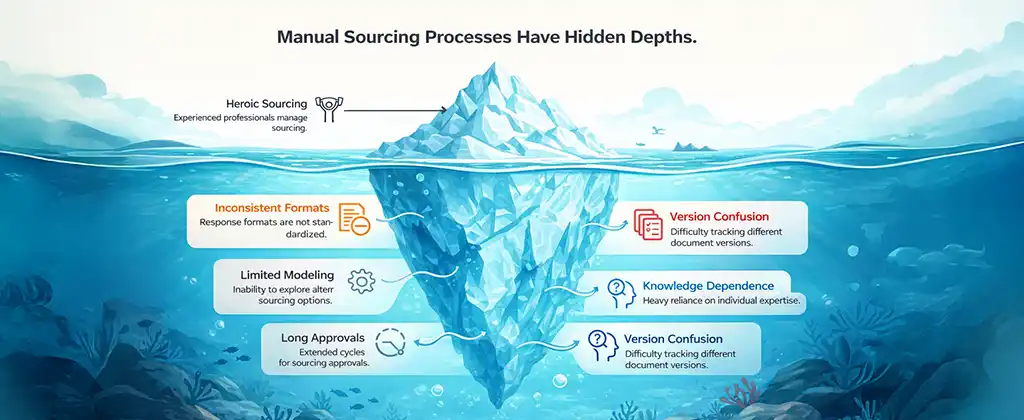
As organizations grow, these constraints begin to slow competitiveness.
The strategic logistics procurement approach
Market leaders treat transportation sourcing as a repeatable operating model rather than an annual exercise.
Core elements often include:
- Structured lane architecture
- Formal supplier communication methods
- Multi-round negotiations
- Transparent evaluation logic
- Documented award decisions
These practices build both agility and defensibility.
Carrier selection frameworks
Price is rarely the only variable.
Enterprises assess carriers across dimensions such as:
Performance history
Network strength
Economic durability
Technology compatibility
Sustainability alignment
Balancing these considerations requires disciplined comparison methods.
Lane-based sourcing as the analytical backbone
Organised opportunities around consistent lanes let procurement leaders view market dynamics more clearly, including competition levels, supplier concentration risk, and areas for strategic optimisation.
Structured sourcing turns dispersed bid data into more insightful intelligence that helps make better decisions. Procurement teams benefit from a clear, cohesive viewpoint that increases their commercial clout without sacrificing governance.
An organization’s commercial position is improved while maintaining compliance and ethical standards through consistency, visibility, and quantifiable assessment. While building stakeholder trust, transparency and sound governance shield the company from unanticipated risks.
As an outcome, sourcing function moves beyond administrative execution to strategic value creation. Every choice made here is supported by evidence, tenable, and consistent with long-term company success.
Multi-round RFQs and competitive intelligence
Rather than single submissions, iterative bidding uncovers efficiency opportunities and improves market transparency.
Suppliers understand expectations.
Buyers gain comparability.
The outcome is typically stronger alignment between cost and service.
Cost versus service trade-offs
A persistent challenge in logistics sourcing is determining the financial value of reliability.
Is faster transit worth a premium?
What is the cost of variability?
When should resilience override savings?
Advanced procurement teams have now started prioritising data-driven assessment and converting complex questions into measurable parameters. Embedding structured analytics into evaluation processes, systematically quantifying key variables to replace opinion-led discussions with evidence-based insights.
Governance requirements, Risk, and compliance
Internal controls and regulatory expectations demand clarity.
Organizations must demonstrate:
Fair competition
Consistent evaluation
Traceability
Supplier compliance
Structured environments make these requirements achievable at scale.
Centralized versus decentralized models
Global enterprises often wrestle with structure.
Central teams deliver leverage.
Regional teams bring local knowledge.
Hybrid operation models are increasingly gaining traction. A more comprehensive strategic objective is indicated by this shift to a more contemporary approach. Through the combination of structured oversight and adaptive responsiveness, teams provide organizations with the ideal balance between centralized control and operational flexibility.
This change to a more modern strategy indicates a more all-encompassing strategic goal.
Spot versus contract strategies
Determining the right mix is central to effective logistics procurement strategy.
- Contracts provide predictability.
- Spot markets offer flexibility.
The optimal balance shifts with market conditions and demand stability.
Regional versus global carrier partnerships
Blending international scale with regional expertise allows organizations to optimize service while maintaining resilience.
However, governance complexity increases proportionally.
The expanding role of technology
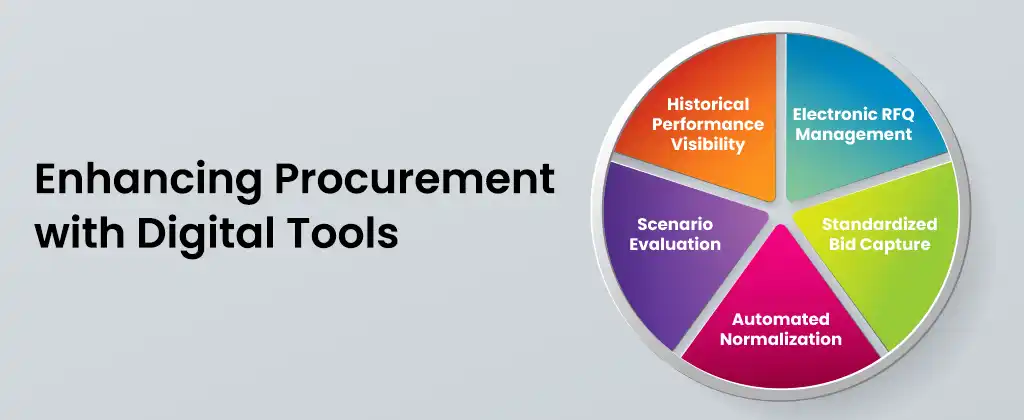
Digital systems are transforming sourcing in logistics by introducing structure and repeatability.
These tools free professionals to focus on strategy rather than administration.
Freight procurement software as infrastructure
Modern freight sourcing solutions encourage accountability and intelligence in the procurement process. They create a systematic atmosphere where sourcing choices are open, auditable, and improved over time. By creating a traceable evaluation framework, organizations can confidently defend their choices while identifying ongoing opportunities for improvement.
They establish a methodical environment in which sourcing decisions are transparent, auditable, and continuously enhanced.
It becomes a backbone for governance rather than a convenience.
For related capabilities, explore our approach to digital sourcing workflows.
Transparency and auditability
- Every interaction becomes traceable.
- Every interaction becomes traceable.
- Changes are visible.
This reduces operational risk significantly.
Continuous sourcing versus event cycles
Forward-thinking organizations refresh awards dynamically, ensuring competitiveness while avoiding disruption.
This trend will only accelerate.
Integration with enterprise systems
Future-ready environments will connect procurement, ERP, and operational data streams.
This convergence will enable predictive planning instead of reactive correction.
Where leaders are investing next
Expect growth in intelligence layers associated with advanced decision support, frequently described as emerging ai org chart tool-style augmentation for logistics environments.
The objective is not automation alone, but improved confidence.
Practical takeaway
Transformation begins with standardization of decision logic.
Technology amplifies maturity of an organisation; it never replaces it.
See how enterprises digitize freight sourcing with ProcureKey
Frequently Asked Questions
Lorem ipsum dolor sit amet, consectetur adipiscing elit. Ut elit tellus, luctus nec ullamcorper mattis, pulvinar dapibus leo.
 17th, June 2026 | 12:00 PM EST
 30 Min + Q&A