


Category
Strategic SourcingDate Posted
March 6, 2026For years, Excel spreadsheets and email threads have been the default tools for running sourcing events.
RFQs circulated via email, supplier responses tracked in spreadsheets, evaluations compiled manually, and approvals coordinated through follow-up messages and attachments.
This approach worked when sourcing volumes were lower, supplier pools were limited, and decisions rarely required revisits.
Today, however, sourcing teams operate in a very different environment.
RFx cycles are more frequent.
Stakeholders involvement has increased.
Auditability, transparency, and speed are no longer optional.
As a result, many procurement organizations are reassessing a fundamental question:
Is Excel still a system or has it become a constraint?
This article explores why sourcing teams shift away from Excel- and email-based processes, what changes when sourcing becomes centralized, and how organizations are making this transition without heavy disruption.
Why Excel Became Sourcing’s Foundation and Why It Is Now Under Strain
Excel earned its place in procurement for good reasons.
It is flexible, universally available, and easy to adapt to different sourcing formats.
For straightforward, single-round RFQs or basic price comparisons, spreadsheets offer quick control.
However, sourcing complexity has grown faster than spreadsheets can reasonably support.
Common stress points begin to appear when:
- Multiple suppliers respond in varying formats
- Line-item or multi-lot evaluations are required
- Technical and commercial assessments must be separated
- Stakeholders request clarifications, revisions, or re-evaluations
- Decisions must be justified months later
At this stage, Excel shifts from analytical tools to coordination mechanism.
The Hidden Operational Cost of Email-Driven Sourcing
Email plays an equally crucial and problematic component in traditional sourcing.
Email is effective for basic communication, but fragile as a process backbone.
Typical challenges include:
- RFQ documents circulating in multiple versions
- Supplier responses arriving with inconsistent file names and formats
- Clarifications requests buried in long email threads
- No unified view of supplier participation or response status
- Difficulty proving when information was shared and with whom
These challenges rarely surface during the RFQ itself.
They surface later, during audits, internal reviews, supplier disputes, or post-award justifications.
What seems manageable in real time often becomes opaque in hindsight.

When Sourcing Moves from “Execution” to “Governance”
Organizations are beginning to rethink how they approach sourcing.
It is no longer treated as a purely operational task but as a strategic decision-making process that must stand up to scrutiny.
This shift introduces new expectations:
- Consistent version control across RFx stages
- Traceable supplier communications
- Structured evaluation method rather than ad-hoc scoring
- Documented approvals with clear award rationale
- Repeatable processes across categories and regions
While Excel and email can support parts of this but only with heavy manual effort and increasing risk.
This is where centralized sourcing platforms enter the picture.
Estimates become stronger when request intake and approvals are structured.
What “Centralized Sourcing” Actually Means (and What It Doesn’t)
Centralized sourcing is often misunderstood as heavy transformation or rigid standardization.
In practice, it simply means this:
All RFx-related activities – creation, supplier responses, evaluation, collaboration, and award, occur within a single structured environment.
Key characteristics include:
- One source of truth for RFx data and documents
- Defined stages instead of informal handoffs
- Supplier responses captured in structured formats
- Evaluation criteria embedded into the process
- Controlled access for internal and external participants
What centralized sourcing does not require:
- Replacing existing ERPs
- Redesigning upstream procurement workflows
- Forcing teams into inflexible templates
- Large-scale IT re-architecture
For many organizations, it operates alongside existing systems, focusing only on the sourcing layer.
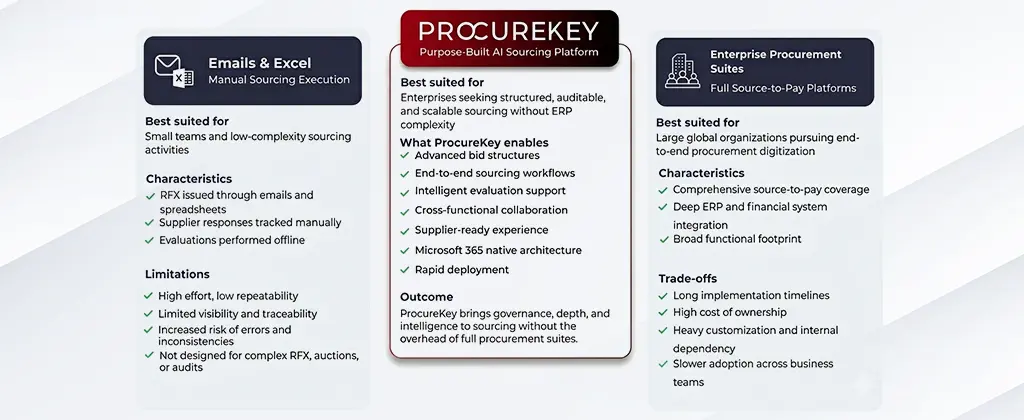
How Sourcing Experience Changes for Procurement Teams
The shift away from Excel isn’t about sacrificing flexibility.
It is about reducing friction.
Procurement and sourcing teams often notice improvements in four areas:
Process Clarity
Supplier Consistency
Collaboration Without Chaos
Defensibility of Decisions
Making Transition Without Disrupting Business
One of the biggest misconceptions about moving away from Excel and email is that it must be abrupt.
Most organizations transition incrementally.
Common starting points include:
- Using a centralized platform only for high-value or complex RFQs
- Running spreadsheet-based analysis alongside structured supplier inputs
- Standardizing RFx communication while keeping existing approval flows
- Introducing evaluation frameworks one category at a time
The goal is not to eliminate spreadsheets overnight.
It is to remove them from roles they were never meant to fulfill such as process control, audit defense, and stakeholder collaboration.
How Platforms Like ProcureKey Enable Transition
As sourcing teams move shift from Excel and email driven sourcing, the transition is often supported by platforms purpose-built for the PR-to-Award layer, without replacing existing systems.
Platforms like ProcureKey show how sourcing can be centralized without forcing large-scale process or IT changes.
Focused on Sourcing, Not Replacing Existing Systems
Centralized sourcing platforms work alongside ERPs, keeping requisitions, budgets, and downstream processes intact, while RFx creation, supplier interaction, evaluation, and award are managed in one structured environment.
Structured RFx and Supplier Responses
RFQs are issued from a unified workspace, supplier responses are captured in comparable formats, and communication history is automatically preserved — reducing manual consolidation and version risk.
Controlled Evaluation with Flexibility
Evaluation criteria and scoring models are embedded into the sourcing event, enabling item-level or weighted comparisons. Data can still be exported for deeper analysis, but the decision trail stays intact.
Collaboration Without Fragmentation
Stakeholders can review, score, and comment within the same system, eliminating spreadsheet circulation and ensuring accountability through role-based access.
Governance Built In
All sourcing actions responses, evaluations, approvals, and award rationale are recorded as part of the event, making decisions easier to defend during audits or reviews.
The value of platforms like ProcureKey is not in eliminating Excel, but in removing it from roles it was never designed to play such as process control, collaboration, and audit defense.
Centralized sourcing platforms enable teams to scale sourcing activity, maintain flexibility, and improve decision confidence without increasing operational complexity.
Excel Is Not Disappearing — Its Role Is Evolving
Excel remains a powerful analytical tool.
What is changing is where it fits.
In modern sourcing environments:
- Excel supports analysis, modeling, and scenario planning
- Centralized platforms manage process, data integrity, and governance
This separation allows teams to retain analytical freedom while reducing operational risk.
The shift, therefore, is not about abandoning familiar tools.
It is about placing them in the right context.
A Natural Next Step in Sourcing Maturity
The movement from Excel and email toward centralized sourcing platforms is not driven by technology trends alone.
It reflects the growing expectations placed on procurement decisions.
As sourcing becomes more collaborative, more frequent, and more visible, informal systems struggle to keep pace.
Centralization offers structure without sacrificing flexibility — enabling procurement teams to operate with clarity, confidence, and accountability.
For many organizations, it is not a radical change.
It is simply the next logical step in how sourcing is executed.
Explore how procurement teams move beyond email and Excel to structured RFX execution in our upcoming webinar
Lorem ipsum dolor sit amet, consectetur adipiscing elit. Ut elit tellus, luctus nec ullamcorper mattis, pulvinar dapibus leo.
 17th, June 2026 | 12:00 PM EST
 30 Min + Q&A