


Category
Strategic SourcingDate Posted
May 6, 2026Why Most Sourcing Strategies Fail Before They Start
Go ask your procurement team to describe their sourcing strategy. You’ll hear all the right buzzwords. Category segmentation. TCO. Supplier rationalisation. Good stuff on paper.
Now ask how the last RFQ actually ran. Five suppliers got an email. Quotes came back in three different formats. Somebody spent a day and a half getting them into the same Excel. The lowest price won. That’s not a procurement sourcing strategy. That’s habit dressed up as process. And it’s happening at companies with $200M in addressable spend who should know better by now.
The real strategy lives in slide decks nobody opens after the QBR. The real work lives in inboxes. Those two things never meet. And the gap between them? That’s where your savings disappear, where audit findings come from, and where procurement loses credibility with the business. Enough diagnosis. Ten procurement and sourcing strategies that actually change what happens after the slide deck closes.
Ten Sourcing Strategies That Work in 2026
1. Category Intelligence Before Category Management
Who makes this stuff? How many real suppliers exist? What actually drives the cost — material, labour, energy, or some combination you haven’t thought about? Most teams can’t answer any of that before they publish the RFQ. They negotiate from gut feel. Their supplier doesn’t. A procurement sourcing strategy starts with knowing the market, not hoping you’ll figure it out during the bidding.
2. Total Cost of Ownership Over Unit Price
A supplier quotes $0.42. Another quotes $0.51. Easy call, right? Add freight, buffer stock for longer lead times, rejection rates, duties. That $0.42 lands at $0.68. Happens all the time, and people keep falling for it because the comparison spreadsheet only has one column: unit price.
The fix is building TCO into your evaluation criteria before bids come in. Ask for landed cost, lead time, packaging specs, warranty. Make suppliers compete on the full picture, not just one number they know you’re sorting by. Procurement sourcing strategy is about cheapest outcome, not cheapest quote. The teams who get this right stop celebrating “savings” that evaporate six weeks after the PO drops.
3. Supplier Consolidation (With a Safety Net)
Forty-seven suppliers for office furniture is a mess nobody wants to manage. Single-sourcing your critical raw material is a gamble nobody should be taking. There’s a middle ground, and most teams miss it because they treat consolidation as an all-or-nothing exercise.
Cut the count in low-risk categories. That’s where volume discounts actually stick and management gets simpler. Keep optionality where disruption hits production. Itemized bidding makes this visible — compare line-by-line and you’ll see where consolidation saves money versus where it just concentrates risk in a smaller number of hands.
4. Multi-Source Critical Categories
Sole-source for anything critical is a bomb with a slow fuse. Multi-sourcing means running competitive events across two or three qualified suppliers and actually rotating volume. Not just listing a backup in a spreadsheet. The best sourcing strategies in procurement treat this as a discipline. You need RFQs that handle split awards at the item level. All-or-nothing defeats the purpose. And doing splits manually on a 200-line RFQ across five suppliers stops being hard and starts being reckless. That’s where procurement automation earns its keep.
5. Should-Cost Modelling
Before publishing anything, know what the item should cost. Not last year’s price. What it should cost given current material indices, labour rates, logistics, and a reasonable margin. Even a rough model changes the dynamic completely.
When a supplier comes in 40% above your model, you’ve got specific numbers to push back on. You can point to the material component, the conversion cost, the logistics assumption. That’s a negotiation. Showing up without a model and hoping for competitive tension? That’s a prayer. And your supplier can tell the difference.
6. Structured RFQ Execution
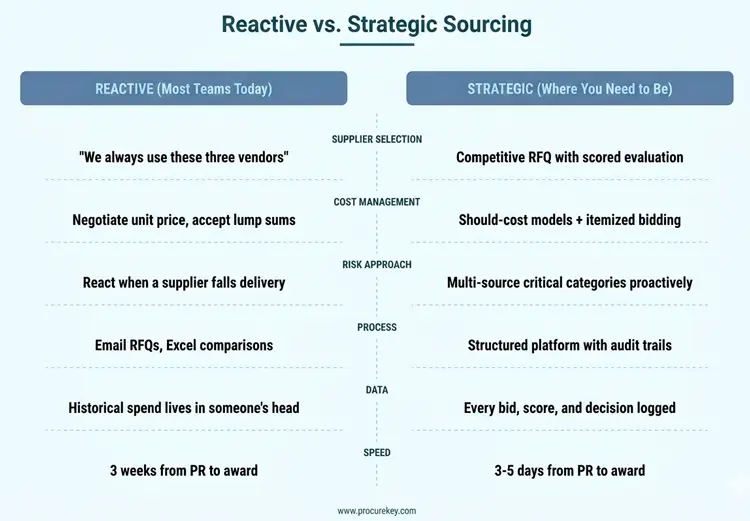
Most sourcing teams don’t have a process. They have a ritual. Somebody sends an email. One supplier replies with a PDF. Another puts numbers inline. A third sends a file in a format nobody requested. Three days of cleaning before a single bid gets evaluated. And the person who built that master comparison file? They’re the only ones who understand it. That’s not a system. That’s a liability.
Templates. A portal. Scoring criteria locked in before the first response. None of that is groundbreaking. But almost nobody does it consistently. I’ve seen half-billion-dollar companies running sourcing out of a shared Outlook folder. Sourcing strategies for procurement only work when the execution underneath is solid. Strategy without process? Just ambition with a deadline.
7. AI-Assisted Bid Evaluation
Most of the AI noise in procurement is exactly that — noise. But bid evaluation is the exception. Twelve suppliers, 80 line items. AI spots the lowball hidden in row 247 and the delivery promise that contradicts the supplier’s actual track record. Sourcing strategies in procurement depend on what happens after the RFQ closes. A spreadsheet with 960 cells and a deadline isn’t a fair fight for any analyst. AI doesn’t make the call. It makes the call faster and better informed.
8. Supplier Development
Sometimes the best available supplier is 80% of what you need. Not ideal, but the supply base is what it is. So help them close the gap. Share forecasts so they can plan capacity. Give honest feedback after every cycle — not just when they mess up, but when they do well. Tell them what winning the next round looks like.
It takes time. A year, sometimes two. But the supplier who outperforms the “safe” option eighteen months later and gives you preferred pricing because you invested early? That didn’t happen by luck. Somebody in procurement saw the potential before it was obvious.
9. Regional Diversification
Eighty percent of spend in one geography isn’t a sourcing strategy. It’s a risk position. Have a pre-qualified alternative in a different region that can take 50–60% of volume within two months if the primary gets disrupted. Tariffs, export bans, port closures — the trigger is irrelevant. What matters is whether you’ve got an option or you’re scrambling. Procurement and sourcing strategies in 2026 have to price in what’s happening in the world, not just in the supply base.
10. Continuous Market Sensing
Annual reviews are dead. Or they should be. A commodity dip in March shouldn’t wait for September’s planning cycle. A new supplier with better pricing shouldn’t sit in anyone’s inbox for six months while someone waits for the “official” review window.
Track indices. Watch supplier financial health. Run events when conditions favour you, not when some calendar reminder fires. The best sourcing strategies stay alive between reviews. The reactive ones just pay more and wonder why costs keep creeping.
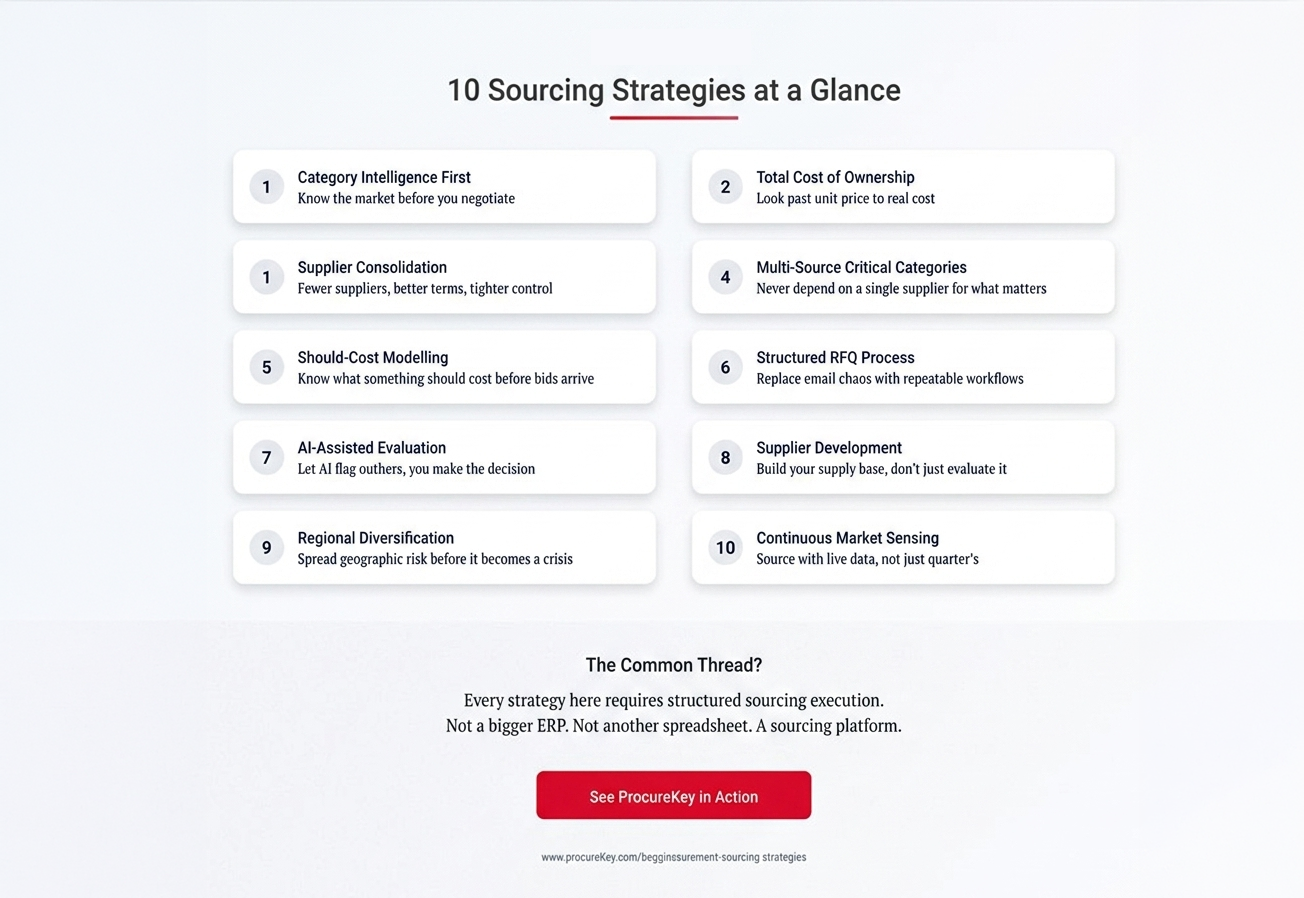
One thread ties all ten together: none of them work if sourcing execution is broken. The smartest category plan in the world is worthless when RFQs run through email and evaluations live in a spreadsheet someone built in 2019.
Three Things to Do This Quarter
1. Audit your last 10 sourcing events. How many had scoring criteria set before bids arrived? Less than half? Process is your first fix.
2. Pick one high-spend category. Build a rough should-cost model. Use it next time you negotiate. Watch the conversation change.
3. Name your top 3 sole-sourced categories. Qualify one alternative for each before the quarter ends. Don’t wait for a crisis.
Frequently Asked Questions
Where ProcureKey Fits
Every strategy here needs one thing underneath it: a structured path from Purchase Requisition to Award. That’s ProcureKey. Not P2P. Not ERP. Sourcing execution, inside Microsoft 365. RFQs in days. Comparisons in minutes. Full audit trail on every award.
You don’t need a bigger system. You need a sourcing layer that’s fast, structured, and auditable. That’s the gap ProcureKey fills.
 17th, June 2026 | 12:00 PM EST
 30 Min + Q&A