


Category
Strategic SourcingDate Posted
May 1, 2026You send an RFQ to four suppliers. Three respond. Two are within budget. You pick the cheaper one, negotiate a bit, and issue the PO. Six weeks of emails for a 3% discount. Sound familiar?
That’s how most procurement teams buy. And it leaves money on the table every single time. Not because the suppliers are overcharging — but because the process doesn’t create any structural pressure for them to offer their best number. They quote what they think you’ll accept. Not what they’re willing to accept.
Reverse bidding flips the whole thing on its head. You stop chasing individual suppliers for their “best price” and instead post the requirement openly. Multiple vendors compete against each other. In real time. Prices drop — sometimes dramatically — because the competitive pressure is baked into the format itself. For once, the buyer runs the pricing conversation instead of reacting to whatever lands in the inbox. That’s what this guide unpacks: the mechanics, the tradeoffs, the categories where it works brilliantly, and the ones where it’ll blow up in your face if you’re not careful.
What Is Reverse Bidding?
Think of a regular auction. Multiple buyers compete for one item. Price goes up. The highest bidder wins. eBay works this way. So does every art house.
Reverse bidding flips that completely. One buyer, multiple sellers. The buyer posts a requirement — “I need 10,000 units of X, delivered by Y date, meeting Z spec” — and suppliers compete by bidding the price down. Each new bid has to beat the current lowest offer. The supplier willing to deliver at the best price (and who meets the buyer’s criteria) wins the contract.
The key shift: in a traditional procurement negotiation, the supplier names a price and you negotiate from there. They know their floor. You don’t. Here, the market sets the price through live competition. The information asymmetry that usually favours the seller evaporates. Buyers see exactly where the market lands — across multiple qualified vendors, in real time.
You’ll also hear this called a reverse auction, e-reverse auction, or competitive bidding event. Same concept, different labels. The mechanism is identical: structured competition where the buyer defines the rules and suppliers compete within those rules. ProcureKey’s reverse auction platform digitises the entire workflow — but the principle is as old as procurement itself. The software just makes it fast, transparent, and auditable.
How the Process Actually Works
The concept is simple. The execution is where most teams either get it right or create a mess. Here’s the process step by step.
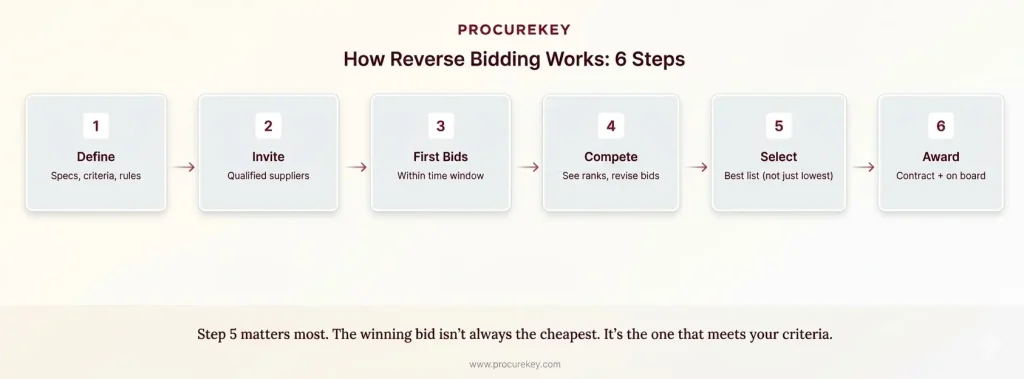
Step 1: Define what you’re buying
This is where most teams rush and then pay for it later. Nail the spec. Quantities, delivery windows, quality thresholds, evaluation weights — get it all down before a single supplier sees the event. Why? Because a vague requirement gets you vague bids. And vague bids lead to disputes at delivery that cost ten times what you saved in the auction. The sharper your spec, the harder it is for anyone to game the process.
Step 2: Invite qualified suppliers
Not a mass blast. You’re inviting vendors who’ve been pre-qualified or who you know can deliver. Three to eight is the sweet spot for most categories. Fewer than three and there’s not enough competition. More than twelve and the event gets noisy without improving the outcome.
Step 3: Suppliers submit opening bids
Within a defined time window, each supplier submits their initial price. This establishes the starting range. Some suppliers bid aggressively from the start. Others hold back to see where the market sits. Both approaches are rational.
Step 4: Live competition begins
This is where it gets interesting. Suppliers can see their ranking — usually anonymised — and revise their bids downward. If Supplier A is sitting at position 3 and wants the contract, they need to beat the current leader. The clock runs. Bids drop. The competitive pressure is structural, not theatrical.
Step 5: Buyer evaluates and selects
And here’s the part that separates a good event from a race to the bottom. The winning bid isn’t automatically the cheapest. Smart buyers use weighted criteria — price counts, sure, but so do delivery capability, quality track record, and compliance. The lowest number means nothing if the supplier can’t deliver.
Step 6: Contract awarded
The winning supplier gets the award, the contract is issued, and onboarding begins. Every bid, every revision, every timestamp is logged. The audit trail exists before anyone asks for it.
Reverse Bidding vs Traditional Bidding
The comparison is stark once you lay it out. In traditional bidding, the supplier names a price and the buyer negotiates from there. The supplier has the information advantage — they know their floor, their margin, their walk-away number. You don’t. In the reverse model, that dynamic inverts. The market reveals the price through competition, not through one supplier’s opening position. That’s not a small difference. It’s a structural shift in who controls the sourcing process.
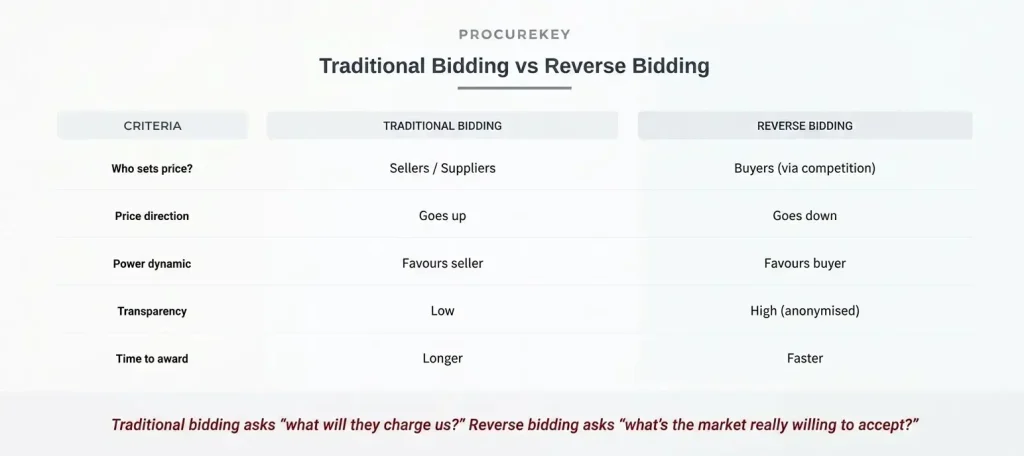
The transparency angle matters more than most people realise. In a one-on-one negotiation, neither side has full visibility into the market. In a reverse bid, the buyer sees exactly where the pricing lands across multiple qualified vendors. That’s not just a better price. It’s market intelligence you can use for the next twelve months of category planning.
See It in Action — Live Reverse Auction Demo
Where It Works — Industries and Use Cases
The approach isn’t universal. It works best where the specification is clear, multiple qualified suppliers exist, and price is a meaningful evaluation factor. That said, the range of industries using it is broader than most people expect.
Government and Public Sector
Public procurement practically invented structured competitive bidding. Transparency requirements, audit obligations, and taxpayer accountability make reverse auctions a natural fit. Several government agencies report 15–25% savings on categories they moved from sealed-bid tenders to live reverse auctions.
Construction and Real Estate
Subcontractor services, building materials, MEP supplies. Project-based sourcing where the specification is drawn up before the event and every percentage point hits the project margin. When you’re sourcing concrete supply for a 14-month project, the difference between the first quote and the competitive market rate can be six figures.
Logistics and Freight
Here’s the thing about freight — it’s one of the highest-volume reverse auction categories on the planet and most shippers still source it over email. A company running a 200-lane RFQ could spend six weeks collecting carrier quotes lane by lane. Or they could structure it as a reverse auction and watch pricing converge to actual market rates in an afternoon. A reverse bidding platform handles the lane-level bidding, normalises the data across carriers, and builds the comparison without anyone touching a spreadsheet.
Manufacturing
Raw materials, components, packaging. Categories where the spec is locked and three to five vendors can deliver. This is where the approach first gained traction 20 years ago, and it’s still the strongest use case.
Healthcare
Medical supplies, non-critical equipment, facilities services. The compliance layer is heavy, but once suppliers are pre-qualified, the bidding event itself compresses what would normally be a month of back-and-forth into a single structured session.
IT and Technology Services
Hardware, licensing, managed services. When three or more vendors can deliver the same outcome, letting them compete beats negotiating one at a time. Less effective for custom development work where scope is fluid — but for anything with a clear specification, the auction format works.
What Buyers Actually Gain
Let’s be specific. Not “it saves money.” Everyone says that. Here’s what actually changes when you shift from bilateral negotiation to structured competition.
Structural cost reduction
Not harder negotiation. Structural competition. When five suppliers can see they’re being outbid in real time, the pricing reflects what the market is willing to accept — not the first number someone put in an email three weeks ago. Industry benchmarks consistently land between 10–19% savings vs bilateral negotiation. Some categories hit 25%+.
Actual price discovery
After a reverse bid, you know the market rate. Not the rate one supplier offered you. The actual competitive floor. That intelligence is worth as much as the savings on the current contract because it informs your category strategy for the next two years.
Speed
A well-structured event completes in under an hour. The negotiation cycle it replaces? Weeks. Sometimes months. Your sourcing team gets capacity back — capacity to run more events and cover more spend, not just process the same events faster.
A wider supplier pool
The digital format makes it practical to include international vendors who wouldn’t have been contacted in a manual process. More competition. Better pricing. And a supplier management process that actually expands your options instead of recycling the same three vendors.
Data you can use
Every bid, every price point, every timestamp. Exportable. Analysable. When your CPO asks “what’s the market rate for this category?” you have an answer based on live competitive data — not a guess based on the last contract.
The Risks — And How Smart Teams Handle Them
The approach isn’t without tradeoffs. Pretending otherwise would be dishonest. Here’s what to watch for.
The race-to-the-bottom problem
If price is the only criterion, suppliers cut corners to win. Quality drops. Delivery slips. Relationship damage. The fix is weighted scoring. Price gets a weight — maybe 40%, maybe 60%, depends on the category — but it’s never 100%. Delivery track record, quality history, compliance status, and technical capability all factor in. The best bid isn’t the cheapest. It’s the one that scores highest across everything that matters.
Supplier disengagement
Compress margins too hard and good suppliers stop participating. They’ll bid on your competitors’ events instead. The mitigation is realistic reserve prices and not running reverse bids on categories where you need a long-term partnership more than you need a lower number. Not everything belongs in an auction. Knowing when not to run one is part of the discipline.
First-time complexity
Nobody nails the first event. The criteria need tuning. The auction rules feel unfamiliar. Supplier invitations take longer than expected because you’re figuring out the system. That’s the reality — event number one is slower than event number ten. But here’s what experienced teams will tell you: by the third event, the whole thing feels routine. And most platforms include hands-on support for that first run specifically because they know the learning curve is front-loaded.
Frequently Asked Questions
The concept isn’t new. But the gap between teams that use it and teams that don’t is widening. On one side: structured competition, real price discovery, auditable decisions, and a sourcing team that covers more spend with less effort. On the other: email chains, bilateral negotiations, and a vague sense that the pricing could be better but no data to prove it.
What’s changed is the tooling. Ten years ago, running a reverse bid required enterprise software and a team that knew how to configure it. Today, a reverse bidding platform handles the setup, the live event, the audit trail, and the post-event analytics in one system. The barrier to entry has dropped. The savings haven’t.
The shift doesn’t require overhauling procurement. It requires running one event differently and letting the result speak for itself.
Three Things to Do This Quarter
Identify your top 3 categories by annual spend where you have 3+ qualified suppliers and a clear specification. Those are your candidates for a reverse bid. Run one event. Don’t overhaul everything. Pick a mid-complexity category, set up the auction, and compare the outcome to your last manual negotiation. Time saved, pricing achieved, audit trail quality. Measure the gap. If the event delivered better pricing in less time with a cleaner record, you’ve got the business case for scaling. If it didn’t, you’ve still got competitive market data you didn’t have before.
 17th, June 2026 | 12:00 PM EST
 30 Min + Q&A