



Category
Strategic SourcingDate Posted
June 23, 2026In 2023, a pharmaceutical manufacturer’s procurement department received what appeared to be a routine RFQ response from a long-standing packaging supplier. The email carried the correct logo, the correct contact name, and a PDF quote attached. A procurement coordinator opened the attachment, entered credentials the document requested, and within 48 hours attackers had access to the company’s supplier database, contract pricing for 200+ vendors, and every supplier contact record on file.
The entry point was procurement. Not IT infrastructure. Not a misconfigured firewall. A procurement inbox doing exactly what it does every day. Most enterprise security programmes still treat procurement as a low-risk function. The data says otherwise. Supplier bank details, contract pricing, bid specifications, payment authorisations. That volume of sensitive commercial data rarely gets the same governance applied to finance or HR systems. And attackers have noticed the gap.
Where the Exposure Actually Sits
Consider what moves through a procurement system in any given week. Supplier bank details attached to payment setup forms. Contract pricing that a competitor would pay to see. Bid responses with proprietary technical specifications embedded in the attachments. The volume of sensitive commercial data is substantial, and most of it travels between the organisation and external parties whose own security posture is unknown.
The exposure is structural, not incidental. Procurement is outward-facing by design. Onboarding a new supplier opens a connection to an external network. Issuing an RFQ sends commercial intelligence outside the perimeter. And at most mid-market organisations, significant portions of this communication still run through email and shared spreadsheets with no encryption, no access logging, and no way to determine who opened or forwarded a file. Platforms like ProcureKey exist in part because that communication model is no longer defensible from a risk standpoint.
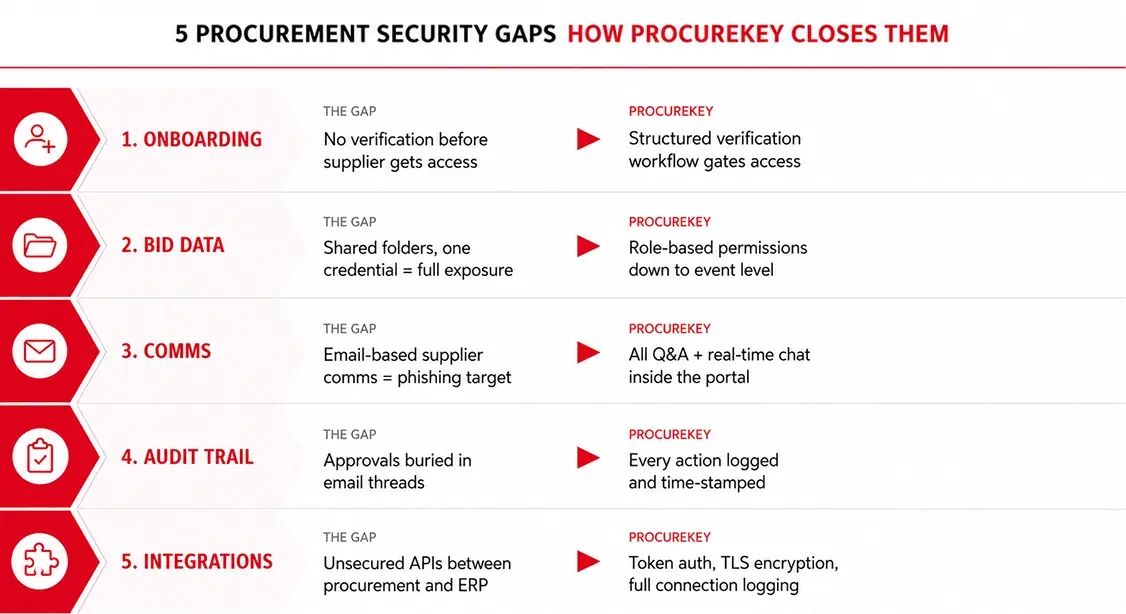
Five Security Gaps Specific to Procurement Workflows
PROCUREKEY.COM
1. Supplier Onboarding Without Verification Gates
How does the organisation verify that a new supplier is legitimate before granting them access to bid on a sourcing event? At most mid-market companies, the answer is a credit check and a web search. Fraudulent suppliers have become significantly more sophisticated. They build convincing websites, provide fabricated references, and submit competitive bids. The objective is either payment fraud or data harvesting through portal access. ProcureKey’s supplier management module gates supplier access behind a structured verification workflow. Documents must be uploaded. Compliance must be attested. Category qualification must clear. Only then can the supplier participate in an event.
2. Bid Data Sitting in Shared Folders
Evaluation scorecards stored in shared drives. Contract terms in email folders. Supplier pricing on a spreadsheet anyone in the department can open. That is one of the largest unmanaged attack surfaces in procurement. A single compromised credential exposes years of commercial intelligence. When bid evaluation runs inside a governed platform with role-based permissions, a buyer managing packaging categories cannot access raw materials pricing. An evaluator sees only the event they’re assigned to. The data segmentation that most organisations apply to financial systems needs to extend to procurement data with the same rigour.
3. Supplier Communication Running Through Email
Procurement teams receive external correspondence all day. That makes them high-value targets for phishing. A spoofed RFQ response from a known supplier is the most common variant. Altered bank details on a legitimate-looking invoice is another. These attacks succeed because the behaviour they exploit, responsiveness to supplier communication, is exactly what makes a procurement professional effective. Moving supplier communication into a platform changes the dynamic entirely. ProcureKey’s eAuction and RFQ environment keeps all bid responses, Q&A, and real-time chat inside the portal. There is no email to spoof because the communication channel is the platform, not Outlook.
4. No Audit Trail on Approvals and Award Decisions
When an auditor or regulator asks “who approved this purchase and when?” the answer at most organisations is a scramble through email threads and folder histories. Approvals are buried in forwarded messages. Version histories are unreliable. There is no way to demonstrate that the person who should have approved a purchase actually did. ProcureKey logs actions automatically. Approvals, score entries, document uploads, bid submissions. All of it time-stamped and immutable. The audit trail builds itself rather than depending on someone remembering to save a screenshot.
5. Unsecured Integrations Between Procurement and Enterprise Systems
The procurement platform connects to the ERP. The ERP connects to the finance system. Each integration is a potential entry point if authentication and encryption are not properly configured. We have encountered production environments where the API between the procurement platform and the ERP carried no authentication token. Anyone who located the endpoint could extract supplier data directly. ProcureKey connects to ERP, finance, and contract systems through token-based authentication, TLS encryption in transit, and full logging on every connection. No open endpoints.
Review ProcureKey’s Security Architecture
How ProcureKey’s Architecture Addresses These Gaps
ProcureKey runs inside the Microsoft 365 tenant the organisation already operates. That is not a deployment shortcut. It means the security policies, identity management, conditional access rules, and data governance controls already in place for M365 extend to procurement data automatically. There is no parallel security stack to build. The credentials your team already uses are the credentials that govern procurement access.
Permissions operate at the category and event level, so a packaging buyer and a raw materials buyer see different data sets even though they’re on the same platform. MFA inherits from the tenant without additional configuration. The sourcing data, supplier records, and contract documents all sit in the same governed environment. There are no disconnected tools with their own access policies creating gaps that nobody monitors.
For organisations in regulated industries, this architecture matters for a practical reason: when the auditor asks how procurement data is secured, the answer is the same M365 compliance posture the organisation already documented for its last certification review. No separate security narrative required.
Operational Practices That Reduce Exposure
Run a supplier communication audit this quarter. How much procurement correspondence currently passes through personal inboxes? Start with RFQ distribution. If bid responses are arriving as email attachments, that is an unmonitored channel with no access control. Moving bid collection into a portal is the single change that eliminates the most common attack vector in procurement.
Review access permissions quarterly. People change roles. Contractors finish their engagements. What was meant to be temporary access quietly becomes permanent because nobody revokes it. If the procurement system does not enforce role-based permissions automatically, build a quarterly review into the compliance calendar. Go through the user list. Match each person’s access to their current role. Revoke anything that doesn’t fit. This takes an afternoon once a quarter and prevents the kind of access creep that turns a minor compromise into a full data exposure.
Invest in procurement-specific security awareness. The generic corporate phishing training that IT runs annually is not enough for a team that handles external supplier communication all day. Build training around the actual scenarios: what does a spoofed RFQ response look like in practice? How do altered bank details get embedded in an otherwise legitimate invoice? When a “urgent” payment request arrives, what is the verification step before it moves forward? The procurement team is the first line of defence on these threats because they are the ones receiving them.
The security gaps in procurement are not the same gaps that enterprise IT programmes were designed to close. IT secures the network perimeter. Procurement’s exposure is in the workflow: the supplier data collected during onboarding, the competitive intelligence contained in bid evaluations, the payment details flowing between AP and the supplier base. Addressing that exposure requires a platform where governance is embedded in the procurement process rather than layered on top of it. That is the design principle behind ProcureKey. The platform runs inside M365 because that is where the organisation’s security controls already operate.
