

Category
eSourcing SoftwareDate Posted
July 20, 2026eSourcing software is a digital system that manages the supplier selection lifecycle electronically. It covers RFI, RFP, and RFQ creation, competitive reverse auctions, bid evaluation, and contract award in one connected environment. It replaces the email-and-spreadsheet approach to sourcing with a centralised, auditable process that puts more suppliers into competition, cuts the time from sourcing kickoff to award, and creates a defensible decision trail on every event.
Choosing the right one starts with three questions most vendor sales teams dodge. Does it actually fit how your team works on a Tuesday morning? Can you go live without turning it into a six-month IT project?
If your organisation sits in that $20M to $500M addressable spend range and you’re evaluating eSourcing software for the first time, or replacing a legacy tool that costs more than it saves, this guide is written specifically for you. Not for the Fortune 500 procurement department with a dedicated technology team. Written for the procurement director who needs competitive sourcing running this quarter, not next year. Most eSourcing buyer’s guides target enterprise procurement teams with 50+ people and a seven-figure technology budget. This one is built for teams of 5 to 20 who need to run competitive sourcing events without adding headcount, without a consulting engagement, and without waiting until next fiscal year to see results.
What Is eSourcing Software?
In plain terms: eSourcing software digitises how your team selects suppliers. From writing the requirement and reaching out to vendors, all the way through bid evaluation, negotiation, and contract award. It sits in a different lane from eProcurement software, which covers the broader procure-to-pay world of purchase orders and invoices.
Consider what you’re doing right now. RFQ drafted in Word. Emailed to six suppliers one at a time. Responses arrive in five formats over ten days. Somebody rebuilds the comparison from scratch in Excel. The award decision is defended with a verbal explanation that the auditor won’t accept next March. eSourcing software moves that entire cycle into one system: structured bids, weighted scoring, automatic audit trail.
Here’s what belongs in the tool. RFQ, RFP, and RFI management so your team creates and tracks sourcing events in one place. Reverse auctions that let suppliers compete on price while you watch the numbers move.
What Is the Difference Between eSourcing and eProcurement?
eSourcing is the selection phase. You issue the event, collect bids, evaluate, and award. eProcurement is the bigger picture: it picks up where eSourcing ends and handles POs, invoicing, and payment.
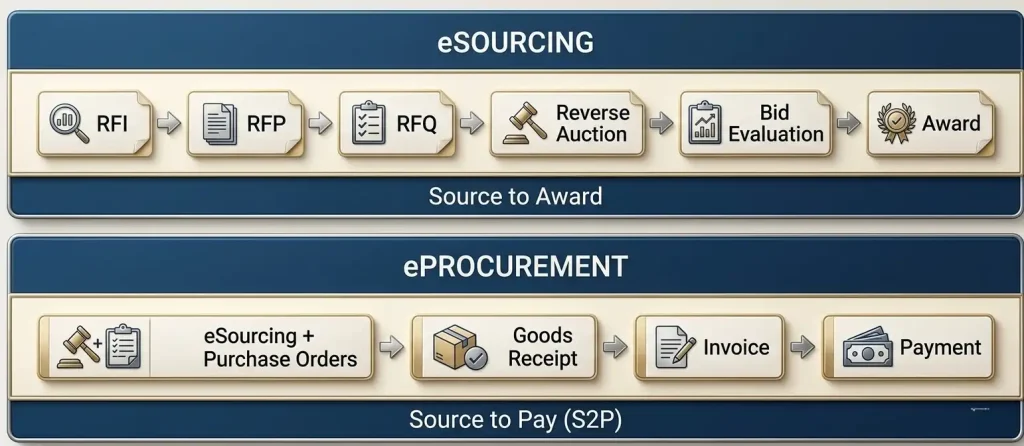
| ESOURCING | EPROCUREMENT |
|---|---|
RFI > RFP > RFQ > Reverse Auction > Bid Evaluation > Award | eSourcing + Purchase Orders > Goods Receipt > Invoice > Payment |
Source to Award | Source to Pay (S2P) |
Start where the money is. Competitive supplier selection generates savings. PO processing doesn’t.
What Are the Key Benefits of eSourcing Software?
Six things change after deployment. Each one below is backed by a verified ProcureKey number.
1. Sourcing costs drop when suppliers compete properly
Reverse auctions are the biggest single lever. When five suppliers can see in real time that their bid isn’t winning, pricing drops to levels that email negotiation physically cannot reach. But it’s not just auctions. Structured competitive events on categories that previously went to the incumbent by default produce savings even without a live auction. The act of putting three suppliers in formal competition changes the conversation.
2. Sourcing cycles get shorter because the manual work disappears
Over 100,000 RFQs run through the system annually across the customer base. That volume proves the point: the bottleneck in most sourcing operations isn’t the number of events the team can handle. It’s the time each event consumes. Cut the per-event overhead from 15 hours to 4 and your team runs three times the events without hiring anyone.
3. Award decisions come with a built-in defence
GDPR compliant. SOC 2 Type 2 certified. ISO certified. Microsoft Solution Partner. Recognised with the Technology Innovation Award at the 14th Procurement Excellence Summit (2025). And when the CFO walks in asking why Vendor B got the nod over Vendor A, your procurement director pulls up the event. Criteria. Scores. Comments. Every evaluator’s reasoning on screen. Criteria. Scores. Evaluator comments. Thirty seconds. Done. Not 30 minutes of reconstructing email threads.
4. More suppliers compete because the barrier to entry drops
The improvement doesn’t just show up in the auction results. It shows up in the first-round pricing. Suppliers who know they’re entering a structured, scored competition with visible deadlines quote more aggressively on the opening bid than they would in a casual email exchange. A procurement analyst in Dallas told us her suppliers started quoting 6-8% lower on initial submissions after she moved three categories onto the eSourcing system. Before any auction. Just from the competition signal.
That dynamic is why eSourcing software pays for itself faster than almost any other procurement technology investment. The savings don’t come from a feature. They come from changing the competitive conditions around every sourcing event your team runs. More suppliers. More transparency. More downward pressure on price. The software is just the mechanism.
5. The team handles more events without adding headcount
Supplier management is centralised so the next sourcing event doesn’t begin with the same question every time: “who should we invite?” Vendor profiles carry performance data, bid history, and compliance status across events. The analyst starting a new RFQ in a category someone else sourced last quarter picks up where they left off.
6. The software works inside the tools your team already uses
ProcureKey is available on Microsoft AppSource with over 50,000 downloads. It runs inside Microsoft 365. Same login as Outlook, Teams, and SharePoint. No new vendor cloud to evaluate. No separate security review for IT. No migration project. The procurement team is running sourcing events inside the environment they already use every day.
See What 25x ROI Looks Like for Your Team
What Should You Look for When Choosing eSourcing Software?
Most buyer’s guides for eSourcing software tell you what the category does. They skip the part that actually matters: how to evaluate one tool against another. Five criteria separate the tools that work for mid-market teams from the ones built for Fortune 500 procurement departments with a different budget, a different timeline, and a different definition of “fast.”
We’ve seen mid-market procurement teams evaluate eSourcing software the way they’d evaluate an ERP: a 6-month selection process with 40 requirements, 3 vendor demos, and a committee decision. By the time they chose a tool, the problem they were trying to solve had cost them another two quarters of manual sourcing. The five criteria below are designed to cut that evaluation to weeks, not months. If a tool passes all five, it’s worth a trial. If it fails on two or more, move on.
Integration with your existing systems
Deployment speed and time to first event
Pricing model transparency
Mid-market fit vs enterprise over-engineering
Security and compliance certifications
ProcureKey Meets All 5 Criteria. Verify It Yourself.
How Much Does eSourcing Software Cost?
The pricing conversation in eSourcing is unusually opaque. Legacy vendors hide numbers behind sales calls. So here’s what the market actually looks like in 2026. Three models dominate.
Per-event pricing
Per-user pricing
Annual enterprise licence
ProcureKey offers a 7-day free trial with no credit card required. Your team runs a live sourcing event before committing to any pricing plan. That’s a fundamentally different buying experience from the “request a demo and wait for a sales call” approach that dominates this category.
One practical tip on pricing evaluation: calculate your cost per sourcing event under the current manual process. Include analyst hours, document preparation time, bid consolidation, and approval routing. Most mid-market teams find the number is $2,000 to $4,000 per event when they’re honest about it. Any eSourcing software that costs less per event than that manual baseline has a positive ROI from event one.
Who Should Use eSourcing Software?
Rolling out a big software change always comes with a few risks. Many teams do a great job buying the software but mess up when it is time to turn it on.
Right fit
Procurement teams managing $20M to $500M in addressable spend who run 10 or more competitive events a year. At that volume, the cost of running sourcing on email exceeds the cost of the software by a wide margin.
Microsoft 365 organisations that want esourcing services running where their data already lives. No new vendor in the security register. No separate credentials to manage. No procurement data sitting in someone else’s cloud. The IT team signs off in a day because there’s nothing new to evaluate.
Teams replacing legacy eSourcing tools with $200K+ annual licences. Per-event or per-user pricing matches actual usage instead of locking the team into an enterprise contract that assumes triple the volume.
Less suited
That’s a contract management conversation, not a competitive sourcing problem. eSourcing software adds value when there’s a market to compete in. Where there isn’t, the tool adds process without adding savings.
$0 to Get Started. No Legacy Licence Required.
Frequently Asked Questions
Enterprise-grade eSourcing software should hold GDPR compliance, SOC 2 Type 2, and ISO certification as a baseline. ProcureKey holds all three, plus Microsoft Solution Partner status and the Technology Innovation Award at the 14th Procurement Excellence Summit (2025).
Choosing eSourcing software isn't about finding the tool with the longest feature list. It's about finding the right fit for your team's size, your existing systems, and your sourcing volume. For mid-market organisations that don't have a six-month implementation window or a $200,000 annual licence budget, the right tool deploys in hours, prices by usage, and works inside the systems your team already trusts.
delivers $200,000 in average customer savings with a 25x ROI track record. MJH Life Sciences saved $90,000 in year one. The Technology Innovation Award at the 14th Procurement Excellence Summit (2025) recognised the approach. And the 7-day free trial means you can verify all of this with your own data, your own suppliers, and your own sourcing events before committing to a plan.