

Category
eSourcing SoftwareDate Posted
July 17, 2026You’re sourcing a $500K facilities maintenance contract. Five qualified suppliers. Two of them have worked with your company before and know your pricing history. If you run an open auction, those two will anchor their bids just below what you paid last time and let the new entrants fight for the scraps. Sealed bidding changes that dynamic completely. Nobody sees anyone else’s number. Every supplier prices the job based on their own cost structure, not on what they think the others will offer.
That’s the case for sealed bidding in procurement, and it applies to a lot more categories than most teams realize.
What Is Sealed Bidding?
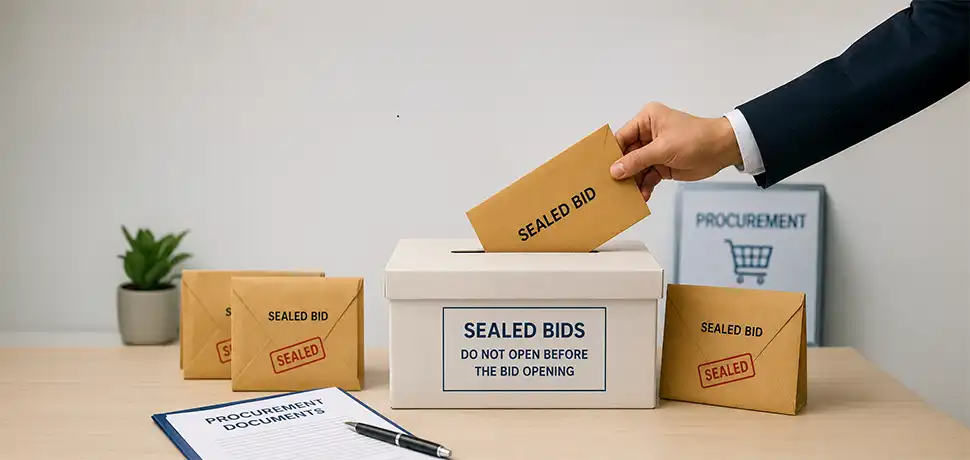
In a sealed bid event, every supplier submits their pricing without seeing what anyone else has offered. The bids stay locked until the submission window closes. Then the buying team opens everything at once and scores each response against the same published criteria.
The format removes one variable that distorts pricing in open auctions: knowledge of the competition. A supplier in a sealed bid can’t anchor to someone else’s number. They can’t wait to see the current leader and undercut by 1%. They have to put forward their genuine best offer because they don’t know what genuine best looks like for anyone else at the table.
Sealed Bidding vs Open Bidding: Side-by-Side
Neither format is universally better. The right choice depends on the category, the supplier pool, and what you’re optimizing for.
| DIMENSION | SEALED BIDDING | OPEN BIDDING |
|---|---|---|
Bid visibility | Confidential until deadline | Visible in real time to all participants |
Pricing behavior | Based on supplier’s own cost model | Reactive to competitors’ bids |
Best for | High-value contracts, sensitive relationships, public sector | Commodity categories, price-driven events |
Competitive pressure | Comes from uncertainty | Comes from live leaderboard ranking |
Supplier gaming risk | Low: no anchoring possible | Higher: last-second sniping, incremental undercutting |
Evaluation basis | Multi-factor: price weighted against quality, delivery, and compliance scores | Tends to default to lowest price wins |
Audit trail | Built in: every bid timestamped, opening documented | Depends entirely on whether you used a platform or email |
The sealed format works when you need bids that reflect actual supplier capability, not just willingness to beat the next number on a leaderboard. Open bidding, like what runs on ProcureKey’s eAuction platform, works when you want live price competition to compress negotiation time. Different tools for different categories.
How the Sealed Bid Process Works
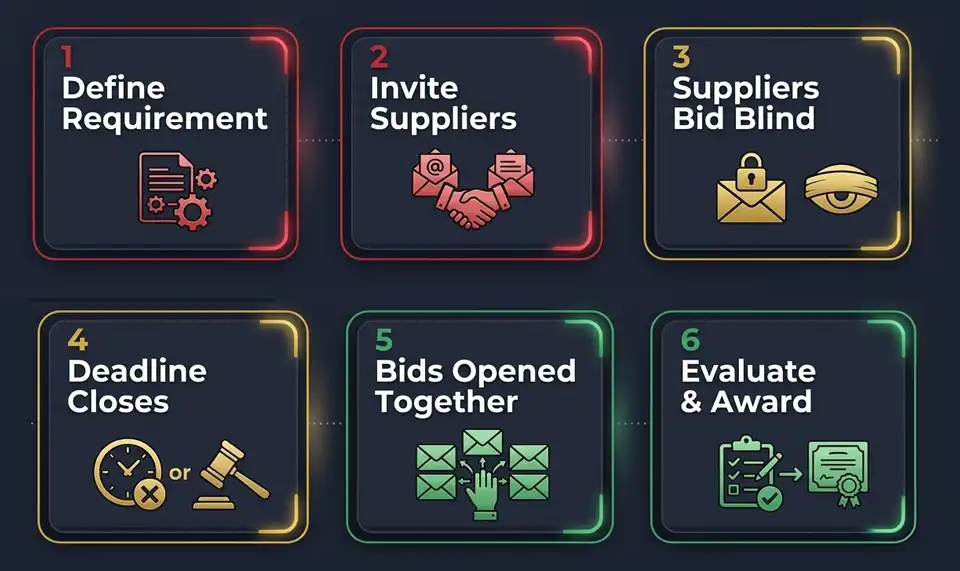
It starts with a defined requirement. Spec, quantity, delivery terms, evaluation criteria. Everything a supplier needs to price the job without guessing. This typically flows from an internal purchase requisition that’s been approved and converted into a sourcing event.
Suppliers receive the bid package and a firm deadline. They prepare and submit their response without seeing any other bids. No leaderboard. No ranking. They don’t even know how many other suppliers are bidding. Deadline arrives, everything opens at once, and the evaluation team runs the scoring matrix. If the top two are close, a clarification round narrows it down before the final call.
The whole sequence can take two to four weeks depending on the category complexity. Government procurement agencies sometimes mandate sealed bidding by regulation. Private-sector teams choose it when the situation calls for it.
When Sealed Bidding Is the Right Call
Not every sourcing event needs a sealed bid. An MRO consumables order with a $10K annual spend doesn’t justify the overhead. But there are categories where the sealed format is clearly the better choice.
High-value contracts where suppliers have long-term relationships with your company. If they know your pricing history, open bidding lets them anchor. Sealed bidding neutralizes that advantage. Government and public-sector procurement where sealed bids are often required by regulation. Construction and capital projects where the spec is complex enough that price alone doesn’t determine the best supplier. Manufacturing categories where quality scoring and delivery reliability matter as much as cost. And any situation where supplier relationships are sensitive and you don’t want vendors seeing each other’s pricing.
Why Procurement Teams Prefer Sealed Bids for High-Value Categories
The fairness argument sells itself. Same information, same deadline, same criteria for everyone. No supplier gets a head start from watching somebody else’s number. That matters less to the procurement team running the event and more to the one defending the award decision to internal audit three months later.
But the less obvious benefit is pricing honesty. When a supplier can’t see the competition, they price based on their own margins and capabilities. You end up with a truer picture of what the market will bear for a given spec. That data feeds directly into your supplier management process and informs the next sourcing cycle for that category.
The audit trail is strong by design. Every bid is timestamped. The opening is documented. The scoring matrix is applied uniformly. When the CFO asks why Supplier C won a $300K contract, the answer is a documented evaluation, not a verbal explanation.
Running Sealed Bids on Procurement Software
Sealed bidding run over email is sealed bidding in name only. If bids arrive in different formats, at different times, into different inboxes, and get opened by whoever happens to check first, you’ve lost the controls that make the format valuable. Procurement software like ProcureKey’s RFx management platform puts those controls in a system.
Suppliers submit through a portal against a structured template. Bids lock automatically at the deadline. Nobody on the buying team can view submissions before the cutoff. When the window closes, all bids become visible simultaneously and the evaluation scoring runs against the criteria the team defined upfront. The decision trail is built into the workflow, not reconstructed after the fact from forwarded emails.
A sealed bid run through email is theater. A sealed bid run through a controlled platform is procurement.
You won’t use sealed bidding for every category. A $10K MRO order doesn’t need it. But when the contract is worth $300K, when the supplier relationships are sensitive, when you need pricing that reflects real costs instead of competitive posturing, sealed bids deliver a cleaner result and a stronger paper trail than any open format. ProcureKey runs sealed bid events alongside open eAuctions, RFQs, and multi-attribute scoring, all inside Microsoft 365.