


Category
Strategic SourcingDate Posted
March 31, 2026The Bid Evaluation Problem Nobody Talks About
Here’s something that should embarrass procurement teams at companies spending $100M+ on external goods and services: the moment bids arrive, the evaluation process falls apart. Not because people don’t know how to evaluate. Because the tools they’re using weren’t built for the job.
Engineering scores technical bids in one spreadsheet. Finance builds a pricing comparison in another. Procurement tries to merge the two, but the scoring scales don’t match and one evaluator used a 10-point system while another used 5. Three days of consolidation. A formula error nobody catches. And the award recommendation goes to leadership on a file that two people trust and everyone else quietly questions.
That’s not a talent problem. It’s a tooling problem. And it’s exactly what bid evaluation tools are supposed to fix — if you pick the right one.
Eight Features That Separate Useful Bid Evaluation Tools from Expensive Shelfware
Not every feature on a vendor’s demo checklist deserves your attention. Some are foundational. Some are nice-to-have. And some sound impressive until you realise nobody on your team will use them. Here’s what actually moves the needle.
1. Weighted Scoring and Auto-Calculated Results
This is non-negotiable. You define the evaluation criteria — technical capability, pricing, delivery, compliance, whatever matters for this event — and assign a weight to each. Evaluators score. The tool calculates the weighted total automatically. No formula errors. No mismatched scales. No “let me just check the SUMPRODUCT one more time.” The moment you remove manual calculation from bid evaluation, two things happen: speed increases and scoring disputes decrease. Both matter.
2. Side-by-Side Supplier Comparison
Five suppliers. Twelve evaluation criteria. You need to see them next to each other in a single view — filterable, sortable, with the ability to drill into a specific criterion and compare how each vendor responded. This sounds basic. But ask yourself: when was the last time your team had this without somebody building it manually in Excel? The comparison dashboard is the feature evaluators actually use during the committee meeting. If it’s not clear and instant, people default to gut feel. And gut feel is how you end up defending an award you can’t trace.
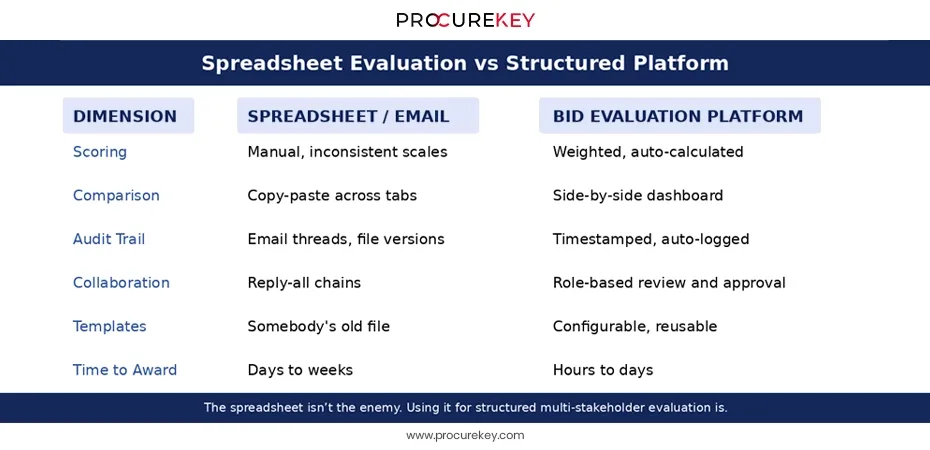
The spreadsheet isn’t the enemy. Using it for structured multi-stakeholder evaluation is.
3. Compliance Documentation and Audit Trail
Every score, every comment, every evaluator’s individual rating — timestamped and logged. Not reconstructed from memory two weeks after the award. Built as the evaluation happens. For teams in regulated industries, public sector, or any environment where procurement decisions get audited, this isn’t a feature. It’s a requirement. And the bid evaluation tools that treat compliance as an afterthought — “you can export a report later” — are the ones that create problems when audit actually shows up.
4. Multi-Stakeholder Collaboration and Approval Workflows
Bid evaluation is never one person’s job. Engineering evaluates technical fit. Finance checks the commercial terms. Operations cares about delivery timelines. Legal reviews risk clauses. The tool needs to let each stakeholder score their assigned criteria without seeing the others’ scores prematurely — then consolidate automatically when the window closes. And the approval workflow that follows the scoring needs to be configured, not improvised over email. “Who needs to sign off?” shouldn’t be a question you answer differently every time.
5. Integration with Your Existing Stack
A bid evaluation tool that doesn’t connect to your ERP, your procurement management system, or your contract repository is an island. Award data should flow downstream to generate POs without re-keying. Supplier master data should sync, not get re-entered. If integration requires a six-month IT project, the tool is adding work, not reducing it. Ask about API availability and pre-built connectors for SAP, Oracle, Microsoft Dynamics during the evaluation — not after you’ve signed.
6. Configurable Evaluation Templates
A capital equipment RFP doesn’t use the same evaluation criteria as an IT services tender. The tool should let you build, save, and reuse templates for different event types — with category-specific criteria, scoring scales, and evaluator assignments already configured. This isn’t about convenience. It’s about consistency. When every project team invents their own evaluation from scratch, you can’t benchmark, you can’t learn from past events, and you can’t defend the approach when someone asks why this RFP was scored differently from the last one. Pair this with structured RFQ processes and the full sourcing cycle runs on the same framework.
7. Analytics and Reporting That Answer Real Questions
How long does our average evaluation take? Which categories consistently attract the fewest bids? Where do evaluator scores diverge most? These are the questions procurement leadership needs answered — not just “here’s a pie chart of spend by category.” Good bid evaluation software provides real-time dashboards, exportable reports, and historical data that lets you compare performance across events. The analytics should tell you where the process is slow, where scoring is inconsistent, and where you’re leaving value on the table.
8. Scalability and Role-Based Access
A tool that works for a five-person team running three events a month might collapse when you need forty evaluators across four departments scoring a complex tender. Role-based access matters — not everyone needs to see everything. Engineering doesn’t need pricing data during technical evaluation. Finance doesn’t need technical specs during commercial scoring. And the platform should handle multi-department, multi-entity deployments without a separate instance for each business unit.
How to Prioritise Features for Your Organisation
Not every feature above carries equal weight for every team. A 50-person procurement function at a manufacturing company with 200 active suppliers has different priorities than a 10-person team at a professional services firm. And that’s fine. The wrong move is treating every feature as equally important and buying the platform with the longest checklist.
Start with what breaks most often. If your evaluations stall because three stakeholders can’t coordinate scoring, collaboration and workflow should be at the top of your list. If audit findings keep surfacing in internal reviews, compliance and audit trail capability is your first filter. If every RFP evaluation starts from a blank spreadsheet because nobody saved a template from the last one, configurable templates will save your team the most hours in the first quarter.
Company size matters here too. A mid-market team running 15 events a quarter needs speed and usability above all else. An enterprise function managing cross-border tenders across business units needs scalability, role-based access, and ERP integration as non-negotiables. Match the tool to where you are, not where a vendor’s roadmap says you should be.
And the biggest trap: evaluating bid evaluation tools against a feature checklist and picking the one with the most ticks. That’s how you end up with software that does thirty things and your team uses four. Buy for your actual bottleneck. If strategic sourcing is the broader goal, make sure the evaluation tool connects to the rest of the sourcing workflow — not just the scoring step.
Four Pitfalls When Choosing Bid Evaluation Tools
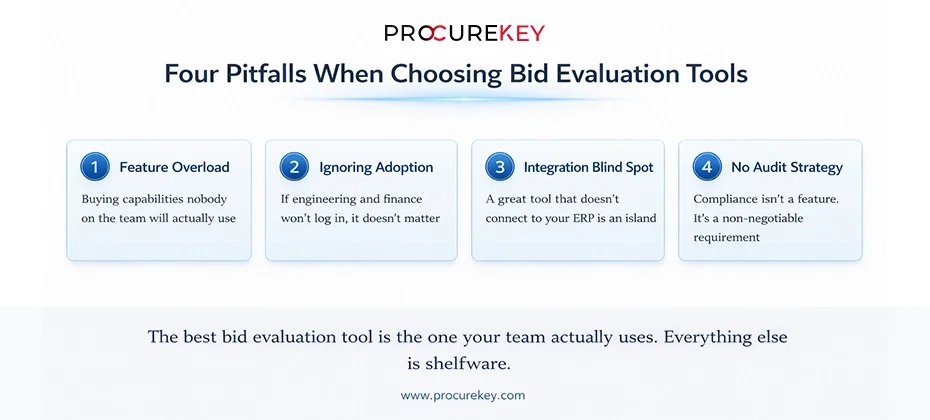
Buying for the demo, not the workflow
Demos are designed to impress. The real test is whether your team — including the occasional users in engineering, finance, and legal who score one event per quarter — can figure out the tool without three days of training. If the interface is too heavy for non-procurement stakeholders, adoption plateaus within months. Half the team goes back to email. You’re paying for a platform that runs at 40% utilisation.
Ignoring the people who actually score
Procurement picks the tool. But procurement isn’t the only user. The evaluators who determine which supplier wins — technical leads, operations managers, finance analysts — need to find the tool approachable on first use. If they don’t, they won’t log in. And offline evaluations sent via email defeat the entire purpose.
Treating integration as a phase-two problem
It’s never phase two. If the bid evaluation tool can’t connect to your ERP at launch, it won’t connect six months later either. The award data will get re-keyed manually. The supplier records won’t sync. And you’ll have one more system that creates work instead of reducing it.
Underestimating the audit requirement
Every procurement team says “yes, we need an audit trail” during the buying process. Then they test for it last. Compliance should be evaluated first, not because it’s the most exciting feature, but because the cost of getting it wrong is the highest.
Three Things to Do This Quarter
Pull your last five bid evaluations. How many ran through a structured tool with an audit trail? How many ran through email and Excel? The ratio tells you how urgent this is. Identify your two biggest evaluation bottlenecks. Is it scoring consolidation? Stakeholder coordination? Comparison formatting? Buy a tool that fixes those two things first. Everything else is secondary. Run one event through a platform before you commit. Pick a mid-complexity RFP, run the evaluation digitally, and compare the experience and audit trail to what your team did manually last time. Let the difference make the case.
The bid evaluation step is where procurement decisions actually get made — and where most organisations are still running on tools that weren’t designed for the job. Weighted scoring, structured comparison, stakeholder collaboration, and a defensible audit trail aren’t luxuries. They’re the baseline. The right bid evaluation software handles all of that without adding process overhead that slows everything down.
The features matter. But what matters more is whether the tool fits how your team actually works — not how a demo suggests you should work. Start with your biggest bottleneck, get the evaluation process right, and build from there. ProcureKey was built for exactly that transition: moving bid evaluation from scattered spreadsheets into a structured, auditable process inside the sourcing workflow. If that’s the gap you’re looking to close, it’s worth seeing how it works.
 17th, June 2026 | 12:00 PM EST
 30 Min + Q&A