
Category
eTenderDate Posted
July 9, 2026Over 70% of public procurement in the EU now runs through electronic platforms. In the private sector, that number is climbing fast — especially among organisations that have realised their paper-based tendering process costs more in delays and compliance risk than the software to replace it ever would. An etender is, at its core, a tender published, managed, and evaluated through a digital platform instead of physical documents and manual processes. That’s the short definition. But the reason procurement teams are making the shift goes well beyond convenience — and beyond any single feature. This guide covers what an electronic tender actually involves, how etendering works in practice, the types of etenders you’ll encounter, the mistakes that trip teams up on their first attempt, and a pre-launch checklist you can use before your next event.
What Is an eTender?
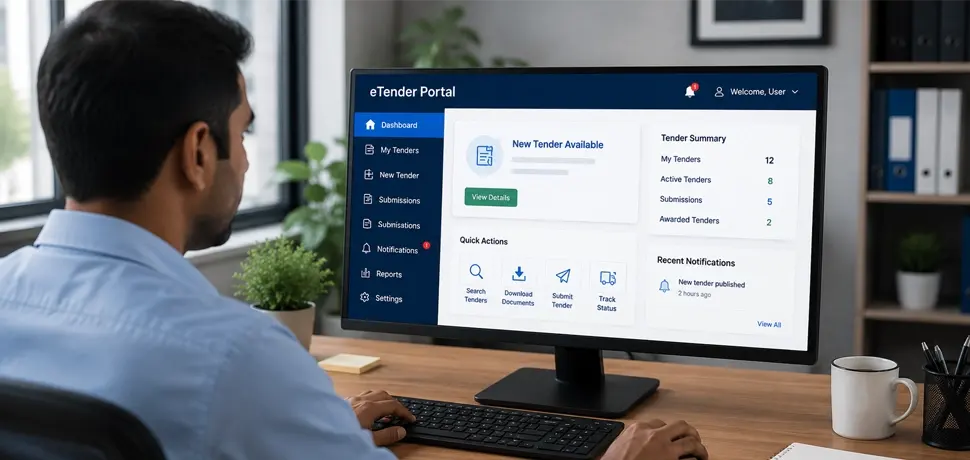
So what is an electronic tender, really? It’s a formal invitation to suppliers to bid on a piece of work — but instead of printing documents, stuffing envelopes, and praying the courier doesn’t lose them, the entire thing runs through a digital platform. The tender goes out digitally. Suppliers respond through the same system. Evaluation happens inside it. Award notification, debrief, compliance record — all in one place. Nobody’s chasing email attachments at 11pm the night before a deadline.
Here’s what actually makes an etender different from just attaching an RFQ to an email and hitting send to five suppliers. First, bids come back in a structured format — so you’re comparing apples to apples, not deciphering one supplier’s PDF against another’s Excel dump. Second, the evaluation criteria are configured before the event goes live, with weights and scoring scales that every evaluator follows. Third — and this is the one that matters most when audit comes knocking — every action by every party is logged with a timestamp. Who opened what. Who submitted when. Who scored how. And fourth, the deadline is the deadline. The system locks out late submissions automatically. No awkward conversations about whether to accept a bid that arrived 20 minutes after close.
If you’re still running tenders through email and shared drives, you already know the problems. Version control nightmares. Supplier responses in six different formats. An evaluation that depends on whoever built the spreadsheet. An e-tender fixes all of that — not by adding process overhead, but by replacing the unstructured mess with a framework that makes the whole cycle faster and auditable.
Types of eTenders
Not every e-tender follows the same format. The type you choose depends on the category, the supply market, how much competition you want to create, and whether you’re operating under regulatory constraints that dictate the process. Here are the four most common.
Open Tender
Published publicly. Any qualified supplier can respond. Best for categories where you want maximum competition and don’t have a pre-established supplier panel. Government and public sector procurement frequently uses this format to meet transparency requirements. The e tendering platform handles the volume — receiving, organising, and scoring submissions from dozens of bidders without manual intervention.
Restricted Tender
Only pre-qualified suppliers are invited to bid. You’ve already vetted the vendor pool through a prior qualification round, and the e-tender goes out to a shortlist. This is typical for complex or high-value categories where you need confidence in the supplier’s technical capability and financial stability before they see the specification.
Request for Quotation (RFQ)
Simpler in scope than a full tender. You’re asking suppliers to quote on a defined requirement — quantities, specs, delivery terms — without the broader commercial and technical evaluation that a formal etender involves. Most etendering platforms support both formats natively. ProcureKey’s purchase requisition software connects directly to the RFQ workflow so the requirement flows from request to competitive event without re-keying.
Reverse Auction
Suppliers compete in real time by bidding the price down. Not technically a tender in the traditional sense, but many procurement teams treat it as a type of etender for categories where the specification is locked and price is the primary differentiator. ProcureKey’s eAuction management software handles the live event, supplier ranking, and post-auction reporting.
How the e-Tendering Process Works
Suppliers compete in real time by bidding the price down. Not technically a tender in the traditional sense, but many procurement teams treat it as a type of etender for categories where the specification is locked and price is the primary differentiator. ProcureKey’s eAuction management software handles the live event, supplier ranking, and post-auction reporting.
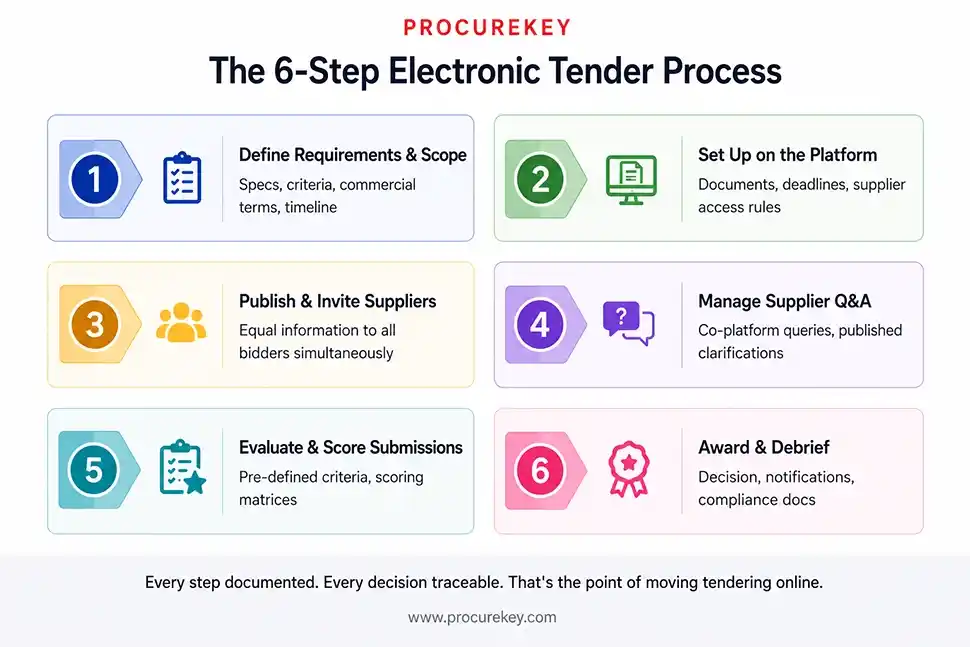
Define Requirements and Scope
Set Up the eTender on the Platform
Publish and Invite Suppliers
Manage Supplier Q&A
Evaluate and Score Submissions
Step 6: Award and Debrief
Ready to Run Your First eTender?
Benefits of eTendering
Time and cost reduction
A paper-based tender cycle runs 4–8 weeks on average. An e tender on a configured platform compresses that to 1–3 weeks depending on complexity. The printing, courier, and manual collation costs disappear entirely. For teams running 20+ tenders a year, the operational savings alone justify the platform. One mid-market manufacturing team cut their average cycle from 6 weeks to 11 days after making the switch — without adding headcount.
Transparency and audit trail
Every action inside the etender is logged. Who accessed the documents. When bids were submitted. What scores each evaluator assigned. The audit trail builds itself as the process runs — not as a retrospective exercise when someone from compliance comes asking questions six months later. This is the feature that procurement directors care about most. Not because they love documentation. Because it’s the only way to defend an award that gets challenged.
Wider supplier reach
An e tender published on a digital platform is visible to a far broader pool than one distributed through the buying team’s personal contact list. More competition. Better pricing. And suppliers who might be the best fit for the requirement but didn’t happen to know someone in your building. International vendors who would never have been contacted through a manual process suddenly become viable candidates.
Compliance and risk reduction
For public sector and regulated industries, the compliance requirements around tendering are non-negotiable. Equal treatment of bidders, documented evaluation, transparent award decisions. These platforms are built specifically to enforce those rules — which is why procurement teams in government, healthcare, and education adopted the digital format before the private sector caught up. For organisations in the private sector catching up now, the good news is that the same infrastructure that satisfies government-grade compliance also makes commercial tendering dramatically faster.
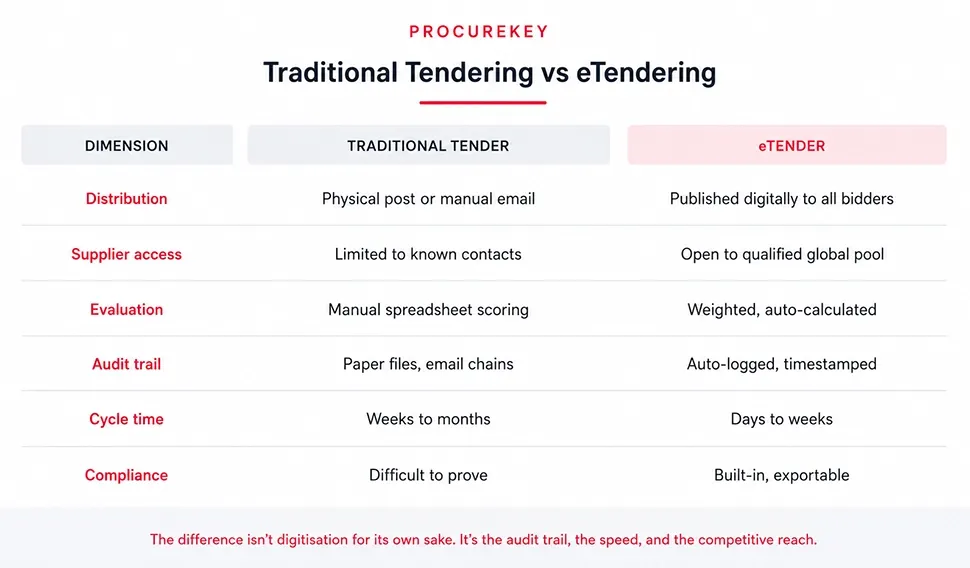
eTender vs Traditional Tender: The Differences That Matter
The comparison table above covers the mechanics. But the real difference isn’t about paper versus screen. It’s about outcomes. An etender produces a defensible award decision backed by a timestamped record of every evaluator’s score. A traditional tender produces a filing cabinet and email threads nobody can reconstruct. That’s the gap.
So where does a traditional process still work? Simple, low-value purchases with low compliance pressure and a small supplier pool. But the moment an e tender involves multiple evaluators, technical complexity, or regulatory scrutiny, the manual process starts cracking. And the cracks cost money — in rework, in delayed awards, in challenged decisions. E tendering doesn’t just digitise the existing process. It creates a process that didn’t exist before: structured, consistent, auditable, and fast enough that your team can run competitive events for categories that used to default to single-source.
Common Mistakes in e-Tender Management
Vague scope documents
If your specification reads like a wishlist instead of a requirement, suppliers will bid against their own interpretation. And you’ll spend the evaluation trying to compare things that aren’t comparable. The fix is boring but essential: lock down the specification before the e tender goes live. Not during. Not after.
Running Q&A through email
The moment one supplier question goes to a personal inbox instead of the platform, the audit trail breaks. And if that question leads to a scope clarification that only one bidder receives? You’ve compromised the process. Every Q&A interaction needs to live in the etendering platform.
Skipping evaluation criteria definition
Deciding how you’ll score after the bids arrive is a recipe for bias claims. The evaluation criteria, the weights, the scoring scale — all of it needs to be defined and documented before the etender is published. Not because it’s best practice. Because it’s the only defensible approach.
Ignoring supplier access equality
If one supplier gets a briefing call that the others don’t, or receives the specification a day early, the integrity of the etender is compromised. Equal access isn’t a nice-to-have. In public procurement, it’s a legal requirement. In private sector, it’s the difference between a clean award and a supplier challenge you can’t defend.
eTender Checklist: Before You Launch
- Specification locked and approved by all stakeholders
- Evaluation criteria defined with weights and scoring scale
- Timeline set — including Q&A period and bid submission deadline
- Supplier shortlist finalised (restricted) or publication channel confirmed (open)
- All supporting documents attached — technical specs, commercial terms, compliance questionnaire
- Platform configured — access rules, deadline enforcement, auto-notifications tested
- Q&A process defined — on-platform only, with clarification publishing rules
- Evaluation committee briefed on criteria and scoring methodology
- Award notification and debrief templates ready
- Compliance sign-off obtained on the etender process and documentation
The etender isn’t a technology upgrade. It’s a process upgrade that happens to require technology. The teams that get the most value from etendering are the ones that use the platform to enforce the discipline they always wanted but couldn’t sustain manually — structured evaluation, equal treatment, documented decisions, and a process that holds up when challenged. Every other benefit flows from that foundation.
If you’re still running tenders through email and spreadsheets, the gap between your process and what’s possible with an e-tender platform is wider than you think. And with platforms that go live in days — not months — the barrier to making the switch is no longer cost or complexity. It’s just deciding to do it.