
Category
Construction SourcingDate Posted
July 7, 2026When we walked through what actually happened, the story was painfully familiar. She’d sent the RFQ by email. Two of the five mills she invited never responded because the message got buried under a hundred other project emails. Her analyst built a comparison spreadsheet that had a broken VLOOKUP nobody spotted for a week. And then the approval package sat on a director’s desk in Jeddah while he was in Dubai for nine days. By the time the PO went out, the supplier’s price had moved and the whole negotiation started over. Seven weeks of dead time. All of it preventable.
Why Procurement Feels Complicated in Construction
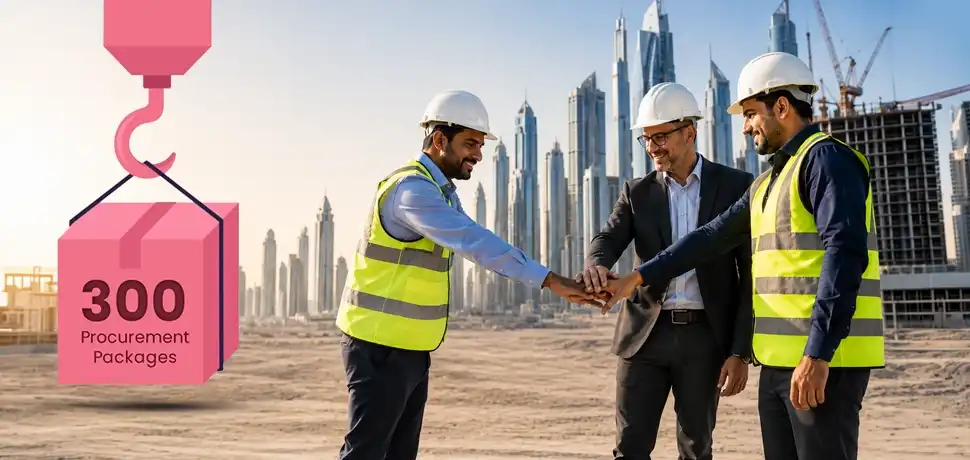
A manufacturing company might run fifty sourcing categories in a year. A single large construction project can blow past three hundred. You’re buying structural steel from a mill in Jubail. Ready-mix from a batching plant twenty minutes from site. Electrical distribution boards from a distributor whose warehouse is in Jebel Ali. Then there’s ceramic tiling, waterproofing systems, elevator packages, fire suppression equipment, landscaping hardscape. The procurement lead on a project like this isn’t managing a supply chain. She’s managing three hundred micro-supply-chains that all have to converge on one site by specific dates.
On top of that, every package above a certain value needs approvals from people who are rarely in the same room. The project manager reviews the technical scope. The QS checks the commercial terms. The client’s rep signs off on behalf of the developer. Finance confirms budget. That’s four people in three cities looking at the same document through email forwards. The approval isn’t the bottleneck. The invisibility is. You can’t chase what you can’t see.
What’s Changing in 2026
Two things are pushing construction procurement teams toward digital tools this year, and neither of them is optional. The first is volume. Saudi Arabia’s Vision 2030 pipeline alone has hundreds of billions of dollars in active projects. NEOM, The Red Sea, Diriyah Gate, Jeddah Tower, the Riyadh Metro extensions. The sheer number of procurement packages each project generates has outgrown what email and spreadsheets can handle. A procurement team of five running three hundred packages manually isn’t slow. It’s physically impossible.
The second force is coming from the client side. Government-backed developers and sovereign wealth funds have started requiring digital procurement records as part of the contract. Structured bid evaluations. Documented approval chains. Audit trails that prove who made which decision and when. This isn’t a preference anymore. It’s a contractual condition. If your procurement process can’t generate these records automatically, you’re going to have a harder time winning the next bid.
How Digital Procurement Actually Helps on the Ground
Requisitions that move on their own
RFQs that reach the right suppliers
Live competition that moves prices
Everything in one place
See How Construction Teams Run Sourcing on ProcureKey
MENA-Specific Challenges That Make This Harder
The projects here are enormous. A mega-development in NEOM or along the Red Sea coast might have two hundred active procurement packages running at the same time. Each one with a different supplier base, a different approval chain, a different critical path date. Trying to manage that volume on spreadsheets isn’t just difficult. It genuinely cannot be done without things falling through the cracks. And on a project of that scale, one package falling through the cracks can mean a contractor claim worth more than the entire procurement team’s annual budget.
Cross-border sourcing adds complexity that doesn’t exist on a domestic project. A tower in Abu Dhabi sourcing structural steel from Turkey, MEP equipment from a manufacturer in Stuttgart, and finishing materials from Guangzhou is dealing with three currencies, three shipping schedules, and three different sets of import paperwork. The procurement team has to track all of that without losing sight of any individual package.
Then there’s compliance. UAE free zone regulations differ by emirate. Saudi Aramco’s IKTVA programme has localisation requirements that affect supplier eligibility. Government-linked projects in the GCC increasingly require that procurement data stays within specific jurisdictional boundaries. A platform that doesn’t handle data security and residency requirements properly is going to create headaches instead of solving them.
What Better Procurement Looks Like
Go back to that Riyadh tower project from the introduction. Same structural steel package. But this time the procurement lead runs it through a digital platform instead of email. She sends the RFQ to six pre-qualified mills on Sunday morning. All six get the same specification document, the same pricing template, and the same Thursday deadline.
By Thursday afternoon, six responses are in. The comparison is already built because every supplier submitted in the same format through the same portal. The evaluation takes an afternoon. Price weighted at 60%. Delivery capability at 25%. Past performance at 15%. The QS and the PM review the weighted ranking together on a screen instead of emailing spreadsheets back and forth for three days. Approval routes to the director automatically. He reviews it on his phone between meetings in Dubai. Signs off Thursday evening. PO goes out Sunday. Total time from RFQ to PO: eight business days. Not eleven weeks. Same team. Same suppliers. Different process.
How ProcureKey Fits Into the Picture
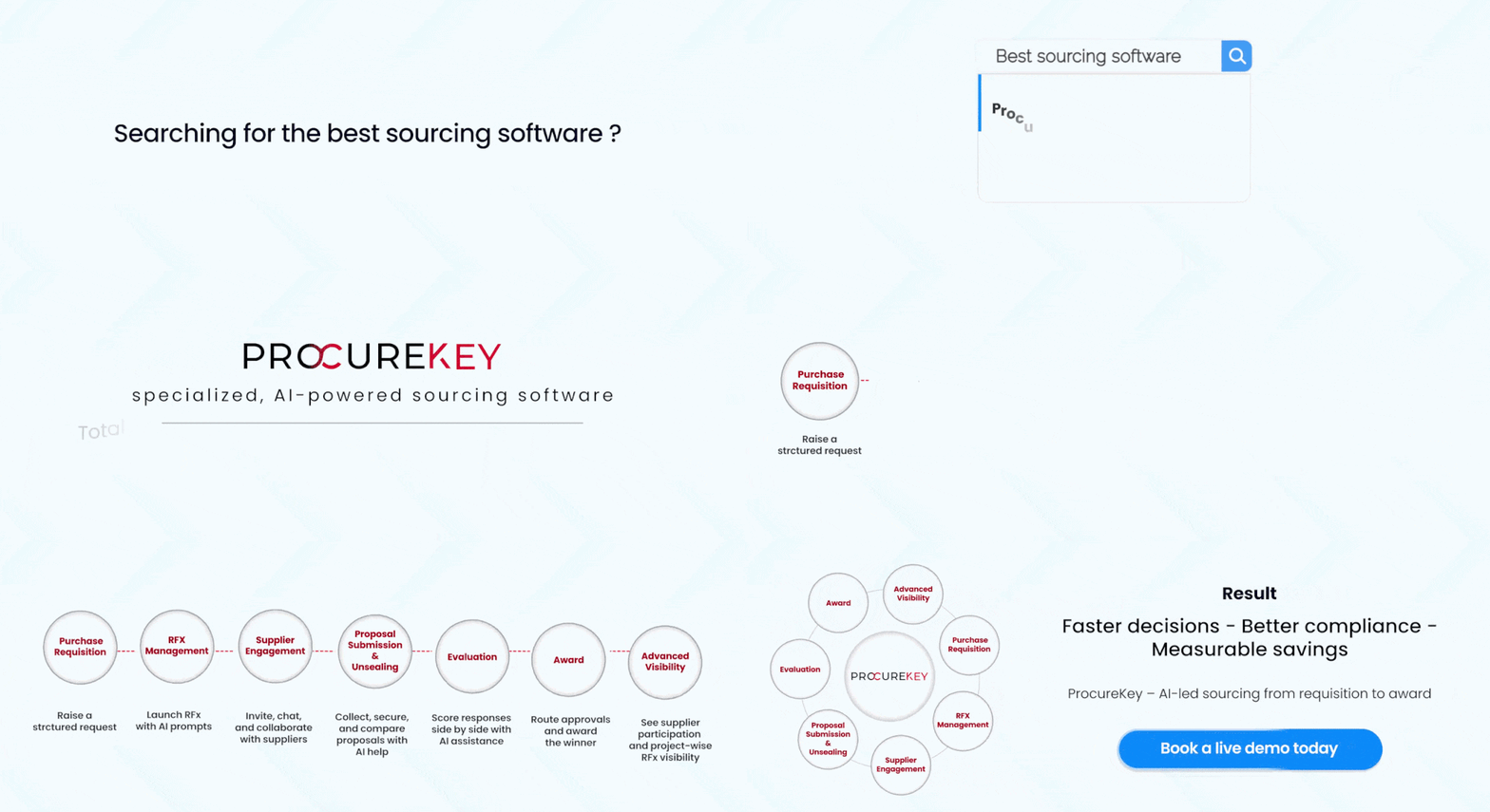
ProcureKey runs inside Microsoft 365, which most construction companies in the Gulf already use for everything else. That matters because it means no separate system to deploy, no new credentials to manage, and no IT project that takes six months before procurement can start using it. Purchase requisitions route through structured approval workflows with automatic escalation when an approver doesn’t respond within a configurable timeframe. RFQs go out through a controlled portal. Reverse auctions drive competition on the high-value packages. And the AI module flags unusual pricing patterns, suggests evaluation criteria based on what worked on similar past events, and identifies categories that haven’t been competitively sourced yet.
On the supplier side, everything is centralised in one database. Qualification status, certifications, performance history, category mapping. When your team needs to find three more concrete suppliers for a new project in Jeddah, the answer is a filtered search. Not a phone call to whoever worked on the last job hoping they remember a name.
Construction procurement in the MENA region is only going to get more demanding. Projects are getting larger. Client documentation requirements are getting stricter. And the procurement teams running these programmes are not getting bigger. The gap between the volume of sourcing work and the capacity to manage it manually is already wide on most projects, and it grows every quarter. The companies that close it will be the ones that moved their sourcing onto a structured platform while their competitors were still sending RFQs over email and chasing approvals on WhatsApp. Start the conversation.