


Category
Strategic SourcingDate Posted
April 2, 2026Here’s a stat that should bother every mid-market procurement leader: AI eSourcing can cut sourcing cycle time by 30–50%. Not over a year. Per event. And yet most teams with fewer than 2,500 employees are still running sourcing out of email and Excel. Not because they don’t know better. Because until recently, the tools that could actually deliver this kind of improvement cost more than the team’s annual budget and took six months to implement.
That’s changing. Fast. And the mid-market teams that figure this out first are going to have a structural advantage over the ones still copy-pasting RFQ templates from 2019.
What eSourcing Looks Like Today — Honestly
Let’s call it what it is. Most mid-market procurement teams run sourcing through email, Excel, SharePoint folders, and the occasional desperate WhatsApp message. Supplier responses come back in twelve formats. Somebody builds a comparison spreadsheet. It breaks. The evaluation takes a week. By the time the award decision lands, the project team has already ordered from whoever picked up the phone first. Sound familiar? It’s not a competence problem. Five people managing $80M in spend can’t build structured sourcing events from scratch every time. Enterprise platforms cost too much. Free tools don’t do enough. If you’ve ever wondered why Excel keeps showing up as the sourcing platform despite everyone knowing its limitations — this is why. No realistic alternative at the right price point. Until AI changed the economics.
Where AI Actually Makes a Difference in eSourcing
Let me be direct about what AI does and doesn’t do here. It doesn’t replace the procurement team. It doesn’t make supplier decisions for you. And it’s not a magic button that turns a chaotic process into a clean one overnight.
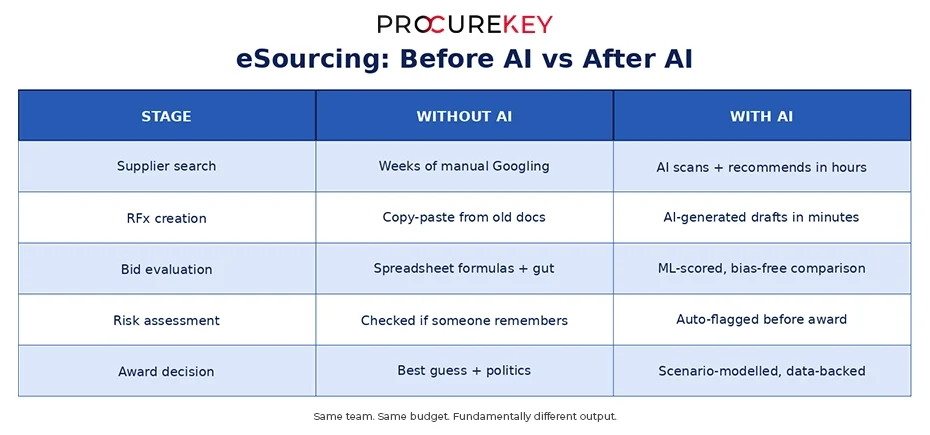
What it does is compress the manual, repetitive, data-heavy work that eats 70% of a sourcing analyst’s week. Finding qualified suppliers for a new category. Generating a structured RFQ from scratch instead of reworking an old one. Normalising 15 bids that came in 15 different formats so your evaluation committee can actually compare them. Flagging a supplier whose credit rating dropped two notches last quarter — before you award them a contract. That’s what AI eSourcing actually delivers when you strip away the buzzwords.
That’s the gap AI closes. Not judgement. Bandwidth. A five-person mid-market procurement team running AI-driven eSourcing has the analytical capacity of a team three times that size. The decisions are still human. But the data that feeds those decisions is structured, complete, and available in hours instead of weeks. And the best part for mid-market teams? The new generation of AI-powered sourcing platforms deploys in days, not months. The barrier to entry has dropped dramatically — and the teams that recognise this are moving while their competitors are still debating whether to run another Excel-based RFQ.
Five AI Use Cases That Actually Matter
Not theoretical. Not “coming soon.” These are the capabilities that mid-market teams are using right now to run sourcing events that would’ve been impossible with their headcount two years ago.
1. Supplier Discovery That Doesn’t Eat Your Week
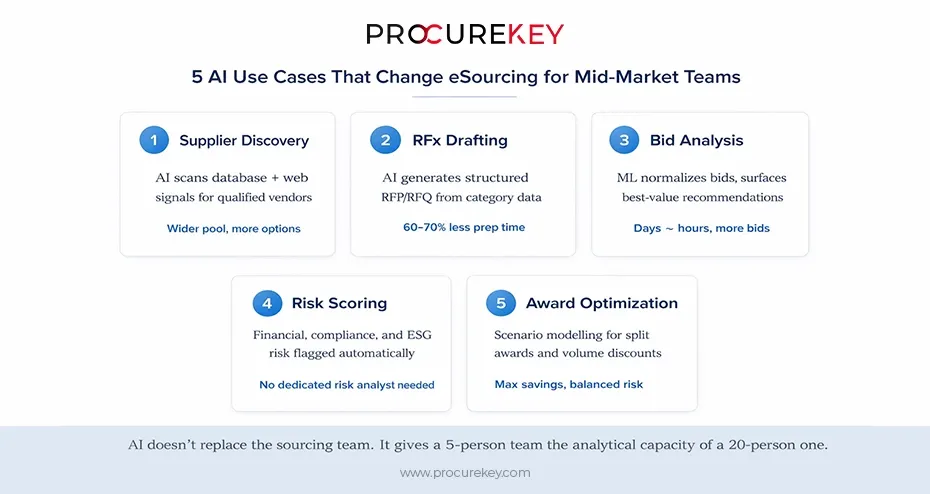
Your incumbent just failed an audit and you need alternatives. Fast. The old way: days of Googling, calling contacts, hoping somebody has a referral. AI scans supplier databases, public filings, and web signals to surface qualified vendors you’d never find manually. A category manager at a 400-person manufacturer identified 14 pre-qualified suppliers for packaging in under two hours. Manually? Two weeks. Minimum.
2. RFx Drafting That Doesn’t Start From a Blank Page
Every RFQ is about 70% the same as the last one. Structure, evaluation criteria, supplier instructions, compliance clauses — all repeating work. AI-driven eSourcing tools generate structured drafts based on category and requirements. A day and a half of prep becomes 30 minutes of review. For a team still running RFQs through email, that changes what’s possible with the headcount they have.
3. Bid Analysis That Removes the Spreadsheet Gymnastics
Twelve suppliers. Eighty line items. Bids in three formats. Your analyst spends two days normalising data before the evaluation even starts. AI does it in minutes — maps responses to criteria, normalises pricing, flags the unit price that’s 40% below every other bid. Produces a scored comparison the committee can work from immediately. Days to hours. Bias removed.
4. Risk Scoring Before the Award, Not After
Mid-market teams rarely have a dedicated risk analyst. So supplier risk gets checked reactively — after the award, if at all. Credit rating tanked? Nobody noticed. ESG compliance lapsed? Not on anyone’s radar. AI flags financial health, compliance status, and delivery performance automatically before the award decision. One healthcare sourcing team caught a preferred supplier’s financial deterioration that would’ve taken an external audit to surface. The tool paid for itself on that single event.
5. Award Optimisation Beyond “Pick the Cheapest”
Split awards. Volume discounts. Regional allocation. The maths behind an optimal multi-supplier award is genuinely complex — and most teams solve it by instinct. AI runs the scenarios in minutes: full award to Supplier A, 60/40 split between A and B, three-way with regional allocation. Total cost, risk, and capacity side by side. This is where structured RFQ processes paired with AI create the biggest step-change for mid-market teams.
Why Mid-Market, Why Now?
Two years ago, AI eSourcing was enterprise-only. The platforms cost $200K+ annually, required six months of implementation, and assumed you had a team of 30 to operate them. That excluded 90% of the companies that actually needed the help most.
What’s changed? Three things. First, cloud-native platforms brought the implementation timeline from months to days. Second, AI models got good enough to handle real procurement complexity — not just keyword matching, but actual bid analysis and supplier scoring. Third, pricing shifted to per-user and per-event models that a $50M–$500M company can justify to finance without a capital request.
And here’s what mid-market procurement leaders are starting to realise: AI sourcing doesn’t just make existing processes faster. It makes processes possible that weren’t before. A $200K category wasn’t worth running a competitive event when the manual overhead was three weeks. When AI compresses that to two days, the calculus changes. Categories that were always single-sourced because “we don’t have time” become candidates for competition. Spend under management goes up.
See How AI-Powered eSourcing Works for Teams Your Size
What to Look for When You’re Buying
Not every “AI-powered” eSourcing tool is the same. Some have genuine machine learning behind the bid analysis. Others slapped “AI” on a keyword search and called it supplier discovery. The AI sourcing market is full of inflated claims. So ask to see the bid analysis work on your data — not a demo dataset. Your actual category, your actual messy supplier responses. If it only works on pre-cleaned inputs, it’s marketing.
Then check two things. Time-to-value: if implementation takes more than two weeks, it’s enterprise-built and you’re paying for complexity your team doesn’t need. Mid-market tools go live in days. And what happens after the AI scores — does the platform produce an audit trail, connect to your ERP, give your CFO something exportable? A brilliant scoring engine that produces output nobody can action is a clever dead end.
Three Things to Do This Quarter
Audit your last five sourcing events. How many hours went into supplier identification, RFx drafting, bid normalisation, and evaluation? That total is your AI eSourcing opportunity cost — the hours your team would get back with the right tool. Pick one upcoming category with 3+ suppliers and a clear spec. Run it through an AI-powered platform alongside your existing process. Compare: time to award, pricing outcome, audit trail quality. One event. Side by side. Talk to finance about per-user SaaS pricing, not capital expenditure. The ROI conversation for AI eSourcing is a 30–50% cycle time reduction and measurable savings on the first event. Lead with numbers, not technology.
AI-driven eSourcing isn’t coming to mid-market procurement. It’s here. The teams adopting it now aren’t just running events faster — they’re running events they couldn’t have run at all twelve months ago. Categories that sat with a single supplier because nobody had time to source competitively? Three qualified bids in a structured framework. Spend under management expanding without adding headcount.
The gap between mid-market teams with AI eSourcing and those without is going to look like the gap between teams that adopted eProcurement in 2015 and those that waited until 2020. One group set the standard. The other spent five years catching up.
 17th, June 2026 | 12:00 PM EST
 30 Min + Q&A