


Category
Strategic SourcingDate Posted
April 6, 2026What is an MRO? If you work in procurement, you already know the abbreviation. But here’s what most organisations get wrong: they treat MRO as a low-priority cost centre instead of what it actually is — a spend category that represents 15–40% of total indirect procurement and directly determines whether production lines stay running or grind to a halt. Understanding what is mro in procurement isn’t just a vocabulary exercise. It’s the starting point for fixing one of the most consistently under-managed areas of supply chain spend. And fixing it starts with sourcing definition and process — not just purchasing.
This guide covers what MRO sourcing means in practical terms, breaks down the categories, explains why sourcing MRO is so different from sourcing direct materials, and gives you a 5-pillar framework for building mro sourcing strategies that actually hold up under operational pressure.
What Is an MRO?
What does MRO stand for?
Maintenance, Repair, and Operations. Three words that cover an absurdly broad range of stuff. We’re talking lubricants, spare motors, safety goggles, cleaning chemicals, the toner cartridge somebody ordered at 4pm on a Friday. None of it ends up in whatever your company sells. All of it is required for the business to function tomorrow morning. That’s MRO. The category procurement inherited but nobody designed a process for.
What is MRO in procurement?
So what does MRO actually mean when a procurement team uses the term? It’s all the stuff that keeps the building running and the machines turning but never shows up in the finished product. The indirect category. The one that finance calls “overhead” and operations calls “essential.” And here’s what makes it different from direct materials: nobody builds a category strategy for MRO. Direct materials get sourcing events, approved vendor lists, negotiated contracts. MRO? In most organisations, somebody orders it when something breaks. That’s mro purchasing at its most common — and its most expensive.
And that’s where the real answer to what is mro in procurement gets interesting. Because the category isn’t just about what you buy. It’s about how you buy it. A bearing is a bearing. But a bearing purchased through a managed catalogue at a negotiated price from a preferred supplier costs 40% less than the same bearing ordered as an emergency spot-buy from the nearest distributor at 2am. Same part. Different process. Completely different cost.
MRO sourcing meaning
When procurement professionals talk about MRO sourcing meaning, they’re asking a specific question: how should we apply structured sourcing discipline to a category that’s historically been treated as spot-buy territory? The answer involves supplier rationalisation, category segmentation, catalogue management, and data-driven demand planning. We’ll get into each of those. But the core insight is this: sourcing mro properly requires a different playbook than sourcing direct materials. The volumes are smaller per transaction. The SKU count is enormous. And the urgency is unpredictable. That combination is exactly why most MRO spend flies under the radar.
Types of MRO Categories
Ask ten procurement managers to define their MRO scope and you’ll get ten different answers. That’s part of the problem. Without a clear taxonomy, spend gets misclassified and opportunities for consolidation disappear. Here’s the standard breakdown that most MRO procurement strategy frameworks use.
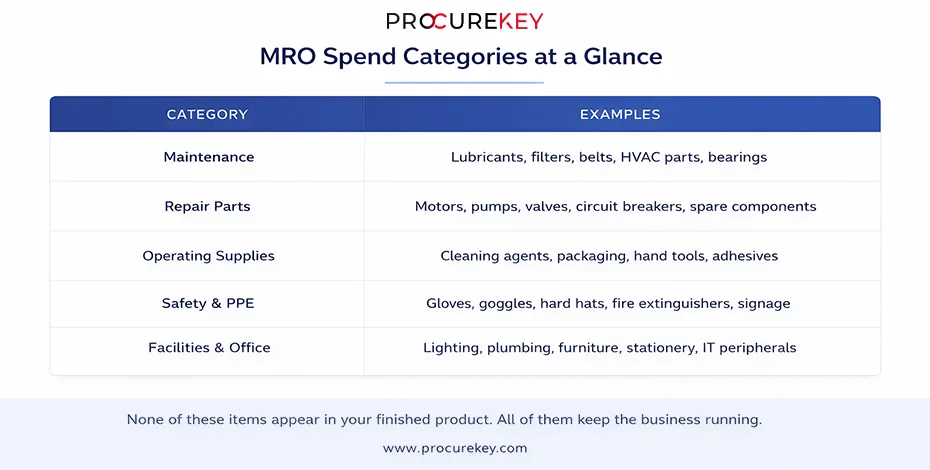
The overlap between categories is where mro purchasing gets messy. A maintenance technician ordering hand tools — is that operating supplies or maintenance? A replacement pump motor — repair or maintenance? The classification matters because it determines which supplier agreement, which budget code, and which approval workflow applies. Without consistent taxonomy, you can’t aggregate demand, can’t negotiate volume terms, and can’t see the total picture.
Why MRO Procurement Is Uniquely Challenging
Direct materials procurement is hard. MRO procurement is hard in a completely different way. And the difficulty is why so many organisations default to “just buy it when we need it” — which costs 15–25% more than a structured approach.
Thousands of SKUs, each worth almost nothing individually
A typical manufacturing plant carries 10,000–50,000 MRO SKUs. Most individual transactions are under $500. The sheer volume makes it impractical to run a competitive sourcing event for every purchase. But in aggregate, those small transactions add up to millions. This is the tension at the heart of every MRO procurement strategy: the individual purchase doesn’t justify process overhead, but the category absolutely does. Ignoring this tension is one of the most common procurement challenges mid-market companies face.
Fragmented supplier base
Without a deliberate rationalisation effort, MRO spend spreads across dozens — sometimes hundreds — of suppliers. Each one is small enough that nobody in procurement pays attention. But collectively? The admin cost of managing 200 MRO suppliers (POs, invoices, deliveries, quality issues) is enormous. And the organisation gets zero volume leverage because spend is scattered.
Maverick spend is the default
Maverick spend — purchases made outside the approved procurement process — is the norm in MRO, not the exception. A maintenance supervisor needs a bearing by tomorrow morning. The procurement process takes three days. So they call the local distributor, pay whatever they charge, and put it on a company credit card. Nobody reviews it. Nobody benchmarks the price. This happens hundreds of times a month at a mid-size manufacturer. And every instance erodes the savings that a proper mro sourcing strategy would capture.
Stockout risk meets overstock waste
Run out of a critical spare part and the production line stops. Overstocking ties up working capital in a storeroom full of items that expire, corrode, or become obsolete before anyone uses them. Ask what is an MRO storeroom really costing you, and the answer is almost always more than anyone expected. The balance is genuinely difficult to get right — especially without historical consumption data and some form of demand planning. Most MRO storerooms are simultaneously overstocked on items nobody needs and understocked on the five things that actually break.
5 Proven MRO Sourcing Strategies
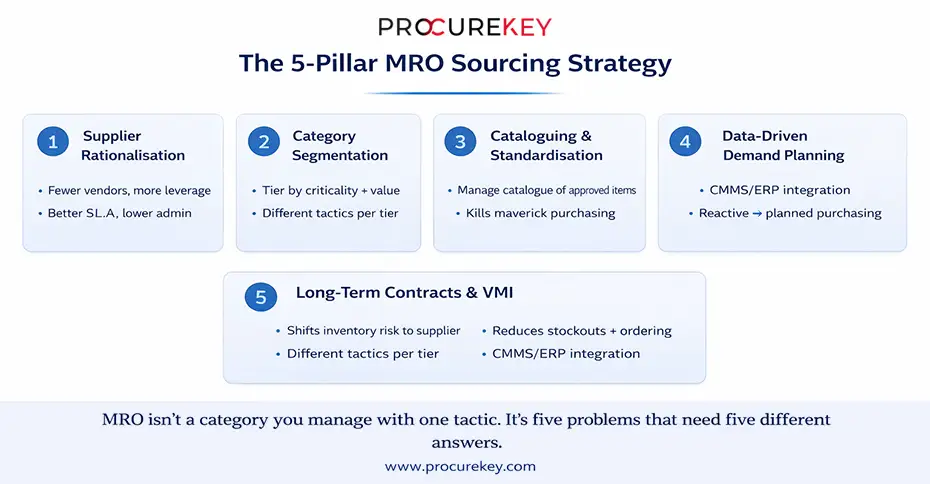
This is where the conversation shifts from “what is an MRO” to “what do we actually do about it.” The 5-pillar framework below covers the mro sourcing strategies that work for organisations managing $5M–$100M+ in MRO spend. Each pillar solves a different piece of the puzzle. Skipping one creates a gap the others can’t cover.
Pillar 1: Supplier Rationalisation
If you’re buying MRO from 200 suppliers, you need 30. Maybe 40. The rest are either duplicative, expensive, or both. Supplier rationalisation means mapping your entire MRO spend, identifying which vendors can cover multiple categories, and consolidating volume onto a core panel. The payoff: volume discounts that didn’t exist when spend was fragmented, fewer POs to process, stronger SLAs because the supplier actually cares about the account size, and a manageable vendor base that procurement can actually govern. Start by running competitive events through a structured RFQ management process for your top 10 MRO categories. That exercise alone will expose how much you’re overpaying on items you buy every month.
Pillar 2: Category Segmentation and Tiering
Ask yourself: should you be spending the same sourcing effort on a custom-engineered impeller for a $2M compressor as you do on toilet paper? Obviously not. But without deliberate tiering, that’s exactly what happens — either everything gets the same light touch (and critical items are under-managed) or everything gets heavy process (and your team wastes weeks sourcing janitorial supplies nobody cares about).
The fix is sorting MRO into tiers. Top tier: high-criticality, high-value items. These get dedicated supplier relationships, safety stock, long-term agreements. Bottom tier: low-value consumables. Catalogue purchasing, approved vendor, competitive event once a year. Done. The middle tier — items that matter but aren’t production-critical — gets periodic competitive review. Match the effort to the risk. Stop treating a $15 box of nitrile gloves and a $4,000 hydraulic cylinder like they belong in the same sourcing workflow.
Pillar 3: Cataloguing and Standardisation
Here’s a scenario every MRO buyer recognises: the same bearing is ordered under four different descriptions, from three different suppliers, at three different prices. Nobody realises it’s the same part. That’s a cataloguing failure. Building a managed catalogue of approved MRO items — with standardised descriptions, part numbers, and approved suppliers — kills maverick spend at the root. If the item is in the catalogue, users order from the approved source at the negotiated price. If it’s not, the request routes to procurement for review. The discipline sounds basic. But it’s the single highest-impact change most organisations can make to their MRO spend. Apply strategic sourcing best practices to build the catalogue correctly the first time, and maintenance doesn’t just get cheaper — it gets faster because people stop wasting time searching for the right part.
Pillar 4: Long-Term Contracts and VMI
Vendor Managed Inventory (VMI) is the underused weapon in MRO sourcing. Think about the items your maintenance team orders every single month without fail. Lubricants. Filters. Gloves. Consumable tools. The same items, the same quantities, the same suppliers — and yet somebody is still raising a PO for them manually every time. VMI flips that. You hand the inventory management to the supplier. They watch the stock levels. They trigger the replenishment. Your team stops carrying excess inventory, PO volume drops 60–80%, and the items that break most often are always on the shelf when maintenance needs them. But here’s the catch that people miss: VMI only works when you have reliable consumption data and a supplier who cares enough about the account to invest in the arrangement. Which is why supplier rationalisation (Pillar 1) comes first. VMI is a tool for strategic partners, not for the local hardware shop you call when the storeroom runs dry.
Pillar 5: Data-Driven Demand Planning
Most MRO buying is reactive. Something breaks, someone orders the replacement. That’s not a strategy. That’s a fire drill that repeats three hundred times a year. And every one of those fire drills costs more than a planned purchase would have.
Here’s what changes when you connect your CMMS (Computerised Maintenance Management System) or ERP to your procurement platform. Suddenly you can see patterns. Those bearings on Line 3? They fail every 90 days like clockwork. Pre-order them. The spare motor that’s been sitting on the shelf for two years untouched? Declassify it. Consumption on cutting fluid spiked 40% last quarter but production volume didn’t? Something’s wrong — investigate before the storeroom budget overruns. The integration between maintenance data and procurement automation is what separates the teams managing MRO proactively from the ones still treating every breakdown like an unpredictable event. It’s not. The data’s been there all along. Nobody was using it.
Ready to Get MRO Sourcing Under Control?
MRO Sourcing Best Practices
The five pillars cover strategy. These best practices cover the operational habits that make the strategy stick day to day. Without them, even the best sourcing framework degrades within six months.
Consolidate before you negotiate
You can’t negotiate MRO pricing effectively if spend is scattered across dozens of suppliers and nobody knows the total. The first step in answering what is mro in procurement at your organisation is data: aggregate your MRO spend by category, by supplier, by site. You’ll find duplication, maverick spend, and price variation on identical items that makes the business case for consolidation obvious. Then negotiate — from a position of knowledge, not guesswork.
Standardise part descriptions and numbering
If the same item exists in your system under five different descriptions, your data is worthless. Standardisation isn’t glamorous. But every other MRO initiative depends on clean data. Get the taxonomy right first. Everything else follows.
Review MRO contracts annually, not on auto-renewal
MRO contracts tend to roll over indefinitely. Prices creep. Service levels drift. And nobody reviews because each contract is “too small to bother with.” Except there are 40 of them. Ask what is an MRO agreement worth reviewing, and the answer is: any agreement that’s been on auto-renewal for more than 18 months. Set a calendar-based review cycle. Even a quick market check once a year keeps pricing honest and gives procurement the leverage to renegotiate terms that have gone stale.
Use consumption data to forecast, not just report
Most organisations have the data to predict MRO demand. They just don’t use it that way. CMMS logs tell you which assets fail most often and what parts they need. ERP tells you consumption rates. Together, they can shift MRO from reactive to planned. The difference between those two modes is the difference between a 2am emergency call and a scheduled replenishment that costs 20% less.
Common MRO Procurement Pitfalls
What is an MRO category that gets managed well? Rare. The question of what is mro in procurement gets answered differently by every department in the building — and that’s half the problem. Here’s what goes wrong most often.
Treating MRO as “too small to manage”
The individual PO is small. The category isn’t. A $30M manufacturer with “unmanaged” MRO is typically overpaying by 15–25% on a spend category worth $3–$6M annually. That’s $500K–$1.5M sitting on the table. Every year. The fix starts with visibility: categorise the spend, aggregate the data, and the business case builds itself.
No preferred supplier programme
Without a defined panel, every buyer picks their own vendor. Prices vary. Quality varies. Lead times vary. And procurement can’t hold anyone accountable because there’s no agreement to hold them to. A preferred supplier programme for the top 10–15 MRO categories captures 80% of the value with 20% of the effort.
Reactive buying as permanent mode
What is an MRO emergency? A $12 bearing that nobody reordered. That bearing becomes a $45 bearing when it arrives by same-day courier because the production line is stopped and the maintenance supervisor needs it now. Emergency purchases cost more than planned ones. Always. Expedited shipping, premium pricing, whatever the nearest distributor charges. Data-driven demand planning (Pillar 5) exists specifically to break this cycle — but it only works if procurement invests in the CMMS integration upfront.
Cataloguing is “somebody else’s job”
It’s procurement’s job. If the catalogue doesn’t exist, users will buy whatever they find. If it’s outdated, they’ll ignore it. Catalogue management isn’t a one-time project. It’s a standing responsibility that directly controls maverick spend.
MRO Procurement Review Checklist
Use this checklist to assess your current MRO programme. If more than three answers are “no,” you’re leaving significant value on the table.
- Total MRO spend aggregated, categorised, and visible to procurement leadership
- Preferred supplier panel established for top 10–15 MRO categories
- Managed catalogue of approved items with standardised descriptions and part numbers
- MRO sourcing strategies defined by category tier (strategic, tactical, catalogue)
- Annual contract review cycle in place for all MRO agreements
- Maverick spend tracked and reported monthly with root cause analysis
- CMMS/ERP consumption data connected to procurement for demand forecasting
- VMI arrangements in place for high-frequency, predictable items
- What is an MRO item? — definition agreed across procurement, maintenance, and finance
- Quarterly review of MRO storeroom inventory for obsolete or overstocked items
So what is an MRO in procurement, really? It’s the spend category that keeps the operation running — and the one that most organisations manage the worst. Not because they don’t care. Because the traditional procurement toolkit wasn’t designed for high-volume, low-value, unpredictable purchasing. The items are too small to source individually and too numerous to ignore collectively. And that contradiction is exactly why a structured approach matters more here than in almost any other category. What is an mro problem worth solving? At most mid-market manufacturers, somewhere between $500K and $2M a year.
The organisations that get MRO right apply structured approaches that match the category’s unique characteristics: supplier rationalisation to create leverage, category segmentation to allocate effort where it matters, cataloguing to kill maverick spend, long-term contracts and VMI to stabilise supply, and data-driven planning to move from reactive to proactive. None of these require massive budgets. They require structured execution. And with the right AI sourcing and procurement software, mid-market procurement teams can manage MRO at a level that would have required an enterprise-scale function five years ago.
 17th, June 2026 | 12:00 PM EST
 30 Min + Q&A