


Category
Strategic SourcingDate Posted
March 24, 2026In 2026, Procurement and sourcing are no longer synonymous buzzwords like before. These are strategic business operations that have a direct impact on competitive advantage, supplier relationships, cost optimization, and compliance. However, a lot of businesses still have trouble understanding the practical distinction between procurement and sourcing, as well as why it’s so important to align both for expansion.
It is not merely academic to comprehend this distinction. It affects how you deploy technology, manage suppliers, negotiate contracts, and produce quantifiable business value.
What’s all covered in the article?
-
What is Sourcing: the brief
-
What is Procurement: the brief
-
What’s the most appropriate way to integrate sourcing and procurement processes in your organisations’ operations.
-
How modern tools are reshaping both functions
-
How can you achieve better cost control, governance, and supplier performance?
CHECKLIST
For quick supplier evaluation
- Regular evaluation
Conduct regular evaluation of your supplier performance
- Create assessment Form
To standardize your evaluation and make your decisions better, faster, and more strategic
- Discuss with data & facts
And keep the communication going at all times
- Organize regular discussions
With your suppliers to plan and improve on areas that are sub- optimal
- Establish evaluation criteria
As well as standards, processes, and procedures around it
- Select and classify suppliers
Based on your supplier assessment goals
- Use technology
To make best use of the information you have
- Re-evaluate performance
Re-evaluate supplier performance based on your established criteria
- Repeat the process
The core function of sourcing is to find the right supplier at the right value.
It involves:
-
Market research
-
Supplier identification
-
Request for Proposal (RFP) management
-
Bid comparison
-
Negotiation and supplier selection
Explore more on our guide of sourcing meaning. Find a detailed breakdown of sourcing meaning and process.
What’s the significance of sourcing in 2026?
Sourcing in 2026 is more modernised, It is increasingly automated, data-driven and risk-aware. While global supply chains are facing volatility, strategic sourcing ensures:
-
Cost competitiveness
-
Supplier diversification
-
Risk mitigation
-
Long-term value creation
This is where sourcing vs procurement begins to separate, sourcing is strategic, analytical, and forward-looking.
What Is Procurement?
Execution and Governance:

Procurement includes sourcing, but goes much further.
It encompasses the complete lifecycle of acquiring goods and services, including:
- Purchase requisitions
- Purchase orders
- Contract management
- Invoice processing
- Supplier performance tracking
- Compliance management
In simple terms, procurement ensures that what sourcing decides is actually executed smoothly and compliantly.
This is the core of procurement vs sourcing, execution versus strategy.
Sourcing vs Procurement: A Side-by-Side Comparison
Understanding the procurement and sourcing difference becomes clearer with comparison:
| Parameter | Sourcing | Procurement |
|---|---|---|
| Primary Focus | Supplier selection | End |
| Nature | Strategic | Operational + Strategic |
| Timeline | Project-based | Continuous lifecycle |
| Key Activities | RFPs, negotiations, supplier analysis | POs, approvals, payments, compliance |
| Objective | Best value & supplier fit | Efficient acquisition & governance |
| Technology Use | eSourcing, bid analytics | ERP, P2P systems, automation tools |
When organizations blur sourcing and procurement, they risk inefficiencies. When aligned, they unlock performance.
How does the Sourcing and Procurement Process connect?
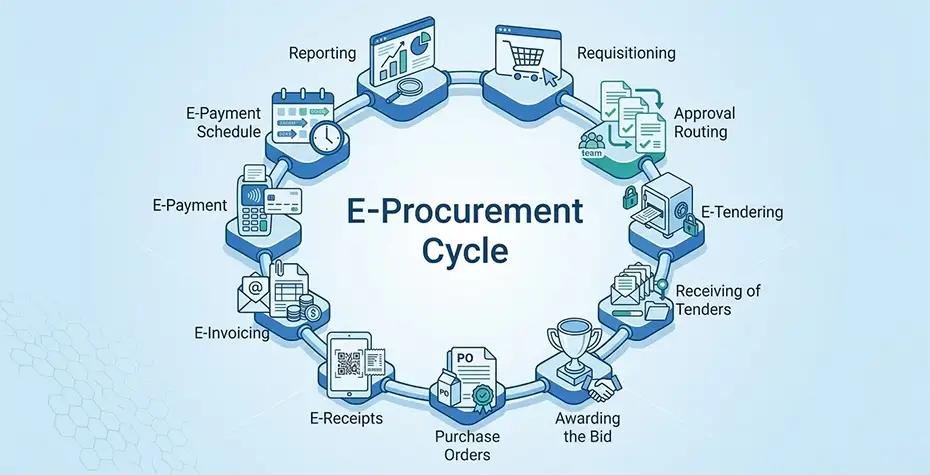
Everything above sounds great in a strategy deck. Executing it quarter after quarter—that’s where freight procurement software earns its keep.
The sourcing and procurement process works as a connected ecosystem:
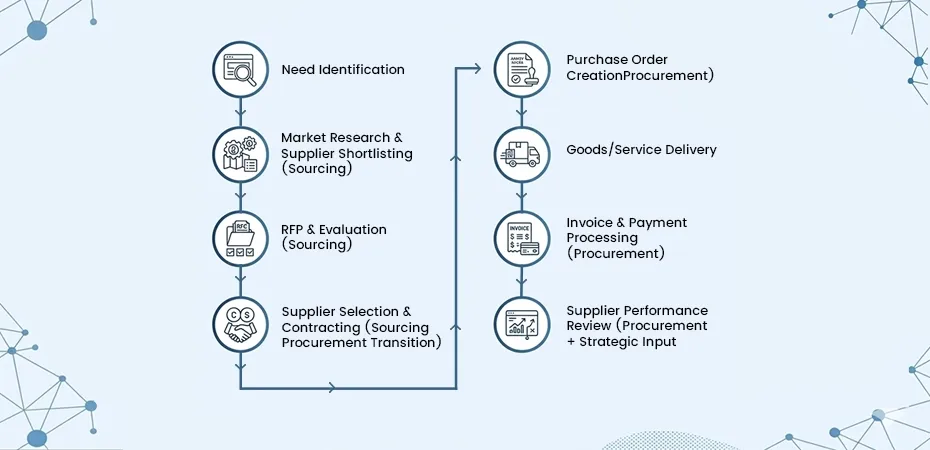
Sourcing initiates value. Procurement sustains and governs it.
Why the Difference Matters More in 2026
Global supply chains are increasingly complex. Regulatory expectations are higher. Cost pressures are constant.
Organizations that understand sourcing and procurement as distinct yet integrated functions achieve:
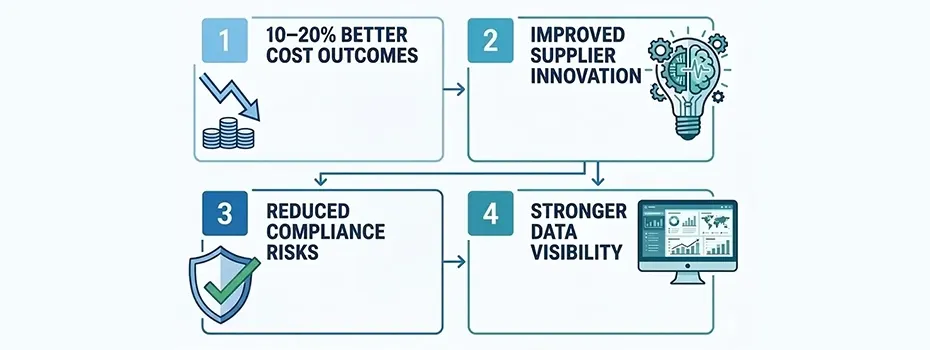
The shift toward autonomous sourcing is transforming how businesses run competitive events—reducing manual effort while increasing transparency.
Similarly, procurement automation streamlines approvals, minimizes errors, and improves cycle times.
Looking to modernize your sourcing strategy?
Explore how digital platforms can centralize and simplify supplier selection.
Common Misconceptions Around Procurement and Sourcing
Let’s address a few:
Myth 1: Procurement and sourcing are the same.
Reality: Sourcing is a component within procurement—but with a distinct strategic role.
Myth 2: Technology replaces negotiation expertise.
Reality: Technology enhances decision-making but doesn’t replace strategic judgment.
Myth 3: Procurement is purely administrative.
Reality: Modern procurement drives governance, compliance, and cost control at scale.
Understanding procurement vs sourcing correctly improves organizational clarity and accountability.
How Technology Is Reshaping Sourcing and Procurement
Digital platforms in 2026 are bridging the traditional gaps.
| Traditional Approach | Modern Digital Approach |
|---|---|
| Email-driven RFPs | Centralized eSourcing platforms |
| Spreadsheet comparisons | Automated bid analytics |
| Manual approvals | Workflow automation |
| Fragmented supplier data | Unified dashboards |
| Limited visibility | Real-time reporting |
AI-driven tools allow procurement and sourcing teams to collaborate seamlessly.
Ready to transform your sourcing and procurement process?
Discover how ProcureKey integrates automation with strategic control.
Building an Integrated Strategy
To maximize value from procurement and sourcing:
-
Define clear ownership between sourcing and operational procurement teams
-
Standardize evaluation criteria
-
Invest in automation and analytics
-
Monitor supplier performance continuously
-
Align sourcing goals with broader business objectives
When strategic sourcing and structured procurement operate together, organizations move from reactive purchasing to proactive value creation.
Final Thoughts
The conversation around sourcing and procurement in 2026 is no longer about definitions, it’s about performance.
Organizations that understand the procurement and sourcing difference, align strategy with execution, and embrace automation will outperform competitors in cost control, governance, and supplier collaboration.
If your sourcing vs procurement strategy still lives in spreadsheets and email threads, it may be time for transformation.
The future of procurement and sourcing is integrated, intelligent, and insight-driven.
 17th, June 2026 | 12:00 PM EST
 30 Min + Q&A