



Category
Strategic SourcingDate Posted
March 26, 2026Why Supplier Evaluation Is Getting Harder
Ten years ago, you could evaluate most bids on three criteria: price, delivery, and whether the vendor had done something similar before. That was enough. It isn’t anymore.
Sourcing decisions now pull in stakeholders from engineering, finance, legal, operations, and compliance — each with their own priorities and a different definition of “best.” Add sustainability metrics, supply chain risk assessments, regulatory requirements that change by jurisdiction, and technical specifications that require subject-matter expertise to evaluate. A five-supplier RFP for capital equipment or professional services isn’t a comparison exercise. It’s a multi-dimensional decision with real consequences if the scoring doesn’t hold up under scrutiny.
And here’s the part nobody says out loud: most supplier evaluation processes weren’t designed for this complexity. They were built for simpler events and stretched to handle everything else. That’s how you end up with weighted RFP scoring as a concept everyone agrees on and almost nobody executes well.
What Is RFP Scoring?
Strip away the jargon and RFP scoring is straightforward: you define what matters, you rate each vendor against those criteria, and you let the numbers tell you who fits best. It turns qualitative proposals into quantitative comparisons you can defend. When it’s done properly, the RFP evaluation framework creates transparency that protects the procurement team and the organisation. When a vendor asks why they lost, you point to specific scores against specific criteria. Not a vague “we went in another direction.”
But here’s where most teams go wrong. They define the evaluation criteria, hand out scorecards, collect the numbers, and assume the process worked. It didn’t. Not if every criterion carried equal weight. That’s where weighted RFP scoring changes the outcome.
Unweighted vs Weighted RFP Scoring
Unweighted scoring treats every criterion the same. Technical capability counts as much as vendor references. Price counts as much as innovation. Looks fair. In practice, it produces ties, false equivalencies, and decisions that don’t reflect what the business needs.
Weighted RFP scoring fixes that by assigning relative importance to each criterion before a single bid is opened. Technical capability gets 40%. Pricing 25%. Delivery 20%. Experience 15%. The weights force the committee to agree upfront on what the organisation prioritises for this event. That conversation alone surfaces disagreements before they derail the evaluation.
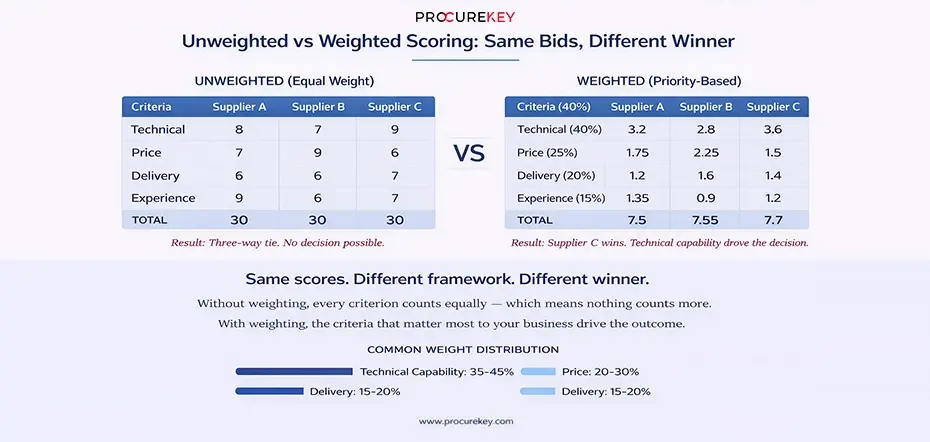
Same raw scores. Weighted scoring produces a clear winner. Unweighted scoring produces a tie.
The example above tells the story. Three suppliers with identical raw totals — 30 points each. Dead tie. No basis for choosing. But once you apply weighted RFP scoring reflecting business priorities, Supplier C wins clearly because technical capability — the criterion the organisation said mattered most — drove the outcome. Without weighting, the committee would have been stuck arguing gut feelings for a week. With it, the data made the decision defensible in thirty seconds.
Key Components of a Strong RFP Evaluation Framework
A weighted scoring model is only as good as the RFP evaluation framework around it. Get these wrong and the numbers won’t mean anything.
Criteria Definition
Evaluation criteria need to map directly to what was asked in the RFP. If you didn’t ask about sustainability, you can’t score on it later. Sounds obvious. Happens constantly.
Weighting Methodology
Weights should be agreed on before bids are opened. Not during evaluation when someone’s already formed a preference. Lock them, distribute them, don’t touch them mid-process.
Scoring Scale and Calibration
Every evaluator needs to understand what a 7 means versus a 5. Run a brief calibration session before scoring starts. Without it, one person’s generous 8 is another’s strict 6 and the consolidated scores mean nothing.
Technical vs Commercial Separation
Keep technical and commercial scoring apart until both are complete. If the committee sees pricing before scoring technical capability, the numbers will be anchored.
Audit Documentation
Every score, every rationale, every evaluator’s sheet. Logged. When audit asks why Supplier X lost, you need the full record — not a summary from memory two weeks later.
Why Spreadsheet-Based Evaluation Breaks Down
Here’s what actually happens. Engineering evaluates technical bids in their spreadsheet. Finance runs pricing in a different one. Procurement tries to merge both, but the scales don’t match, the evaluation criteria labels differ, and one evaluator scored out of 5 while another used 10. Consolidation takes two days. Someone emails the wrong file. The final version has a formula error nobody catches.
That’s not a failure of effort. It’s a failure of tooling. Spreadsheets work for ad-hoc analysis. They fall apart for structured, multi-stakeholder supplier evaluation where governance matters. The more complex the event — five suppliers, eight criteria, four evaluators — the worse it gets. The process needs a system that enforces the RFP evaluation framework instead of hoping everyone follows it.
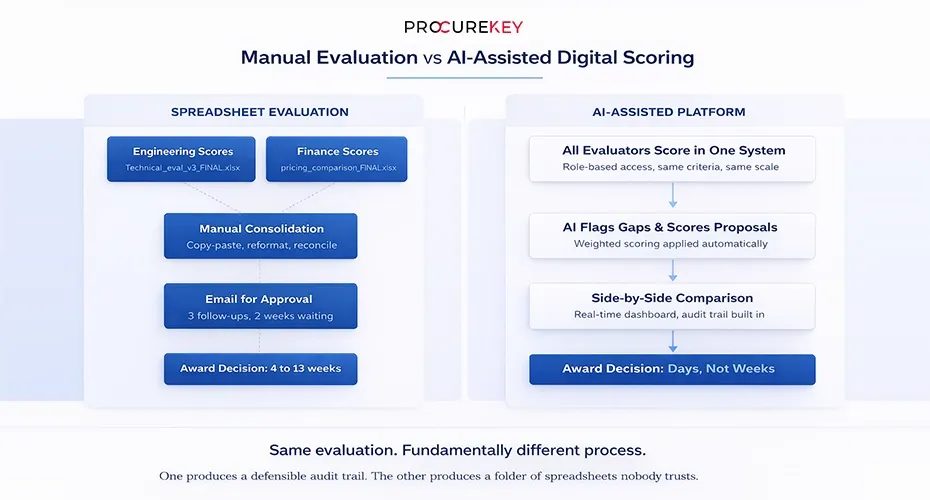
Manual consolidation vs structured digital scoring: same evaluation, fundamentally different process.
Digital Platforms for Structured Bid Evaluation
The shift here isn’t about replacing spreadsheets with a fancier interface. It’s about moving from a file-based evaluation to a workflow-based one. A proper RFP management platform centralises supplier responses, applies weighted RFP scoring templates automatically, gives each evaluator role-based access to their assigned criteria, and produces a consolidated comparison view in real time.
Nobody copies data between sheets. Nobody emails their scores. The platform enforces the framework — same scale, same evaluation criteria, same process for every evaluator. The audit trail builds itself. The weighted RFP scoring math was never the hard part. Getting five evaluators to use the same framework consistently was. Digital platforms solve that by design.
The Role of AI in Modern Bid Evaluation
Here’s where the conversation gets interesting. AI doesn’t replace the evaluation committee. But it can do the work that eats 60% of their time before they even start scoring. The reading, the cross-referencing, the compliance checking — all of that can happen before a human touches the scorecard.
An AI-assisted evaluation engine reads supplier submissions, maps each response against the RFP requirements, and highlights where proposals are strong, where they’re vague, and where they don’t comply. It catches the expired certification that a human reviewer might skim past at 4pm on a Friday. It flags the delivery commitment that contradicts the spec on page 12. And it does this across five suppliers simultaneously — something no manual review can match for consistency.
The AI can also apply your weighted RFP scoring criteria and surface an initial ranking — not as the final answer, but as the starting point for the committee’s discussion. Evaluators still apply judgement. They just start informed instead of starting from scratch. And every scoring insight is explainable and auditable — that’s what makes AI-assisted bid evaluation defensible in a way gut-feel never is.
AI-Assisted Supplier Evaluation with ProcureKey
ProcureKey brings weighted RFP scoring, multi-evaluator participation, and AI-assisted bid evaluation into one platform. Define your evaluation criteria, set weights, assign evaluators by role. Technical and commercial scores stay separated until you consolidate. The AI reads submissions, scores against your criteria, and surfaces what needs attention. Smart supplier suggestions recommend vendors based on past performance and category fit.
Every score and recommendation is traceable. When the CPO asks why Supplier B ranked second, the answer is documented — not sitting in someone’s head. For teams moving from spreadsheets to structured supplier evaluation, ProcureKey makes that transition practical.
Business Impact of Structured Evaluation
Organisations that move from ad-hoc scoring to a structured weighted RFP scoring framework see the impact in weeks. Sourcing cycles compress because nobody’s waiting for manual consolidation anymore. Supplier evaluation improves because scoring reflects business priorities instead of whoever argued loudest in the review meeting. And the cost of a bad decision — which is always higher than anyone budgets for — drops measurably.
Evaluator bias decreases — not because people become more objective, but because the framework makes subjectivity visible. Compliance improves because the audit trail exists before anyone asks for it. And the committee starts trusting the process, which means fewer post-award disputes. That’s the compounding return of doing supplier evaluation properly.
The Future of Supplier Evaluation
Weighted RFP scoring isn’t the ceiling. It’s the foundation. AI that recommends weights based on category patterns. Predictive supplier insights that flag risk before bids arrive. Real-time dashboards that connect bid evaluation outcomes to post-award performance.
But none of that works without the basics. Define the evaluation criteria. Lock the weights. Score consistently. Document everything. Start with the weighted RFP scoring framework. The intelligence follows.