


Category
Logistics SourcingDate Posted
March 10, 2026How Procurement Leaders Can Fix Logistics Sourcing for Good
Here’s a number that should bother most CPOs: freight and logistics typically eat up 5–10% of revenue. That’s a massive line item. And yet, logistics sourcing still runs on the same playbook it did a decade ago—emails to familiar carriers, rates in a spreadsheet, pick the cheapest, move on.
It works. Barely. This piece isn’t going to explain what logistics sourcing is—you know your processes. What we’re digging into is how to make them sharper: better carrier decisions, smarter models, and freight procurement infrastructure that compounds savings instead of resetting every January.
The Real Gap: Operational Buying vs. Strategic Sourcing
Ask any procurement team whether they “source” logistics and they’ll say yes. Dig in and you’ll find operational buying wearing a sourcing hat. Someone needs a truck next Tuesday, calls the carrier they used last time, rate’s “fine,” shipment moves. That’s purchasing. Not strategy.
Strategic logistics procurement looks nothing like that. You’re breaking freight spend apart lane by lane. Grading carriers on what matters beyond rate—on-time record, claims, volume flexibility. Running structured RFQs that let you put bids side by side properly. And connecting those sourcing and logistics choices to the bigger picture: capacity guarantees, sustainability commitments, total cost of ownership.
The companies that actually make this shift? They see 8–15% savings on addressed lanes, end up with carrier partnerships that don’t fall apart when capacity tightens, and stop waking up to rate shocks that were completely predictable.
Why This Category Is So Difficult to Get Right
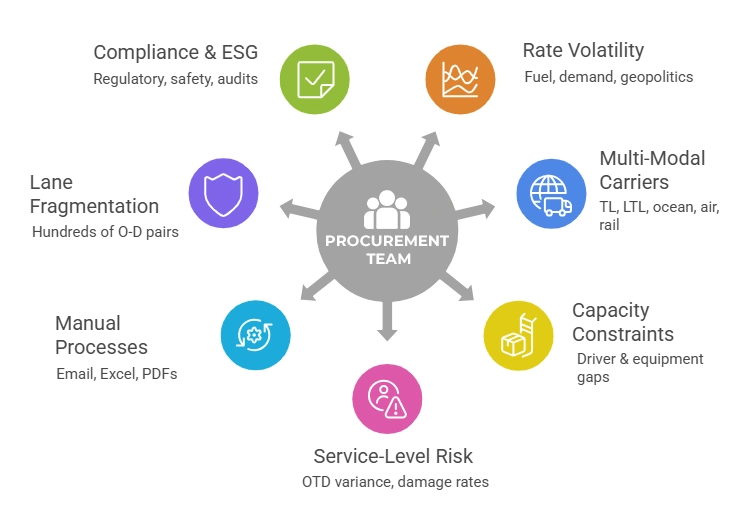
Sourcing in logistics would be easier if freight rates were just volatile but trackable—like raw materials. The truth is far messier. Fuel surcharges jump overnight. A port backup in one region cascades into rate hikes across three others. You lock a contract rate in January and by July it bears no resemblance to reality.
On top of that, the carrier landscape is a mess. Think about it—your typical mid-size shipper is dealing with anywhere from 25 to 50 different providers. Truckload operators, LTL networks, ocean lines, air cargo, maybe rail. No two of them quote the same way or define “on time” the same way. You’ll have one carrier that absolutely nails a particular corridor—best rates, best reliability—and is completely average or worse everywhere else. And here’s the kicker: their performance isn’t static. A provider that earned your trust two years ago could be coasting now, and unless your team is actively watching the numbers, that slide happens quietly.
And the process itself. One truckload RFQ covering 30 lanes and 10 carriers produces 300+ rate submissions. Most teams manage this in Excel. Bids get buried in email, version control breaks, and by the time a comparison is ready, rates have gone stale. Teams end up sourcing once a year—in a market that moves monthly.
Five Pillars of a Smarter Logistics Procurement Strategy
None of what follows is groundbreaking in isolation. Applied together—and consistently, cycle after cycle—these five pillars turn logistics procurement from a cost centre into a competitive lever.
1. Score Carriers on What Actually Matters
2. Source at the Lane Level
3. Run Multi-Round RFQs
4. Map Your Cost-Service Trade-offs
5. Bake in Risk and Compliance
Picking the Right Sourcing Model
Not every category deserves the same intensity. The quickest way to lose credibility is to spend weeks running a full sourcing event for a low-impact category while large, volatile categories remain unmanaged.
Prioritize categories where you can drive:
| Model | Works Best When | The Gotcha |
|---|---|---|
| Centralised | You want volume leverage across business units | Can miss local carrier nuances |
| Decentralised | Regional freight profiles vary wildly | Spend visibility falls apart fast |
| Contract Freight | High-volume, predictable lanes | Bad forecasts = stranded commitments |
| Spot Freight | Overflow, seasonal spikes, new routes | Admin overhead adds up quickly |
| Hybrid | Most mid-to-large shippers (the real answer) | Needs solid data infrastructure |
| Regional Carriers | Concentrated geographic corridors | Hard to scale beyond their sweet spot |
| Global Carriers | Multi-country, end-to-end moves | You’ll pay a premium on local lanes |
In practice, most companies that do this well run a hybrid—contract rates for top lanes, spot market for volatile routes, regional specialists where they outperform nationals. The trick is having enough data visibility to manage this without drowning.
Where Technology Changes the Game
Everything above sounds great in a strategy deck. Executing it quarter after quarter—that’s where freight procurement software earns its keep.
-
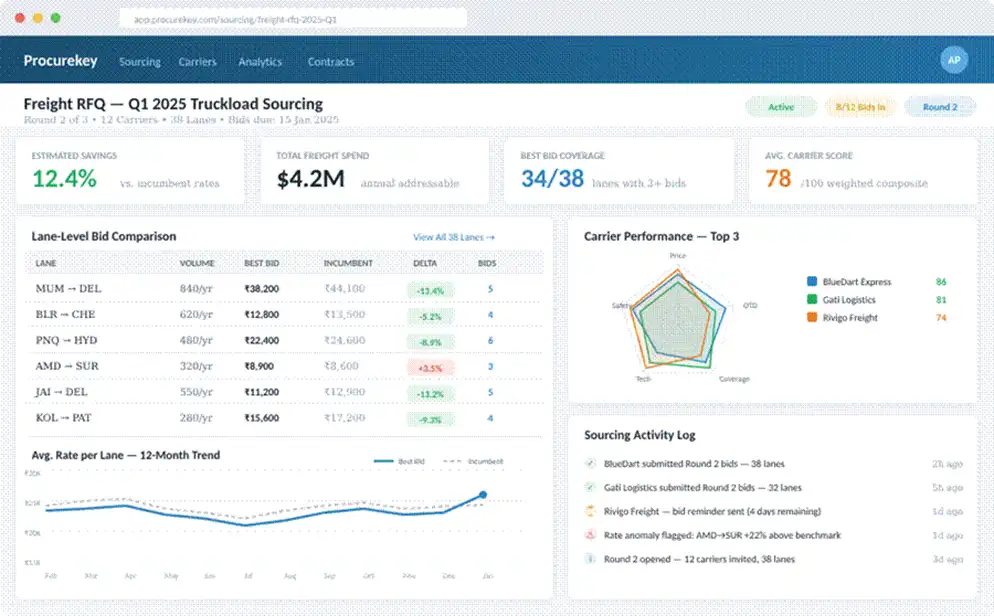
Digital RFQs are the single biggest process upgrade. Carriers get standardised templates, bids flow into one system, and you compare responses across lanes and modes in minutes. Multi-round events that consumed three weeks can wrap in under one.
-
Sourcing analytics turn historical bid data into something useful. Which carriers honour rates post-contract? Who’s slipping on service? Where are you overpaying? These answers exist in your data—but only if it lives in a system, not scattered across Excel files on shared drives.
-
Workflow automation picks up all the repetitive stuff your team shouldn’t be spending brain cells on. Templates get filled in from last quarter’s data. Carriers who haven’t responded get a nudge without anyone drafting a follow-up email. Rates that look way off—suspiciously high, suspiciously low—get flagged before they slip through. Approvals route to the right person automatically. None of this is exciting, but when you add it up, you’re giving your team back 30–40% of their week to work on things that actually require thinking.
-
Audit trails happen automatically. Who was invited, criteria used, how the award was decided—all logged. For teams dealing with compliance, supplier diversity mandates, or ESG reporting, this alone justifies the investment.
Where Transportation Sourcing Is Headed
AI is already here, though not how most vendor pitches suggest. Practical applications right now: spotting patterns in bid behaviour, predicting which providers will honour contracted rates, recommending allocations that balance cost against service risk. Less “autonomous procurement” and more “smarter analyst sitting next to your team.”
This is where modern AI sourcing and procurement software starts to make a measurable difference, turning historical data and lane performance into predictive insight rather than static reports.
The annual RFQ is dying. The shift is slow, but real. Teams pulling ahead aren’t waiting for January to re-bid. They watch lane performance monthly, kick off mini-bids when a corridor underperforms, and reshuffle allocations on the fly. You can’t do this if launching a sourcing event takes three weeks—you need a platform that spins one up in hours.
The real game-changer? Integration. Once your sourcing platform connects to your TMS, ERP, and demand planning—freight procurement stops living on an island. You see whether negotiated rates match invoice costs. You adjust capacity based on real demand forecasts, not guesses from six months ago. The strategic value isn’t in any single event—it’s in the feedback loop between planning and execution.
Three Things to Do This Quarter
- Map your freight sourcing process end to end. Where does time disappear? Where does data get lost between steps?
- Pull up your top 20 lanes by spend and be brutal—did someone actually run a sourcing process for these, or did the contracts just roll over because the team was stretched thin?
- Throw a real test at your tools. Could they handle a multi-round RFQ across 50 lanes without breaking? If the honest answer involves a lot of copy-pasting between tabs and praying nothing gets overwritten—that tells you everything.
Tired of Sourcing Freight in Spreadsheets?
Lorem ipsum dolor sit amet, consectetur adipiscing elit. Ut elit tellus, luctus nec ullamcorper mattis, pulvinar dapibus leo.
 17th, June 2026 | 12:00 PM EST
 30 Min + Q&A