


Category
Supplier ManagementDate Posted
July 14, 2026Picture the last vendor selection your team ran. Six weeks from kickoff to award. Five people with opinions. Eight proposals that arrived in eight different formats. And a comparison spreadsheet that the procurement lead spent two days building and the CFO didn’t trust anyway.
We broke the fix into three parts: a 7-step vendor selection process your team can reuse every quarter, a scoring model with actual percentage weights (not vague advice about “considering multiple factors”), and a honest look at what changes when you move the whole thing off spreadsheets.
Key Takeaways:
- Vendor selection is a structured process of identifying, evaluating, and choosing suppliers. Not just collecting quotes.
- Weighted criteria across cost, quality, risk, delivery, and stability take the guesswork out of the decision.
- Pre-qualifying suppliers before the RFP prevents 80% of late-stage selection problems.
- AI scoring eliminates the consolidation spreadsheet that breaks most evaluations.
- The right supplier management platform turns vendor selection from a one-off project into a repeatable workflow.
What Is Vendor Selection?
Vendor selection is the work between “we need a supplier” and “here’s why we picked this one.” Requirement nailed down. Market scanned. Longlist screened. Proposals collected. Bids scored on weighted criteria. References checked. Contract signed. That’s the full arc.
What it is not: calling the supplier you used last time and asking for a quote. That’s reordering. Vendor selection is what happens when you put the requirement in front of multiple qualified suppliers and let a structured evaluation decide who wins.
The distinction between vendor selection (the one-time decision process) and ongoing vendor management (monitoring performance over the contract term) matters. Selection ends at the award. Management starts after. A bad selection process means management starts with a problem it can never fully fix.
Why a Strong Vendor Selection Process Matters
Risk reduction is the first thing a structured process delivers. Vetted suppliers mean fewer compliance surprises, fewer delivery failures, and fewer quality problems that surface six months into a contract when it’s expensive to switch.
Cost control is the second payoff. The vendor quoting the lowest number isn’t always the cheapest once you add up quality rework, late deliveries, and a support team that takes 72 hours to return a call. A weighted evaluation catches that before you sign.
When the scoring matrix has weights, evaluator comments, and timestamps baked in, the CFO conversation is over in two minutes flat.
And every structured event produces data that makes the next one faster.
The 7-Step Vendor Selection Process
This is the vendor selection procedure that works for mid-market procurement teams running RFx events with 5 to 15 suppliers. Seven steps. Each one has a specific pitfall that shows up when teams cut corners.
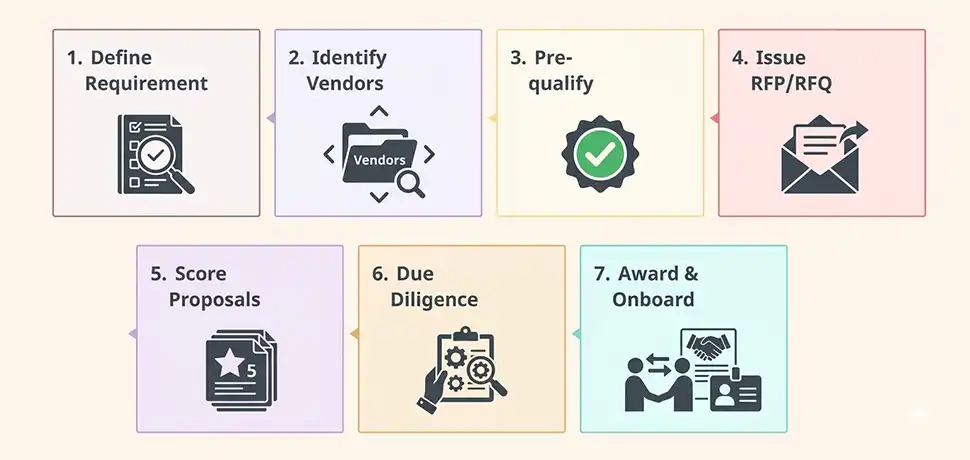
Define the Requirement
Identify Potential Vendors
Pre-Qualify the Longlist
Issue the RFP or RFQ
Score Proposals Against Weighted Criteria
Run Finalist Due Diligence and Negotiation
Award the Contract and Onboard the Vendor
Simplify Vendor Selection with ProcureKey
Vendor Selection Criteria: What to Score On
Vendor selection criteria are the dimensions you score every supplier against. Without them, you’re choosing on instinct. With them, the decision is defensible. The weights should be set before proposals arrive, not adjusted after you’ve seen who quoted what.
| CRITERIA | WEIGHT RANGE | WHAT YOU’RE REALLY MEASURING |
|---|---|---|
Cost and TCO | 15-25% | Unit price plus quality rework, switching cost, support overhead |
Quality and capability | 20-25% | Technical fit. Sample quality. Production capacity for your volume. |
Delivery reliability | 15-20% | Historical on-time rate. SLA with penalties attached. Escalation process. |
Risk profile | 10-20% | Will they still be in business in 3 years? Any geographic or regulatory exposure? |
Certifications | 5-15% | ISO, SOC 2, or whatever your industry mandates. No cert, no bid. |
Responsiveness | 5-10% | Response time during the RFP tells you a lot about response time after the contract. |
References | 5-10% | What their existing customers actually say when you call. |
Innovation and scale | 5-10% | If your volume doubles in 18 months, can they keep up? |
A SaaS buyer in Dallas might weight security at 25%. A construction company in Houston might put that same 25% on safety compliance. The dimensions are universal. The weights are yours. Set them based on what this specific category demands, not somebody else’s template.
Five Places the Process Falls Apart
The team is behind schedule so they skip pre-qualification. An unvetted vendor makes the RFP shortlist. Contract review surfaces a compliance gap. Two weeks lost.
Criteria get defined after proposals are already in. The evaluation becomes a rationalization of a decision someone already made informally.
Five people evaluate. Three of them used different rating scales. The procurement lead spends two days reconciling a spreadsheet that still doesn’t add up. The final ranking gets challenged in the award meeting.
And the decision trail? Buried in an email chain that the procurement lead has to reconstruct from memory six months later when audit comes asking.
These aren’t competence problems. They’re tooling problems. Which is what the next section is about.
How AI and Supplier Management Software Change the Game
The work of vendor selection hasn’t changed. Define, find, qualify, bid, score, negotiate, award. What’s changed is that the coordination no longer needs to run on spreadsheets and email chains.
Instead of emailing forms back and forth, vendors complete everything through a portal with configurable approval steps. They upload documents, fill required fields, and clear the pre-qualification gate before they’re allowed to bid on anything. If they don’t pass, they don’t see the RFP. Simple as that.
Weighted scoring in the system is the second. Multiple evaluators score independently. Technical and commercial scores stay separated until consolidation. The platform applies the weights automatically. No spreadsheet reconciliation. No two-day consolidation exercise.
Audit readiness by default is the third. Every score, every comment, every approval is logged with a timestamp. The decision trail builds itself while the team works.
This is the model ProcureKey’s Supplier Management module runs on: supplier onboarding, configurable pre-qualification, weighted RFP scoring, and AI-assisted evaluation, all inside the Microsoft 365 your team already uses. Customers like Gigajoule Group have reported $90,000 in annual savings from tighter vendor selection discipline. See the full supplier management software capabilities.
Frequently Asked Questions
Seven steps. One system. The vendor selection process works when the criteria, the scoring, and the decision trail all live in one place instead of scattered across spreadsheets and email chains.
See how ProcureKey’s supplier management platform runs your full vendor selection process, from pre-qualification to scored award, inside Microsoft 365.